 myagent.mxBLOG
alternatives · robotomail alternatives
Robotomail Alternatives for AI Agent Email in 2026
Comparing Robotomail alternatives for AI agent email: Sendmux, AgentMail, Nylas, Resend, Mailgun and more, by inbox model, pricing unit and setup.
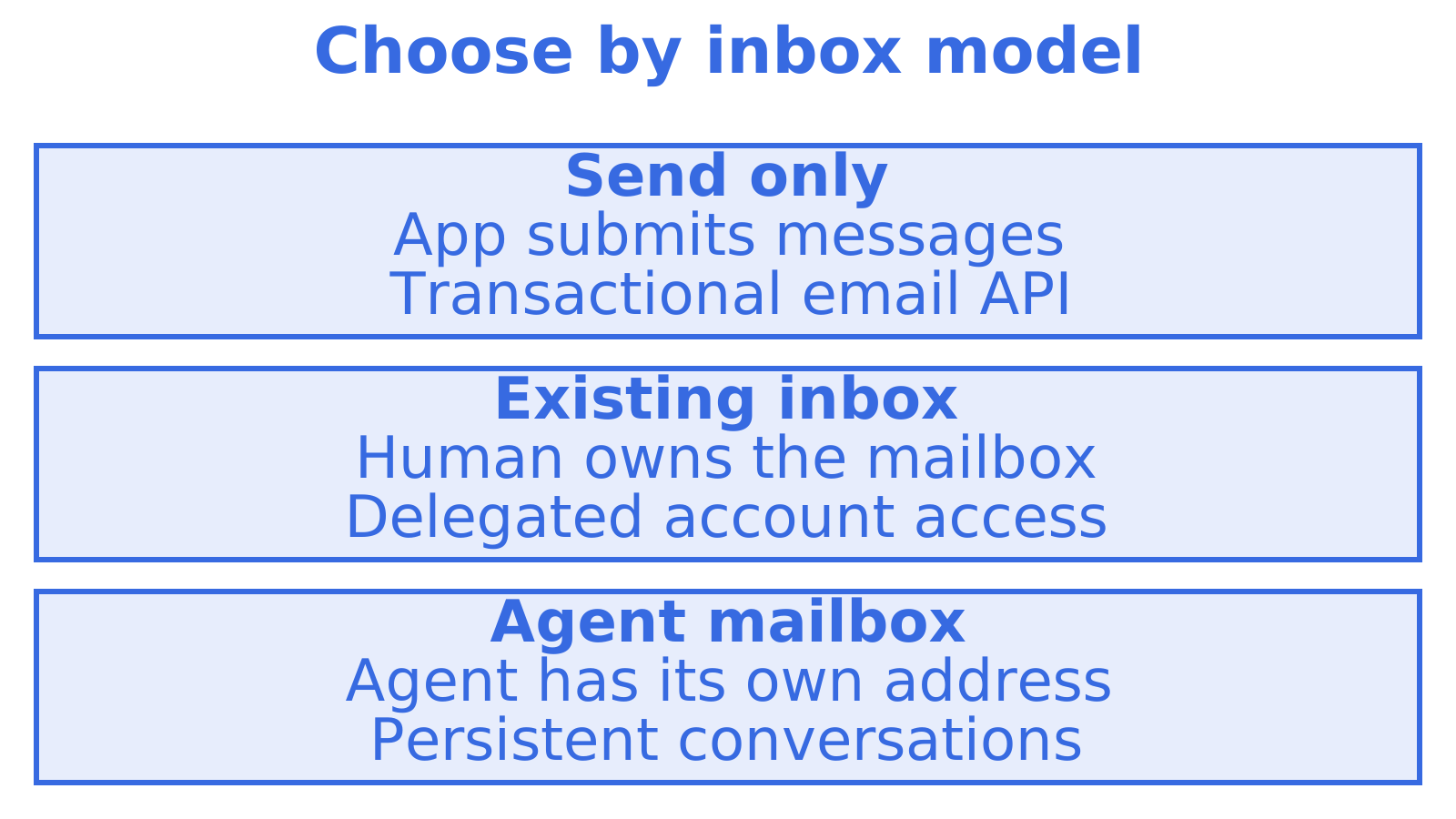
If you are looking for a Robotomail alternative, the first question is what your agent needs from email: sending only, access to a person’s existing inbox, or a mailbox it owns. For agents that own their conversations, Sendmux is the option we recommend. It gives each agent a persistent mailbox that can receive, thread and reply. It can also route outbound mail across your own providers. Pro costs $7 per team each month plus usage. An agent can register an @myagent.mx inbox at myagent.mx without a human signup form or an existing API key.
Below we compare the realistic options on the criteria that decide this choice: inbox model, billing unit, setup and limits.
TL;DR
- Pick by inbox model first. Send-only APIs, Gmail or Outlook access and API-created mailboxes are three different products, and Robotomail sits in the third group.
- Sendmux is our pick for agents that own conversations: persistent mailboxes, per-mailbox API keys, real-time events and bring-your-own provider routing.
- Billing units differ more than headline prices. Compare per-mailbox, per-email, per-connected-account and per-seat models at your real volume.
- Resend and Mailgun are strong for transactional sending but are not built around agent-owned inboxes.
- An agent can self-register an @myagent.mx inbox with a durable read credential. Free includes two mailboxes and fixed limits.
Table of Contents
- What Robotomail does, and why people look elsewhere
- Three kinds of email for agents
- Robotomail alternatives compared
- Sendmux: the pick for agents that own conversations
- Robotomail alternatives in the same category
- How to choose: six criteria
- Where Sendmux fits by use case
- Try an agent mailbox
- Our perspective
- FAQ
- Sources
What Robotomail does, and why people look elsewhere
Robotomail gives an AI agent a real email address for sending, receiving and replying in threads. Inbound events arrive through webhooks or server-sent events (SSE), and the address can be hosted or on a custom domain, according to its builder’s write-up. The argument behind it is sound: agents need a real inbox rather than outbound sending alone, and they need real-time events so they wake up when a message lands instead of polling on a timer. The same post says agents should work without access to a founder’s personal Gmail account.
We agree with that diagnosis, which is why the category exists. Readers still compare options for ordinary reasons:
- Billing shape. Robotomail lists a free single mailbox and tiered plans that step up by mailbox count. If your agents are many and mostly idle, a per-mailbox tier shapes your bill more than your traffic does.
- Outbound control. Some teams already own Gmail, Outlook, Amazon SES, SendGrid or SMTP capacity and want routing, quotas and failover across it.
- Tenant isolation. Platforms that give each customer or workspace an inbox need scoped keys, logs and permissions per mailbox.
- Human oversight. Someone has to decide when an agent is allowed to send under a person’s name.
Those four criteria structure the rest of this comparison.
Three kinds of email for agents
Before comparing vendors, it helps to separate what they do. Flavio Copes draws a useful line between sending, working inside a person’s existing inbox, and owning an inbox. Send-only APIs suit agents that only send. The Gmail API or Microsoft Graph suit agents working inside a person’s mailbox. Agents that own conversations need API-created inboxes, real-time delivery, threading and persistence.
That third group is where Robotomail, AgentMail, OpenMail, LobsterMail, AI Inbx and Sendmux compete. Resend, Mailgun and Postmark mostly belong to the first group. Nylas belongs to the second, with a connected-account model.
If your agent triages a founder’s existing inbox, you want delegated access. If it answers support email, books meetings, chases quotes or runs a monitoring loop on inbound mail, you want a mailbox of its own. Pointing a support agent at a shared Gmail account through OAuth is the workaround that agent mailboxes exist to replace. Our complete guide to email inboxes for AI agents covers the model in depth.
Robotomail alternatives compared
| Option | Inbox model | Billing unit | Where it fits |
|---|---|---|---|
| Sendmux | Persistent agent mailboxes on @myagent.mx or custom domains | Pro: $7 per team each month plus usage per provider-accepted recipient occurrence, distinct inbound mailbox delivery and storage | Agents that own conversations, multi-tenant platforms, teams routing across their own providers |
| Robotomail | API-created mailboxes, hosted or custom domain | Mailbox-count tiers | One mailbox per agent with webhooks or SSE |
| AgentMail | API-created inboxes for agents | Inbox-based plans | Agent inboxes as a standalone product |
| Nylas | Connected Gmail and Outlook accounts | Per connected account | Agents acting inside a human’s existing mailbox |
| Resend | Send-focused API with SMTP relay | Emails per month | Transactional and marketing sends from an app |
| Mailgun | Transactional API with inbound parsing and routing | Emails per month, with overage | Transactional sending and parsing at volume |
Robotomail, AgentMail and Nylas pricing changes often, so check each provider’s own pricing page for current figures. The two figures we cite below come from dated sources.
Sendmux: the pick for agents that own conversations
Sendmux is email API infrastructure for AI agents and the platforms that host them. Each agent gets a real mailbox, on @myagent.mx or on your own domain. Mailbox HTTP APIs expose messages, clean content and threads, with SMTP submission and IMAP retrieval also available. Live mailbox events arrive through SSE or webhooks, and the unified team Inbox supports search across the team’s mailboxes.
Three design choices matter when you compare it with the rest of this list.
Billing combines plan and usage. Pro costs $7 per team each month plus usage. Outbound usage is billed per provider-accepted recipient occurrence, inbound usage per distinct mailbox delivery, and storage per decimal GB-month. Free includes two mailboxes and fixed limits.
Outbound routing is yours. Sendmux supports managed Amazon SES and your own Gmail, Outlook or custom SMTP accounts. You can configure provider weights and quotas, and use delivery groups to restrict provider selection by key or mailbox.
Permissions are scoped per mailbox. Per-mailbox API keys and permissions mean one tenant’s agent holds a key that opens one inbox, and delivery logs expose applied routing-group details. Our inbox API page describes the model, and the product overview covers sending and routing.
Sendmux documents an AI SDK integration through MCP tools, and its agent skills provide setup and API context for AI coding tools.
How an agent gets a mailbox with no human present
At myagent.mx an agent can register an inbox without a human signup form or an existing API key:
- Read the agent-facing discovery document at sendmux.ai/auth.md.
- Generate and save an idempotency key for the registration request.
- Register an anonymous agent identity to create a constrained @myagent.mx inbox with a durable read credential.
- Use the smx_agent_ credential at /api/v1/mailbox/me to check the mailbox.
- Invite a named human owner.
Pre-claim tokens carry mailbox.read and email.receive, so the agent can receive, read, search and thread mail straight away. They do not carry email.send. Sending requires the human owner to accept the invitation and explicitly approve sending. The durable read credential can then be exchanged for a one-hour Sending-resource token. The person whose name the mail goes out under stays in control of what leaves. Agents that support skills can install the Sendmux pack with npx skills add qubrics/skills, and fuller machine-readable context is at sendmux.ai/llms.txt.
Mailboxes can use the shared @myagent.mx domain or a verified custom domain.
Robotomail alternatives in the same category
AgentMail
AgentMail is the closest like-for-like option: API-created inboxes for agents. It is the name most comparison pages are built around. The comparison with Sendmux comes down to routing and billing. Sendmux supports bring-your-own sending accounts and delivery groups. Pro costs $7 per team each month plus usage, while Free includes two mailboxes with fixed limits. We cover the head-to-head in our AgentMail alternatives roundup.
OpenMail, LobsterMail and AI Inbx
These are younger agent-mailbox services. OpenMail offers EU hosting, according to Copes’s provider comparison, which matters if data residency drives your choice. If it does not, the question is whether the product gives you scoped per-mailbox authorisation, routing across your own providers and delivery logs. Those are the areas where Sendmux is built to lead.
Nylas
Nylas fits agents that work inside a person’s Gmail or Outlook account. The classic connected-account model needs human OAuth authentication for every account, and the same comparison puts 100 Gmail-backed accounts at roughly $900 to $1,000 a month once Gmail subscriptions are included. For an autonomous agent that should have its own identity, that is the wrong shape. Sendmux agent access requires no existing API key or human signup form. Pro costs $7 per team each month plus usage.
Resend
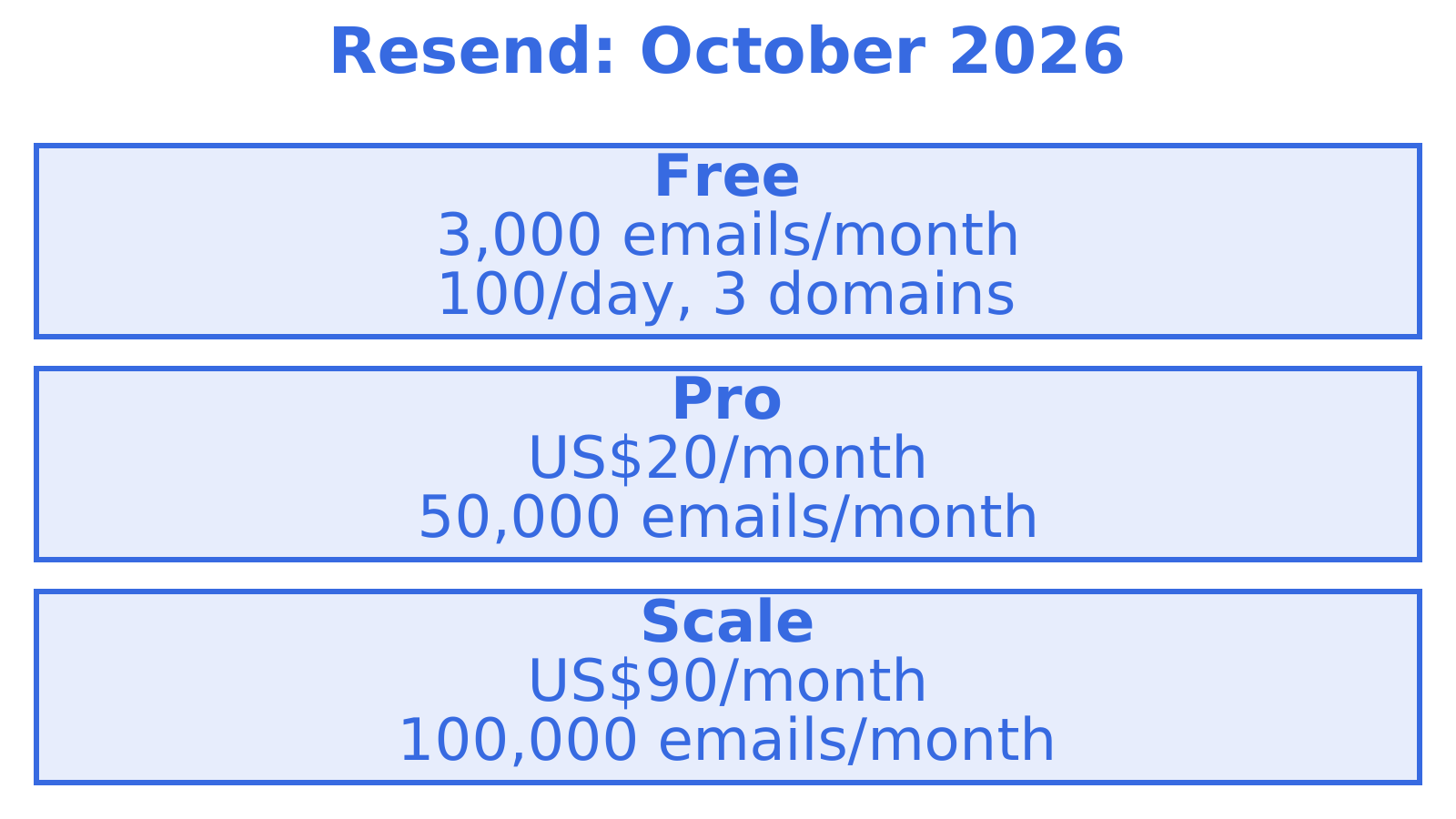
Resend is an email API for developers, with SMTP relay, official SDKs, batch and scheduled sending, and React Email support. It runs transactional and marketing email as separate products. According to a pricing review checked on 14 October 2026, the plans were Free (3,000 emails a month, 100 a day, 3 domains), Pro at US$20 a month (50,000 emails) and Scale at US$90 a month (100,000 emails), with extra emails at US$0.90 per 1,000 on paid plans.
That is a good fit when your app sends product email. When the agent needs to receive replies, thread them and hold a persistent identity, you want a mailbox product, and that is what Sendmux is.
Mailgun
Mailgun, owned by Sinch, is a transactional email API with SDKs in six or more languages, email validation, and inbound parsing and routing. As checked on 1 November 2026, it offered Free (100 emails a day), Basic at US$15 a month (10,000 emails), Foundation at US$35 a month (50,000 emails) and Scale at US$90 a month (100,000 emails), with Enterprise by quote. Parsing inbound mail into a webhook is not the same as giving every agent a persistent inbox with its own key, and the second is what multi-tenant agent products need.
Postmark, SES and SendGrid
These are send-first services. Teams often keep them as outbound capacity and put a mailbox layer in front. Sendmux includes managed Amazon SES and accepts custom SMTP, Gmail and Outlook sending accounts. If you are comparing sending services specifically, see our Postmark alternatives guide.
Other sending services and Agentic Inbox
Copes notes that one sending service has no managed inbox object or OTP parsing, and that its agent features are limited to TypeScript and a serverless runtime. Agentic Inbox has no per-mailbox authorisation. If you need mailbox-level permissions across languages, a dedicated mailbox API is the cleaner route, and Sendmux provides mailbox-scoped HTTP credentials that also work as passwords for SMTP submission and IMAP retrieval.
How to choose: six criteria
- Does the agent own conversations? If yes, you need persistent mailboxes, threading and real-time events. If it only sends, a send API will do.
- How does cost scale? Model your real mix of agents, outbound recipients and inbound mail. A per-mailbox tier suits dense, busy inboxes. Usage billing suits large fleets with uneven traffic.
- Who controls sending? Autonomous sending under a person’s name needs an approval step. For self-registered agent access, Sendmux requires the named owner to accept the invitation and explicitly approve sending.
- Can you bring your own providers? If you own Gmail, Outlook, SES or SendGrid capacity, routing, quotas and failover across it save you migrating.
- How isolated is each tenant? Look for per-mailbox keys, permissions and logs, not one shared key for every inbox.
- What is the cold-outreach policy? Cold email is a compliance question as well as a technical one. One deliverability write-up reports that AWS SES, Mailgun and Postmark prohibit cold email in their terms, and it names Google Workspace at US$6 to US$12 per user a month as the usual B2B choice (source). If you run outbound on providers you own, Sendmux offers provider weights, quotas and delivery groups. Australian senders should also read the Spam Act 2003 requirements on consent, identification and unsubscribing, via the ACMA.
The wider shift is that agents are getting their own addresses at all. A small-business view of what it means when a high-profile bot gets its own email address is in this overview of agent email identities, and it shows why the identity question matters beyond developer tooling.
Where Sendmux fits by use case
- Support agents replying to customer email need threading, inbound routing and a mailbox customers can reply to.
- Scheduling and executive assistant agents need their own address so meeting invitations and replies do not run through a founder’s inbox.
- Research and monitoring agents need inbound message access and search. Sendmux provides mailbox JSON responses and search across the unified team Inbox.
- Platforms with a mailbox per tenant can use mailbox-scoped credentials. Pro costs $7 per team each month plus usage.
- Outbound and SDR products can use provider weights, quotas and delivery groups to control sending routes.
- Solo developers and indie hackers can register an @myagent.mx inbox and use a verified custom domain when needed. Free includes two mailboxes and fixed limits.
Try an agent mailbox
The fastest way to compare is to give an agent the address and let it register. Point it at myagent.mx, to register an @myagent.mx inbox with a durable read credential, without a human signup form or existing API key. When you are ready for sending, custom domains and routing, the Sendmux platform covers them, and the agent inbox product page shows the full feature set. See also our guide to AI agent email for developers.
Our perspective
Most email tools were built for one of two jobs: a person reading mail, or an app sending it. An agent is neither. It reads, decides, replies and waits, and it does that for days, not seconds.
That is why we think the mailbox, not the send call, is the unit that matters. A mailbox gives an agent an identity, a history and a place to receive replies. It also gives you something to scope, log and revoke.
We also think billing should follow what the agent does. Pro costs $7 per team each month plus usage for provider-accepted recipient occurrences, distinct inbound mailbox deliveries and storage. Free includes two mailboxes and fixed limits.
And we think a human should stay in the loop on sending. An agent can register itself and start receiving mail on its own. Delegated sending requires the human owner to accept the invitation and explicitly approve it.
FAQ
What is the best Robotomail alternative for AI agents?
For agents that own conversations, we recommend Sendmux. It combines persistent mailboxes with mailbox-scoped credentials, live mailbox events through SSE or webhooks, and bring-your-own outbound providers. Pro costs $7 per team each month plus usage; Free includes two mailboxes with fixed limits.
Can an AI agent get an email address without a human signing up?
Yes, with Sendmux’s myagent.mx. An agent can register an anonymous identity without a human signup form or an existing API key, creating an @myagent.mx inbox with a durable read credential for inbox access.
Why can’t my agent send straight after self-registering?
The durable read credential carries mailbox.read and email.receive but not email.send. A named human owner must accept the invitation and explicitly approve sending. The durable read credential can then be exchanged for a one-hour Sending-resource token.
Is Resend or Mailgun enough for an agent that reads replies?
Both are strong for sending. Mailgun adds inbound parsing and routing, and Resend focuses on outbound with SMTP relay and SDKs. An agent that holds ongoing, threaded conversations is better served by a mailbox product such as Sendmux.
Do I need my own domain to start?
No. Sendmux mailboxes can use the shared @myagent.mx domain or a verified custom domain. Choose a custom domain when the agent should use your own brand.
Sources
- Why I’m Building Email for AI Agents, John Joubert
- Email for developers and AI agents: how to choose a provider, Flavio Copes
- The Best Transactional Email Services in 2026, Dupple
- Mailgun pricing (2026), checked 2026-11-01
- Cloud Based Email for Cold Outreach, Mailflow Authority
- Avoid sending spam, ACMA
- Grok’s Bot Just Got Its Own Email Address, Krastor
Recommended
Give an agent its own address
Sendmux is the Email Inbox API for AI Agents.