 myagent.mxBLOG
alternatives · Postmark alternatives comparison
The Best Postmark Alternatives for Developers in 2026
Discover top Postmark alternatives for developers in 2026, offering cost savings, enhanced features, and robust routing capabilities to meet your needs.
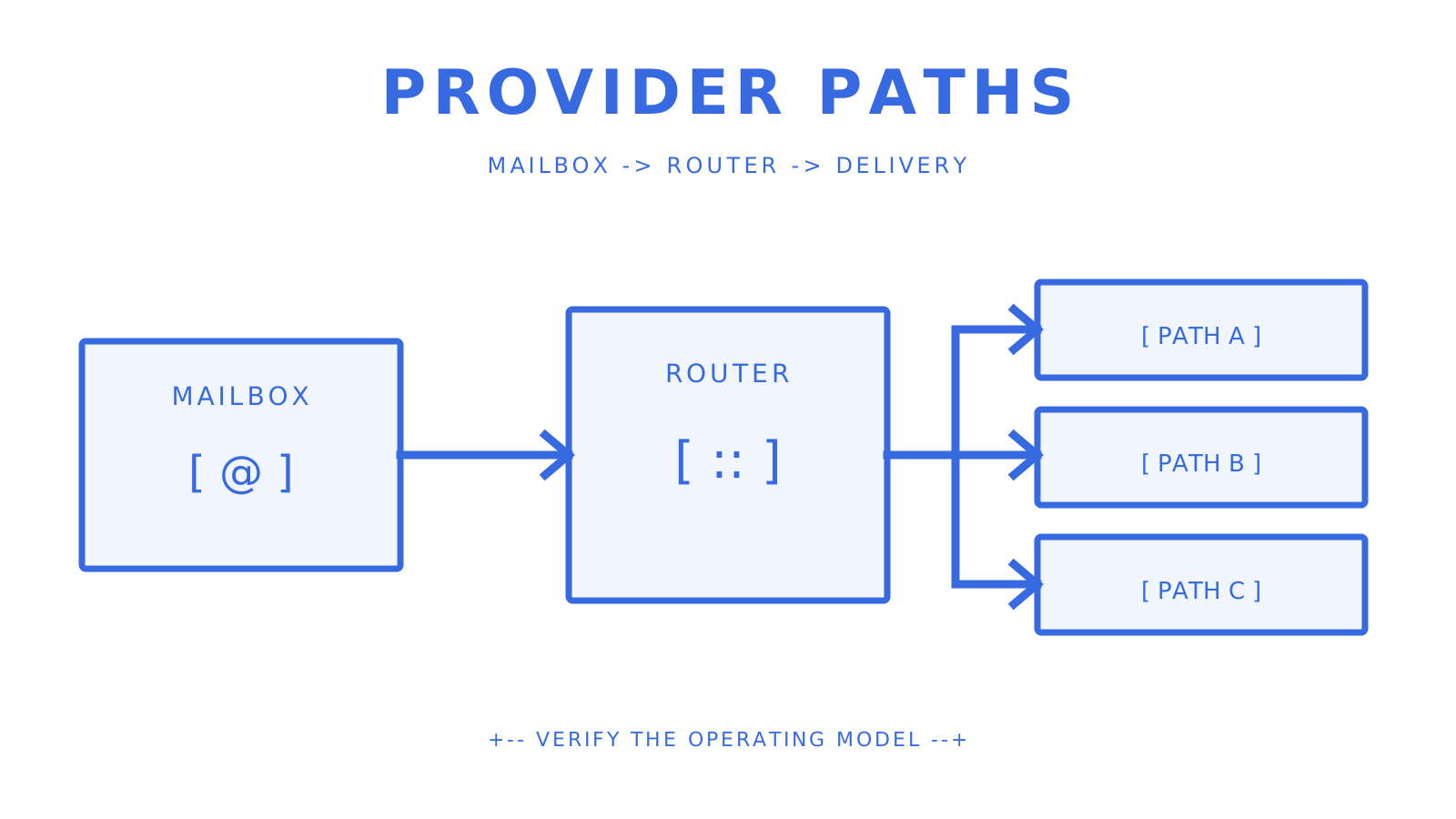
Sendmux is a practical Postmark alternative for teams that need application-owned mailboxes plus configured outbound routes. Its reviewed public contracts cover real mailboxes, clean JSON message and thread content, scoped mailbox credentials, weighted sending accounts, quota windows, and observable delivery outcomes. Amazon SES is a delivery-first option with a current base outbound price of $0.10 per 1,000 messages plus data and optional features. Mailgun documents inbound Routes, while Postmark documents separate Transactional and Broadcast Message Streams.
This Postmark alternatives comparison covers postmark alternatives, postmark vs sendgrid, best transactional email solutions, top SMTP services, best email delivery services, Postmark like services, reliable email senders, postmark vs mailgun, email service providers, and postmark competitors. It separates verified operating models from unsupported rankings and stale sample prices.
Programming Insider’s roundup compares Mailtrap, Mailgun, SendGrid, and Amazon SES. It is useful for building a shortlist, but it does not cover the whole provider set in this article. Compare cost at your own volume, lifecycle tooling, and inbound routing separately. Confirm prices and limits in current provider documentation before making a decision.
Quick category snapshot:
- Mailbox-first application workflows: Sendmux
- Delivery-first cloud email: Amazon SES
- Inbound route processing: Mailgun Routes
- Transactional plus marketing surfaces: Twilio SendGrid, Brevo, or Loops
- Transactional and broadcast separation inside one Postmark account: Postmark Message Streams
Commercial email still needs accurate headers, a valid postal address, a clear opt-out mechanism, and prompt opt-out processing under the FTC’s current CAN-SPAM guidance.
Key Takeaways
Select a Postmark alternative by operating model first: mailbox state, delivery-only infrastructure, inbound routing, or lifecycle workflows. Clearly separate transactional and broadcast traffic, then compare current billable units and migration costs.
| Point | Details |
|---|---|
| Stream separation is explicit | Postmark documents separate Transactional and Broadcast Message Streams and distinct infrastructure for those traffic types. |
| Cost units must match | Sendmux Pro is $7 per team each month plus $0.000500 per connected-provider accepted recipient; Amazon SES lists $0.10 per 1,000 outbound messages plus data and optional features. |
| Dedicated IP warmup takes time | Amazon SES documents roughly two to six weeks depending on the receiving provider, with standard automatic warmup progressing over 45 days. |
| Two-tool stacks remain valid | A delivery provider plus a lifecycle tool can keep responsibilities clear, but it adds another integration and contract. |
| Sendmux fits mailbox-first agents | Real mailboxes, scoped credentials, clean message content, and weighted configured sending accounts are present in the reviewed owners. |
How do these Postmark alternatives compare at a glance?
The useful comparison is the system each option requires you to run. Stale roundup prices are removed; confirm each current tier with the provider before purchasing.
| Option | Verified operating model | Current price evidence used here |
|---|---|---|
| Sendmux | Application-owned mailboxes plus configured sending accounts | Pro is $7 per team each month plus $0.000500 per connected-provider accepted recipient |
| Amazon SES | Delivery-first cloud email service | $0.10 per 1,000 outbound messages, plus data and optional features |
| Mailgun | Sending plus inbound Routes that can forward or store matching messages | Verify the current official pricing page |
| Twilio SendGrid | v3 Mail Send plus Marketing Campaigns Single Sends | Verify the current official pricing page |
| Brevo | Campaigns, Transactional, and Automations channels | Verify the current official plan and daily limits |
| Postmark | Transactional and Broadcast Message Streams | Verify the current official pricing page |
Dedicated IPs are not automatically the best choice. Amazon SES recommends shared IPs for low or irregular volume and documents a gradual warmup for new dedicated IPs. Choose from actual volume, consistency, destination mix, and the operational work your team can sustain.
Provider profiles: what each one actually does well
Sendmux
Sendmux is built around mailbox-first application workflows. The public owners cover mailbox state, clean message and thread content, mailbox-scoped credentials, configured sending accounts, quota windows, delivery logs, and CSV export. Inbound mailbox events use SSE; outbound delivery changes use HMAC-SHA256 signed webhooks.
Sendmux provides SDKs for TypeScript, Python, Go, PHP, Ruby, and Rust. Its first-party LangChain and Vercel AI SDK wrappers expose tools for sending email, listing messages, and replying. The CLI 1.5.0 release has 104 API commands. Choose the client for the operation you need, and keep the sending and mailbox permissions distinct. A wrapper does not turn an inbound mailbox event into confirmation of outbound delivery.
Configured sending accounts support custom SMTP, Gmail API, Outlook API, or managed Amazon SES. Routing weight and per-second, per-minute, per-hour, and per-day quota windows are public fields. The sending implementation filters blacklisted or quota-exhausted accounts and selects available accounts by weight. The owner records a 10M+ accepted messages per day capacity target, not a blanket guarantee.
Verified price: Pro costs $7 per team each month plus usage. Connected-provider recipients cost $0.000500 each, managed Amazon SES recipients cost $0.000750 each, inbound deliveries cost $0.000500 each, and storage costs $0.02 per decimal GB-month.
Mailgun
Mailgun Routes apply filters such as recipient or header matching and actions such as forward(), store(), and stop(). Forwarding to a URL sends a parsed version of the received email over HTTP. Confirm current validation products, limits, and pricing directly with Mailgun.
SendGrid
Twilio SendGrid’s v3 Mail Send is its current HTTP sending surface, while Marketing Campaigns Single Sends handles one-time sends to a list or segment. The Marketing API exposes an ip_pool field, so any stream-separation design remains an explicit configuration responsibility.
Amazon SES
Amazon SES pricing lists $0.10 per 1,000 outbound messages before data and optional features. Shared IPs are ready immediately; standard dedicated IPs require warmup and consistent sending. SES documents standard dedicated-IP warmup as roughly two to six weeks depending on receiving provider, with automatic warmup percentage progressing over 45 days.
Brevo
Brevo’s official guidance distinguishes Campaigns, its Transactional platform, and Automations. Marketing and transactional messages can both use API-backed paths, but their purpose and consent treatment differ. Confirm the current plan, regional terms, and feature limits directly.
Mailtrap
Mailtrap Email Sandbox catches staging messages so teams can inspect content, spam signals, and HTML/CSS without delivering to recipients. The source draft’s never-expiring-free-tier and production-maturity judgments are not retained.
Resend
Resend’s Send Email API accepts HTML, text, hosted templates, and a React component in its Node.js SDK. Its current docs also publish an Idempotency-Key header. This guide does not turn those documented interfaces into a deliverability ranking.
Mailjet
Mailjet’s collaborative editor lets teammates edit together and comment on email content. Its personal-data storage documentation names EU data centres in Frankfurt, Germany, and Saint-Ghislain, Belgium. These are specific product statements. Confirm the processing terms and controls required for your own workload instead of treating a provider feature as a complete compliance decision.
European Alternatives lists Scaleway TEM and rapidmail among Postmark alternatives, but its current page does not list Mailjet. Use the directory to discover candidates. Verify the service’s processing region and contractual commitments directly before making a data-residency decision.
Mailchimp Transactional Email
Mailchimp Transactional is a delivery API and a paid add-on to a Standard or Premium monthly Marketing plan. It can use API or SMTP integrations; confirm current credit-block pricing before comparison.
Dreamlit
Dreamlit’s quickstart describes generating workflow triggers, templates, and copy from a plain-English request after connecting your app. You can review the result with live data and adjust it before publication. That supports the workflow-generation example, not a claim that every integration needs no engineering or that generated content guarantees inbox placement. Verify the sending setup separately.
Loops
Loops documents Campaigns, Workflows, and Transactional email. Workflows are event- or contact-triggered sequences; transactional messages use a separate API surface and support an optional idempotency key. Loops also notes that its default transactional and marketing traffic share reputation signals through the verified domain and a small shared IP pool.
MailerSend
MailerSend’s official template guidance documents drag-and-drop, rich-text, and custom HTML editors, API instructions, test sends, and template analytics tags. Confirm current verification, routing, inbound, and pricing terms directly.
SendLayer, SMTP.com, SMTP2GO
Current official primary documentation was not confirmed for the source draft’s grouped claims. This guide therefore does not publish a dedicated-IP, global-infrastructure, support, inbound, compliance, or price comparison for these services.
Elastic Email
Current official primary documentation was not confirmed during this import, so the source draft’s price and developer-experience judgments are not retained.
Zepto (by Zoho)
Current official primary documentation was not confirmed during this import, so the source draft’s integration and competitive judgments are not retained.
Maileroo, Scaleway TEM, rapidmail, Sweego, Lettermint
Current official primary documentation was not confirmed for the source draft’s grouped capability, residency, pricing, and suitability claims. Verify each provider’s current official documentation, data-processing terms, supported regions, and contract directly.
How do you choose the right Postmark alternative for your team?
Start with four engineering questions, in order.
1. Who owns the mailbox? Decide whether the application needs its own mailbox state, an authorized user’s Gmail or Microsoft 365 mailbox, or only a delivery API.
2. How are traffic types separated? Postmark documents Transactional and Broadcast Message Streams on different infrastructure. Other providers expose different controls, so verify domain, subdomain, configuration-set, IP-pool, suppression, and reporting boundaries directly.
3. What happens on retry and overload? Require documented idempotency, rate limits, backpressure, and event semantics. Test only with consented seed addresses and provider-approved non-production limits.
4. What is actually billable? Compare recipients, messages, data, inbound processing, attachments, retention, dedicated IPs, mailboxes, seats, and support using current official terms.
Red flags to investigate:
- No official API or SMTP contract for the path you need
- No documented domain-authentication workflow
- No clear suppression and complaint handling
- No documented event-signing or retry model
- Compliance or residency claims that are absent from the current contract
The FTC’s CAN-SPAM compliance guide requires accurate header information and subject lines, a valid postal address, a clear opt-out, and processing of opt-out requests within 10 business days. A provider can expose tools, but the sender remains responsible for compliant use.
Transactional vs. marketing email: why the distinction matters for your stack
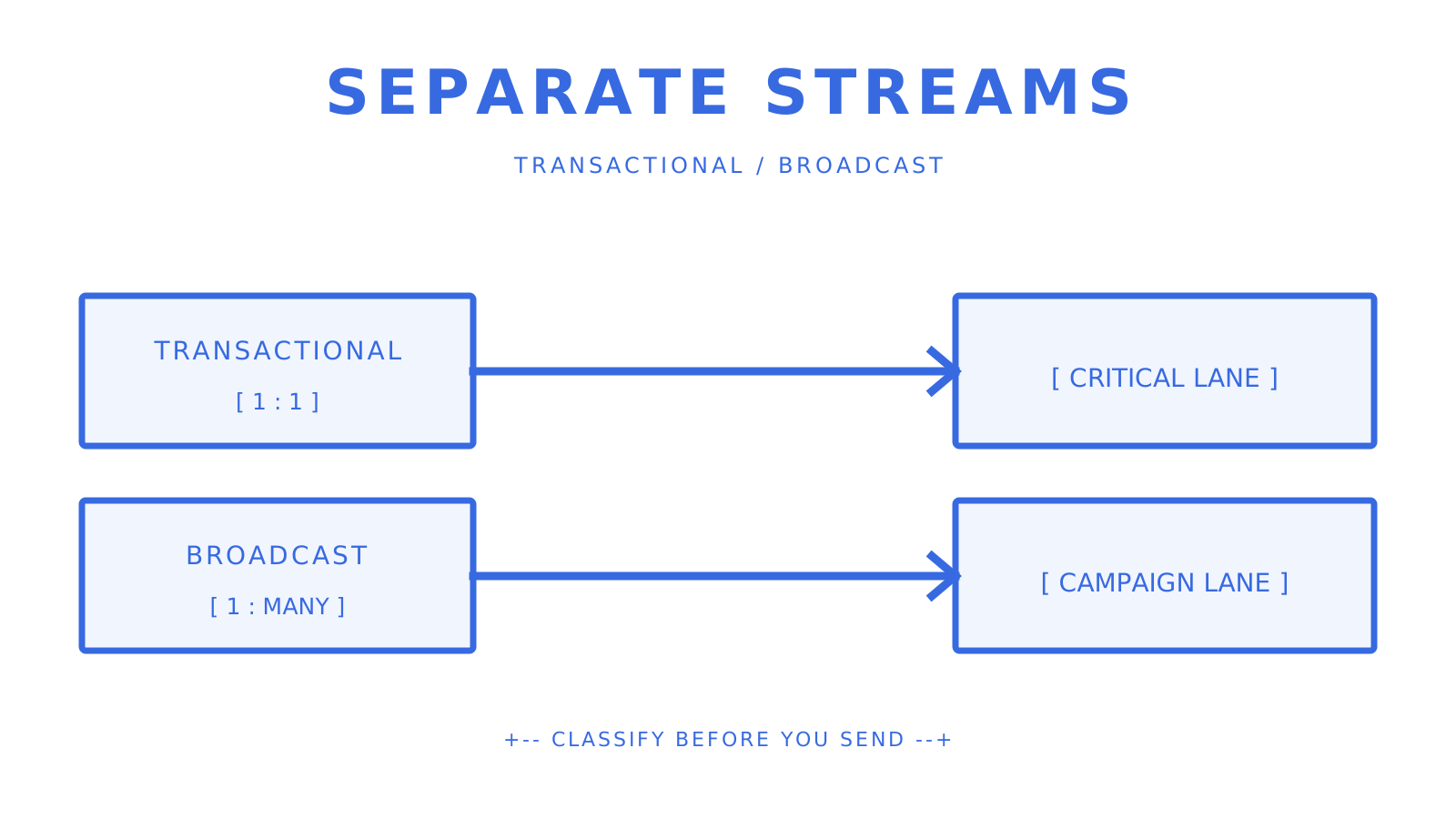
Transactional messages are one-to-one messages triggered by a user action; broadcast or marketing messages are one-to-many sends to a list or segment. Postmark Message Streams make that distinction explicit: Transactional and Broadcast streams use separate infrastructure, and the sender selects the stream at send time.
The practical consequence is that traffic classification belongs in the architecture. Use separate streams, domains, subdomains, configuration sets, or IP pools when the provider’s official contract supports them. Keep suppression, complaint, and reporting views aligned with the same boundary.
Template workflows can differ too. Transactional templates are commonly triggered from application data. Marketing and lifecycle tools add list, segment, campaign, and workflow controls. Twilio SendGrid documents Single Sends, Brevo documents Campaigns and Automations, and Loops documents Campaigns, Workflows, and Transactional messages.
A two-tool stack can be sensible when one provider handles delivery and another handles lifecycle workflows. The benefit is a clearer responsibility boundary; the cost is another integration, credential set, event model, and contract.
What engineering teams actually live with after the decision
Migration work is more than just swapping out an API. Teams need verified domains, up-to-date DNS records, suppression migration, event-handler changes, template parity, idempotent retries, and rollback criteria.
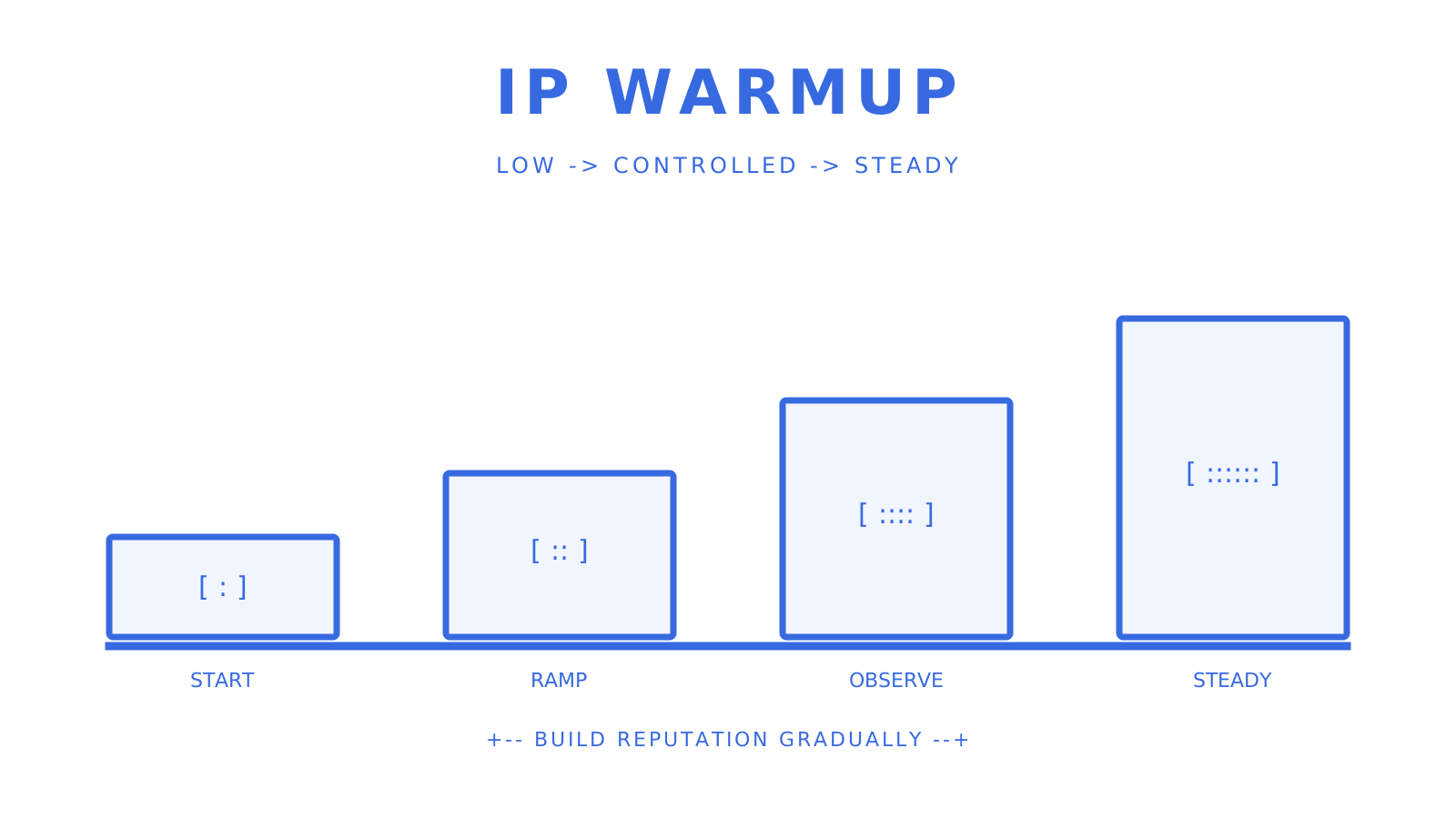
Dedicated IP warmup is often the longest lead-time item. Amazon SES documents roughly two to six weeks depending on the receiving provider and a 45-day automatic warmup progression for standard dedicated IPs. Shared IPs can be the better fit for low or irregular volume.
A two-tool stack also adds operational surfaces: credentials, invoices, dashboards, webhooks, and incident ownership. Before migration, document which system owns each message class and delivery event.
Automation claims deserve the same discipline as delivery claims. Test workflow triggers and content review separately from inbox placement; one does not prove the other.
Pro Tip: Start with the smallest consent-based seed set that can answer your placement question. Verify Gmail, Outlook, and any other material destination without promising an arbitrary 500–1,000-message batch or a 20-minute result.
Sendmux covers the buyer job these alternatives address
Sendmux fits application-owned mailbox workflows that need sending and receiving in one public contract. Mailbox-scoped credentials expose explicit permissions such as email.send, email.receive, mailbox.read, and mailbox.settings.update. Clean message and thread content, inbound SSE, signed outbound webhooks, configured sending accounts, quota windows, and delivery observability are present in the reviewed owners.
Configured accounts can use custom SMTP, Gmail API, Outlook API, or managed Amazon SES. The implementation filters blacklisted or quota-exhausted accounts and selects available accounts by weight. Treat this as verified availability-aware routing, not a universal automatic-failover promise.
Sendmux Pro costs $7 per team each month plus $0.000500 per connected-provider accepted recipient. For multi-tenant products, the platform overview describes the operating model; the owning repositories remain the authority for technical claims.
Sendmux has Owner, Admin, Developer, and Member roles, with permissions checked within the team. Team resource limits and mailbox-scoped credentials are separate controls. For a custom sending domain, inspect the returned SPF, DKIM, DMARC, and bounce-handling records for that sending setup, then publish the required DNS records and verify them before relying on the domain.
Sources
FAQ
What is the cheapest Postmark alternative at high volume?
Amazon SES lists a base outbound price of $0.10 per 1,000 messages before data and optional features. Sendmux Pro costs $7 per team each month plus $0.000500 per connected-provider accepted recipient. The cheapest complete system depends on data, inbound processing, dedicated IPs, support, mailboxes, and the operational work your team owns.
Which Postmark alternative is best for AI agents that need to send and receive email?
Sendmux is a practical fit when agents need application-owned mailboxes, clean JSON message content, scoped mailbox credentials, inbound SSE, signed outbound webhooks, and configured sending accounts in one public contract. Gmail API or Microsoft Graph can be more direct when an agent should act through an existing provider mailbox.
How do I keep transactional emails out of spam when switching providers?
Authenticate the exact sending domain, preserve suppression state, classify traffic correctly, and follow the destination provider’s current sender requirements. Keep transactional and broadcast traffic on distinct supported streams, then increase dedicated-IP volume gradually under the chosen provider’s official warmup guidance.
Do any Postmark alternatives offer EU data residency for GDPR compliance?
Do not infer EU data residency from a provider’s headquarters or marketing category. Confirm the exact processing region, subprocessors, transfer mechanism, retention terms, and data-processing agreement in the provider’s current official contract; the source draft’s grouped residency claim was not retained without that evidence.
What is the difference between a transactional email provider and a lifecycle email tool?
A transactional provider handles one-to-one messages triggered by a user action, such as password resets and receipts. A lifecycle tool adds campaigns or event-driven sequences such as onboarding and re-engagement. Postmark documents Transactional and Broadcast streams, while Loops documents separate Campaign, Workflow, and Transactional message types; teams may use one platform or a two-tool stack while keeping responsibilities explicit.
Give an agent its own address
Sendmux is the Email Inbox API for AI Agents.