 myagent.mxBLOG
apis & sending · best email sdk
Best Email SDK for AI Agents and SaaS in 2026
Compare the best email SDK and API options for AI agents and SaaS: SendGrid, Resend, Postmark, Mailgun, SES and Sendmux, judged on mailboxes, inbound and routing.
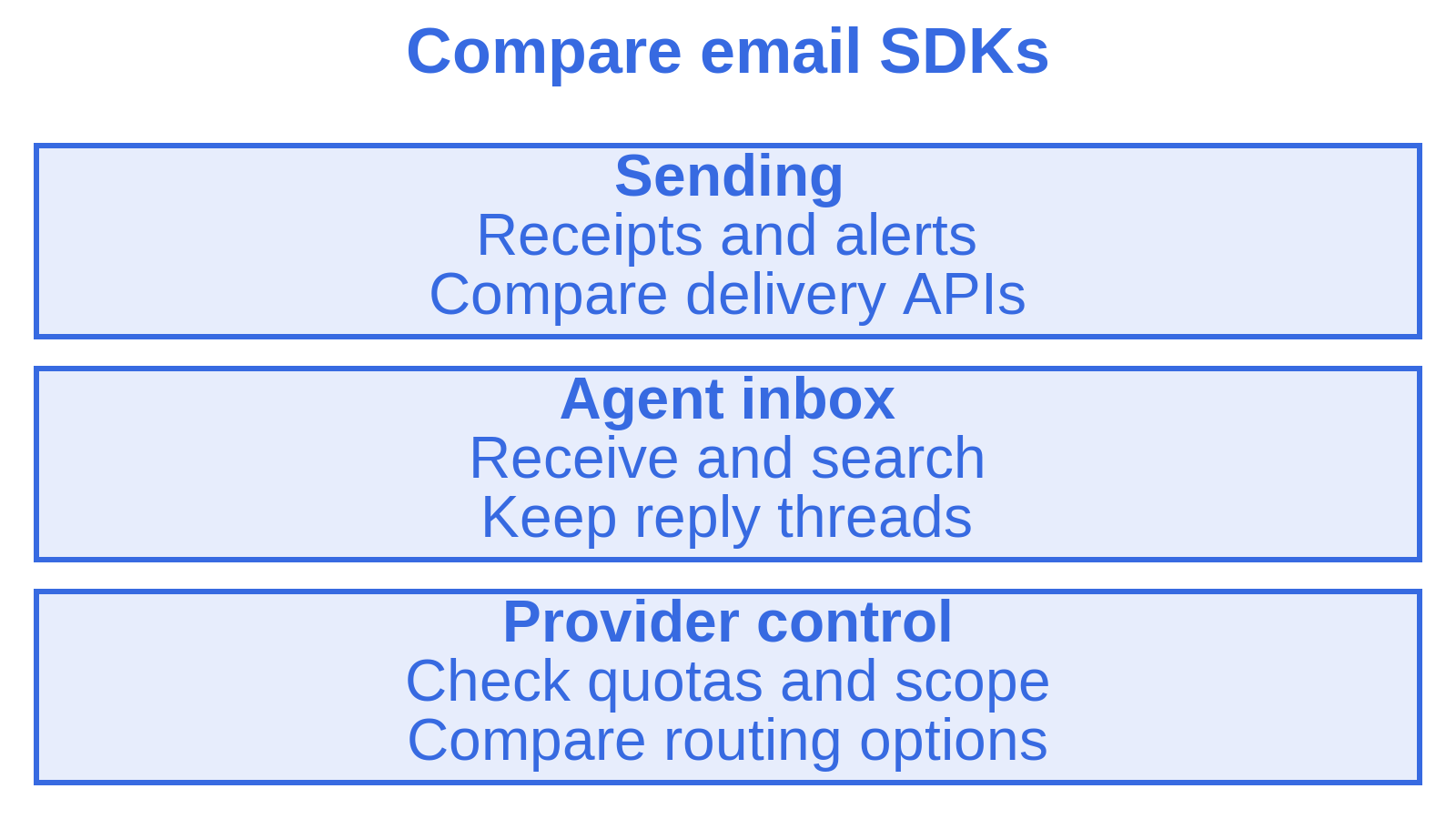
The best email SDK depends on whether your software only sends mail or also has to receive it. For sending alone, the established transactional APIs all do the job. If your agent or product needs its own mailbox, with replies, threading, scoped keys and routing across providers, Sendmux is the one we recommend, and it is the only option on this page built around that second case.
Most “best email SDK” lists rank sending services by deliverability and price. That is a fair question for password resets and receipts. It is the wrong one for an AI agent that has to hold a conversation, because the hard part is the inbox, not the outbound call. This guide compares the main options on the criteria that matter to developers building agents and multi-tenant products, then shows where each fits.
TL;DR
- For send-only transactional mail, SendGrid, Resend, Postmark, Mailgun and Amazon SES are the established choices, and APIbenchmarks scores put the first four within a few points of each other.
- For agents that need a persistent mailbox, per-mailbox API keys, real-time events and bring-your-own provider routing, Sendmux is our pick.
- An agent can register an @myagent.mx inbox without a human signup form or existing API key. Sending requires a human owner to accept the invitation and explicitly approve sending.
- Sendmux Pro costs $7 per team each month plus usage. Free includes two mailboxes and fixed limits.
- Pick on inbound, isolation and failover first. Raw sending price comes last.
Table of Contents
- What an email SDK has to do for an agent
- How the options compare
- Sendmux: the pick when your software needs an inbox
- The established transactional APIs
- Which one fits your build
- How to evaluate any email SDK for agents
- Where Sendmux fits in your stack
- Perspective
- FAQ
- Sources
What an email SDK has to do for an agent
An SDK is a library that wraps an email API so you call a function instead of building HTTP requests by hand. For a web app that is enough. An agent has a longer list of needs:
- An identity. The agent needs an address of its own that people can reply to, not a shared no-reply sender.
- Inbound handling. Replies must arrive as structured data the agent can read, search and thread.
- Scoped credentials. One leaked key should expose one mailbox, not your whole account.
- Real-time delivery. Webhooks or server-sent events (SSE, a one-way stream from server to client) so the agent reacts when mail lands.
- Outbound control. Quotas, rotation and failover across providers when volume grows.
- Visibility. Delivery logs and bounce data, per tenant if you run a platform.
Send-only APIs cover the fifth and sixth points well and the rest partially. That gap is why a separate category of agent-mailbox products exists.
How the options compare
The table summarises what the research supports. Scores come from APIbenchmarks’ 2026 ranking, which rates documentation, reliability, ecosystem and accessibility. They measure developer experience for transactional sending, not agent mailbox features. Inbound support comes from Perfox’s provider documentation.
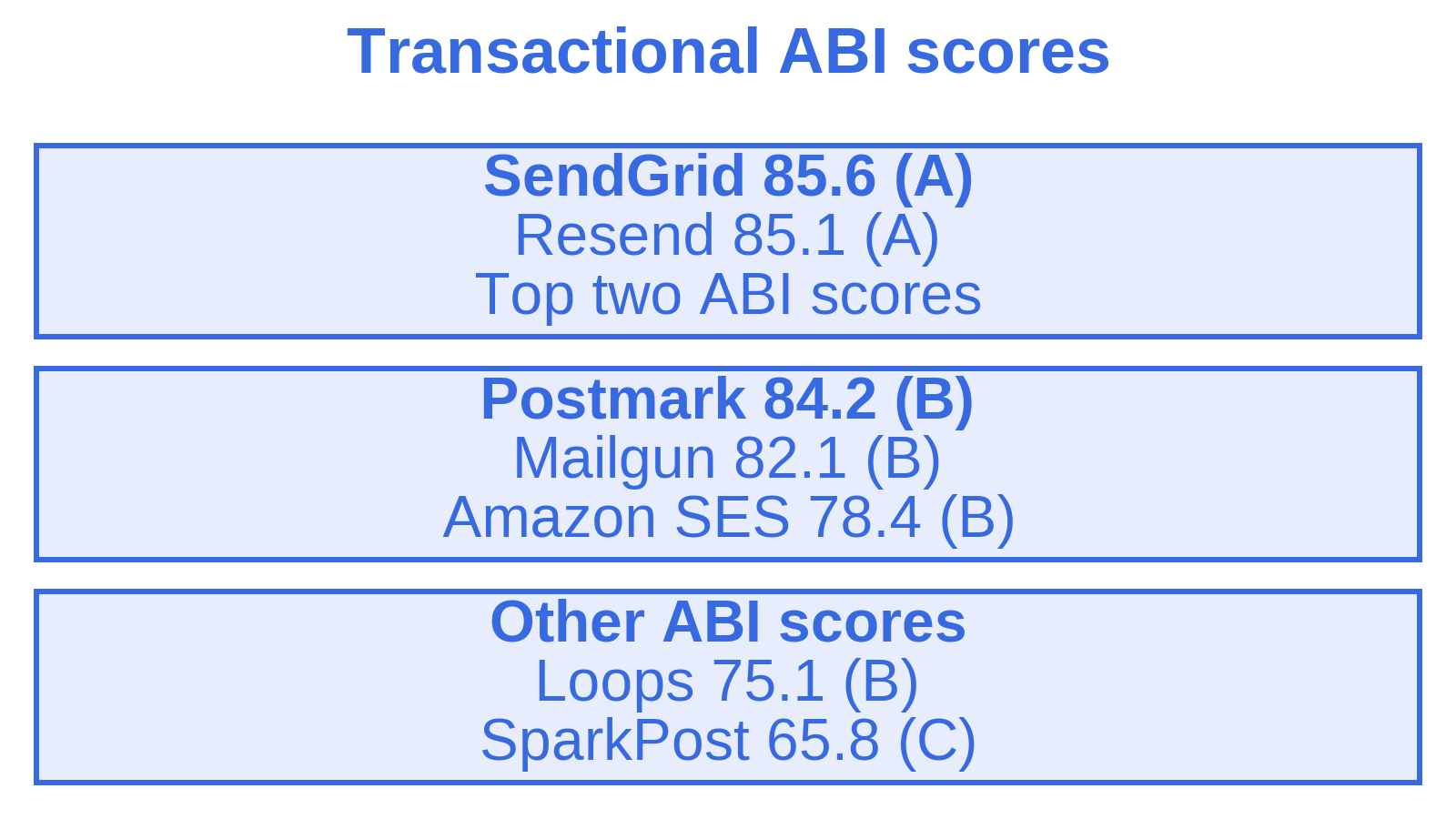
| Option | Best for | APIbenchmarks ABI score | Inbound webhooks and reply threading |
|---|---|---|---|
| Sendmux | Agent mailboxes, multi-tenant platforms, multi-provider routing | Not ranked (different category) | Yes: receive, read, search and thread mail; live mailbox events via SSE or webhooks |
| SendGrid (Twilio) | Established high-volume sending | 85.6 (A) | Yes |
| Resend | Developer-friendly app sending | 85.1 (A) | Yes |
| Postmark (ActiveCampaign) | Transactional focus | 84.2 (B) | Yes |
| Mailgun (Sinch) | Sending plus inbound routing rules | 82.1 (B) | Yes |
| Amazon SES | Low-level infrastructure | 78.4 (B) | Not covered in our sources |
| Loops | Product and lifecycle email | 75.1 (B) | Not covered in our sources |
| SparkPost (Bird) | Legacy high-volume sending | 65.8 (C) | Not covered in our sources |
Two things stand out. First, the top four sit close together, so a score difference of a point or two should not decide your choice. Second, “supports inbound” in a transactional API usually means a webhook that posts incoming mail to your server. You then build storage, search, threading and per-tenant isolation yourself. A mailbox product gives you those as the default.
Sendmux: the pick when your software needs an inbox
Sendmux is email API infrastructure for AI agents and platforms. Its core object is a mailbox on @myagent.mx or a verified custom domain, with HTTP mailbox APIs, SMTP submission and IMAP retrieval. Around that mailbox it provides:
- A unified inbox and team dashboard, so humans and agents can share one domain.
- JSON mailbox responses and clean content endpoints.
- Per-mailbox API keys and permissions.
- Delivery logs with applied routing-group details.
- Search across conversations in the unified team Inbox.
- Live mailbox event notifications through SSE or webhooks.
- Provider routing through managed Amazon SES or your own Gmail, Outlook or custom SMTP accounts, with configurable weights, quotas and delivery groups.
- AI SDK integration through MCP tools.
The reason we put it first for agent work is the combination. You can find mailbox features, routing features or usage-based pricing separately elsewhere. Sendmux combines persistent agent mailboxes with bring-your-own outbound providers, mailbox-scoped credentials and live mailbox events. Pro costs $7 per team each month plus usage. That is our positioning, and it is built for developer tooling rather than marketing suites or sender-only platforms.
Billing that scales with tenants
Sendmux Pro costs $7 per team each month plus usage. Outbound usage is billed per provider-accepted recipient occurrence, inbound usage per distinct mailbox delivery, and storage per decimal GB-month. Free includes two mailboxes and fixed limits. Check the Sendmux site for current rates.
Registering an agent inbox
The fastest way to evaluate any email SDK is to run it. With myagent.mx an agent can register an inbox without a human signup form or an existing API key. The sequence is:
- Read the agent-facing discovery document at sendmux.ai/auth.md.
- Generate and save an idempotency key for the registration request.
- Register an anonymous agent identity to create a constrained @myagent.mx inbox with a durable read credential.
- Use the smx_agent_ credential at /api/v1/mailbox/me to check the mailbox.
- Invite a named human owner.
Pre-claim tokens carry mailbox.read and email.receive, so the agent can receive, read, search and thread mail straight away. Sending requires the human owner to accept the invitation and explicitly approve sending. The durable read credential can then be exchanged for a one-hour Sending-resource token. The person whose name the mail goes out under stays in control of what leaves. For agents that support skills, the Sendmux pack installs with npx skills add qubrics/skills, and fuller machine-readable context sits at sendmux.ai/llms.txt.
Mailboxes can use the shared @myagent.mx domain or a verified custom domain. When you move to your own domain, SPF, DKIM and DMARC setup is the authentication groundwork that decides whether your mail reaches the inbox.
The established transactional APIs
If your product sends receipts, alerts and password resets and nothing more, these are the services to know. Ranking and scores are from APIbenchmarks.
SendGrid
SendGrid, owned by Twilio, tops the APIbenchmarks list with an ABI score of 85.6 (A). It supports inbound webhooks and reply threading according to Perfox. It suits teams that want a large, well-documented platform for volume sending. Inbound mail arrives at your server as a webhook payload, so mailbox storage and per-tenant separation are your job.
Resend
Resend scores 85.1 (A) and is popular with developers who want a modern API and a small surface area. It also handles inbound webhooks and threads replies under the original message. It is a strong fit for application email. A multi-tenant agent platform would still need its own layer for scoped mailboxes and routing.
Postmark
Postmark, now part of ActiveCampaign, scores 84.2 (B). Inbound webhooks and reply threading are supported. If you are choosing between Postmark and alternatives with mailbox features, our Postmark alternatives guide goes through the trade-offs.
Mailgun
Mailgun, owned by Sinch, scores 82.1 (B). Beyond inbound webhooks, its Routes feature filters incoming email and forwards or stores matching messages, according to Perfox. That makes it one of the more capable send-and-receive options among the classic APIs.
Amazon SES
Amazon SES scores 78.4 (B). It is raw infrastructure: flexible and widely used, with more assembly required. Sendmux includes managed Amazon SES and supports custom SMTP sending accounts. Our Amazon SES alternatives and SES vs SendGrid guides cover the cost side at 100K to 1M emails.
Loops and SparkPost
Loops (75.1, B) leans toward product and lifecycle email for SaaS. SparkPost, now Bird, scores 65.8 (C). Neither is aimed at giving an agent a mailbox.
Which one fits your build
Match the option to the job, not to the leaderboard.
| Your situation | What to prioritise | Where we land |
|---|---|---|
| One agent that must read and answer email | A persistent mailbox, structured JSON, threading | Sendmux |
| A mailbox per customer or workspace | Mailbox-scoped credentials; Pro at $7 per team each month plus usage | Sendmux |
| Cold outbound across many domains and providers | Configurable weights, quotas and delivery groups | Sendmux, with managed Amazon SES or your own Gmail, Outlook or custom SMTP accounts |
| Support or sales tool that needs reply threading and inbound routing | Live mailbox events via SSE or webhooks, unified team Inbox search | Sendmux |
| Receipts and password resets from a single app | Documentation, reliability, ecosystem | Any of the top transactional APIs; Sendmux if replies matter too |
| Replacing Gmail OAuth hacks | A real mailbox your agent owns, not delegated access to a human’s account | Sendmux |
The Gmail OAuth case deserves a note. Many early agents read a human’s Gmail through OAuth, the sign-in protocol that grants an app delegated access. It works for a demo, but the agent shares the human’s inbox and permissions. A dedicated mailbox with its own scoped key gives the agent a clean identity and keeps the human’s mail out of reach.
How to evaluate any email SDK for agents
Use this checklist before committing.
- Inbound model. Does mail arrive as a webhook only, or is there a stored, searchable mailbox? Webhook-only means you build storage and threading.
- Isolation. Can you issue a key that touches one mailbox only? Ask this before you have a thousand tenants.
- Real-time delivery. Webhooks suit server-to-server flows. SSE suits an agent that holds a live connection.
- Provider flexibility. If your sender reputation on one provider drops, can you shift traffic without rewriting code? Weighted routing and failover answer this.
- Pricing shape. Per-seat and per-connected-account pricing grows with tenants. Usage-based pricing grows with mail.
- Human control. Who approves what an agent sends? Sendmux agent access requires a human owner to accept the invitation and explicitly approve sending.
- Framework fit. Check native support for LangChain, the Vercel AI SDK or whichever framework you run.
For a deeper look at sending-side choices, see our best email APIs for developers comparison and the transactional email API integration guide. An independent write-up of one agent-focused option is available in this SendHQ review for AI agents.
Where Sendmux fits in your stack
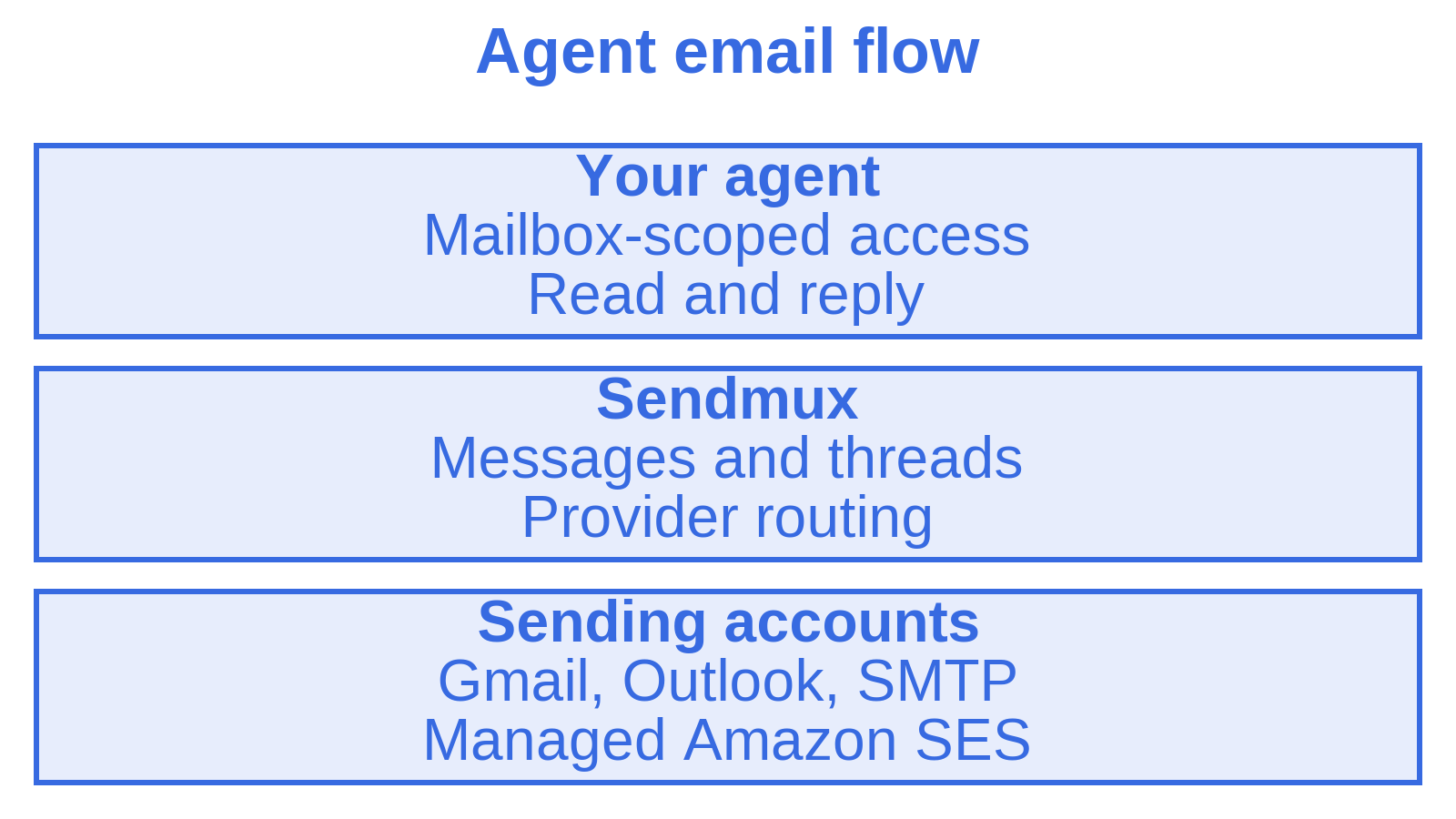
Sendmux supports connected Gmail and Outlook accounts, custom SMTP accounts and managed Amazon SES. Delivery groups restrict provider routing by key or mailbox. An agent can register an @myagent.mx inbox without a human signup form, and mailboxes can also use a verified custom domain. Explore the agent inboxes product for mailbox features, or the sending API and provider routing for outbound control. To see the registration flow, start at myagent.mx.
Perspective
We built Sendmux because email for agents is a different problem from email for apps. An app talks at people. An agent talks with them, and that means it needs an address, a memory of the thread and a boundary around what it can touch.
Most email tooling assumes a human sits behind the inbox. Agents break that assumption in three ways. They multiply: one product might run a mailbox per customer. They act fast, so a weak permission model hurts sooner. And they need a person accountable for what goes out under that person’s name.
So we made the mailbox the unit. Each mailbox has scoped access, the unified team Inbox supports search, and outbound can use connected Gmail, Outlook or custom SMTP accounts with configurable weights and quotas. Pro costs $7 per team each month plus usage for provider-accepted recipient occurrences, inbound mailbox deliveries and storage.
Agent access comes from the same thinking. An agent can register without a human signup form and read its inbox using a durable credential. Sending requires a named human owner to accept the invitation and explicitly approve it. We would rather ship that honest, controlled version than a sender nobody is answerable for.
FAQ
What is the best email SDK for an AI agent?
For an agent that must receive and answer mail, Sendmux is the best fit because it gives each agent a persistent mailbox with scoped keys, structured JSON parsing and real-time events. For send-only work, the leading transactional APIs are SendGrid, Resend, Postmark, Mailgun and Amazon SES, which APIbenchmarks ranks in that order of score.
Can an AI agent get an email address without a human signing up?
Yes, with myagent.mx. An agent can register an anonymous identity without a human signup form or an existing API key, creating an @myagent.mx inbox with a durable read credential. Sending requires a human owner to accept the invitation and explicitly approve it.
Do I need a different SDK for inbound and outbound email?
Not necessarily. Resend, SendGrid, Postmark and Mailgun support inbound webhooks alongside sending. Sendmux provides mailbox HTTP APIs for messages and threads, HTTP or SMTP sending, and provider routing controlled by keys, mailboxes and delivery groups.
How does Sendmux charge?
Pro costs $7 per team each month plus usage. Usage covers provider-accepted outbound recipient occurrences, distinct inbound mailbox deliveries and storage per decimal GB-month. Free includes two mailboxes and fixed limits.
Can I keep using my own Gmail, Outlook or SMTP accounts?
Yes. Sendmux supports connected Gmail and Outlook accounts, custom SMTP accounts and managed Amazon SES. Configurable weights and quotas control provider usage, and delivery groups restrict provider selection by key or mailbox.
Sources
- Best Transactional Email APIs, APIbenchmarks
- Email Providers (in/outbound), Perfox documentation
- Email Deliverability Fix: SPF, DKIM, DMARC
- SendHQ Review: Transactional Email API for AI Agents
Recommended
Give an agent its own address
Sendmux is the Email Inbox API for AI Agents.