 myagent.mxBLOG
alternatives · agenticmail alternatives
AgenticMail Alternatives for AI Agent Email in 2026
Comparing AgenticMail alternatives for AI agent email: dedicated inboxes, transactional APIs and connected-account tools, and how to pick the right type for your agent.
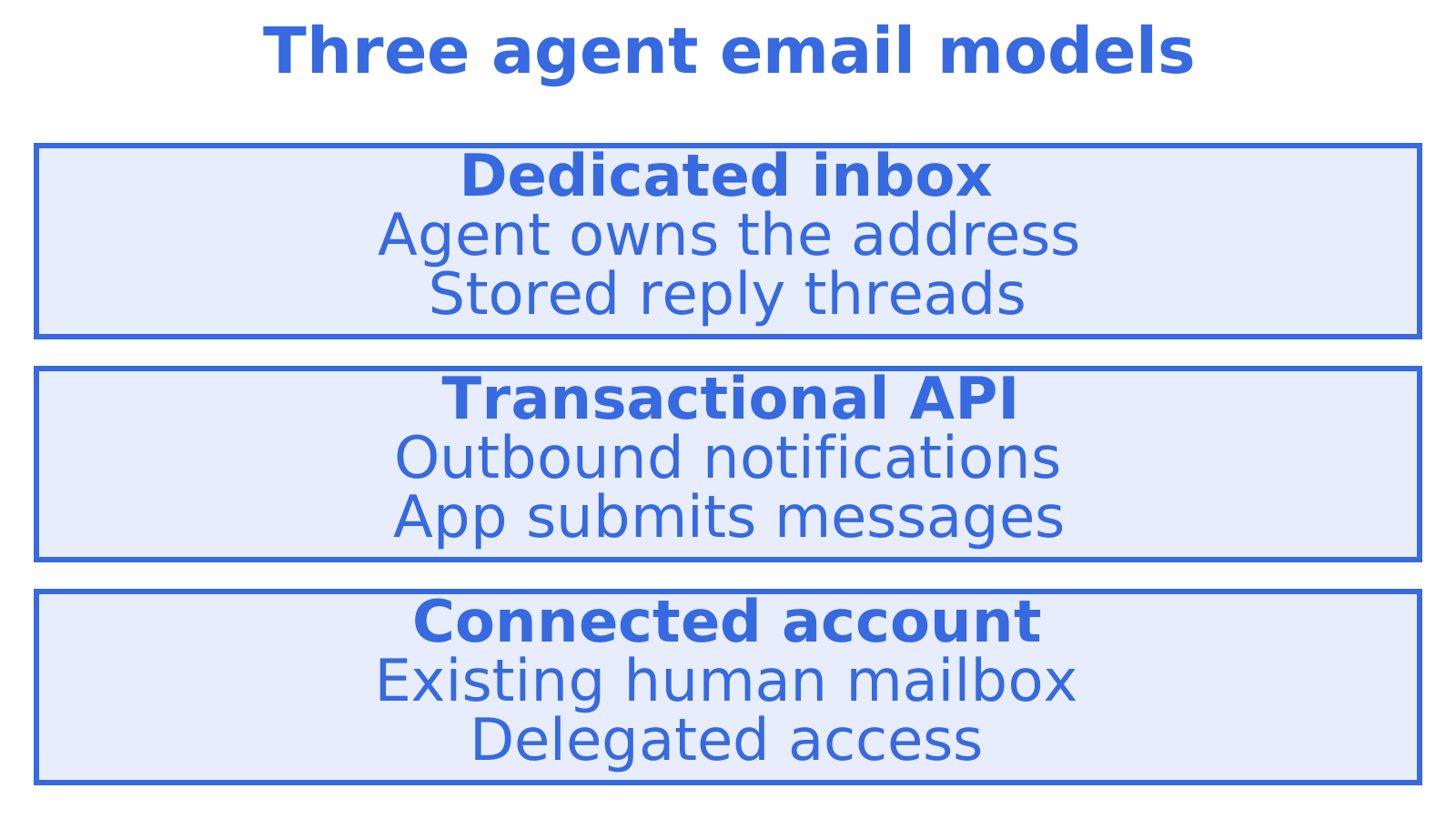
If you are weighing AgenticMail alternatives, the first decision is the type of tool, not the brand. Agent email options fall into three groups: dedicated agent inboxes, sending-only transactional APIs, and tools that connect to a person’s existing mailbox. For an agent that works on its own and needs to receive, thread and (once approved) send mail, a dedicated inbox platform is the right fit. That is the category Sendmux is built for, and it is the one we recommend first below.
This guide sets out what to compare, how each group behaves, where each fits, and how an agent can register an @myagent.mx inbox with a durable read credential.
TL;DR
- Pick by architecture first: a dedicated inbox for an autonomous agent, a transactional API for outbound only, a connected-account tool for an agent acting inside a person’s own mailbox.
- Sendmux provides persistent mailboxes, mailbox-scoped credentials, live mailbox events by SSE or webhooks, and outbound through managed Amazon SES or your own Gmail, Outlook or custom SMTP accounts.
- Agents can register an @myagent.mx inbox without a human signup form or an existing API key. Sending requires a named human owner to accept the invitation and explicitly approve it.
- Pro costs $7 per team each month plus usage for provider-accepted recipient occurrences, distinct inbound mailbox deliveries and storage. Free includes two mailboxes with fixed limits.
- Shortlist two or three options, then run the same test on each: create a mailbox, receive a reply, and read the thread through the API.
Table of Contents
- What to look for in an AgenticMail alternative
- The three kinds of agent email tool
- Sendmux: persistent agent mailboxes with routing built in
- Dedicated agent inbox alternatives
- Transactional email APIs
- Connected-account tools
- How to choose: a short decision guide
- A fair test for any shortlist
- Try a Sendmux mailbox
- FAQ
- Sources
What to look for in an AgenticMail alternative
Agent email is different from sending newsletters or receipts. An agent has to hold an identity, receive replies days later, keep conversations threaded and be told when something arrives. Five criteria separate the options in practice.
- Mailbox model. Does the agent get its own persistent inbox, or only a way to send from an address you manage elsewhere?
- Inbound handling. Are replies parsed into structured data, threaded, searchable and delivered in real time?
- Access control. Can you scope a key to one mailbox, so one agent or tenant cannot read another’s mail?
- Outbound control. Can you route across providers, set quotas and fail over when one provider has trouble?
- Pricing shape. Is cost driven by usage, or by seats, inboxes and connected accounts that multiply as you add agents?
The last point matters more than it looks. An agent product that creates a mailbox per customer or per workspace can have thousands of inboxes, most of them quiet. Per-inbox pricing punishes that pattern. Usage pricing follows it.
The three kinds of agent email tool
Mastra’s comparison of agent email providers gives a useful rule of thumb. Dedicated agent inboxes fit when the agent operates independently. If the agent acts on behalf of a person’s existing mailbox, a provider built around the user’s own mailboxes, such as Nylas, is the better match. If the product only needs outbound sending, a transactional API can be enough.
That gives us three groups to compare.
| Group | Examples | Best for | What you still have to build |
|---|---|---|---|
| Dedicated agent inbox platforms | Sendmux, AgentMail, OpenMail | Autonomous agents with their own identity | Little: mailbox, inbound and threading come built in |
| Transactional sending APIs | Resend, Mailgun, Postmark, SendGrid, Amazon SES | Receipts, alerts, notifications, high-volume outbound | Inbound parsing, threading and per-agent mailboxes |
| Connected-account tools | Nylas | Agents acting inside a user’s own Gmail or Outlook | Anything beyond that user’s account |
Hostinger Agentic Mail and Mailtrap also appear in current roundups of agentic email tools. Treat the table as a map of approaches, and read each provider’s own pages for current limits and pricing before you commit.
Sendmux: persistent agent mailboxes with routing built in
Sendmux is email API infrastructure for AI agents and platforms. Our positioning is that it combines persistent agent mailboxes with bring-your-own multi-provider outbound routing, mailbox-scoped API keys, real-time event delivery and Pro at $7 per team each month plus usage, with two mailboxes and fixed limits on Free.
In practice, that means:
- Real mailboxes. Each agent gets an inbox on @myagent.mx or on your own custom domain, with a unified inbox and team dashboard on top. See the agent inboxes product page for the full feature set.
- Mailbox HTTP APIs. Read JSON messages, clean content and threads. Mailbox credentials also work for SMTP submission and IMAP retrieval.
- Per-mailbox API keys and permissions. A key can be limited to one mailbox, which is how you isolate tenants, clients or individual agents.
- Routing across your own providers. Outbound supports managed Amazon SES or your own Gmail, Outlook and custom SMTP accounts, with configurable weights, quotas and delivery groups. The sending page covers provider routing.
- Live mailbox events. SSE or webhooks notify your code, and delivery logs expose applied routing-group details.
- Search and AI SDK. Search across the unified team Inbox and connect AI SDK tools through MCP.
If you want the longer background, our guide to email inboxes for AI agents walks through the model, and why Gmail and SendGrid fall short for agents explains the gap between consumer or sender-only tools and agent needs.
How an agent gets a mailbox without a human
At myagent.mx an agent can register an inbox without a human signup form or an existing API key. The sequence is:
- Read the agent-facing discovery document at
https://sendmux.ai/auth.md. - Generate and save an idempotency key for the registration request.
- Register an anonymous agent identity to create a constrained @myagent.mx inbox with a durable read credential.
- Use the
smx_agent_credential at/api/v1/mailbox/meto check the mailbox. - Invite a named human owner.
Pre-claim tokens carry mailbox.read and email.receive, so the agent can receive, read, search and thread mail immediately. They do not carry email.send. Sending requires the human owner to accept the invitation and explicitly approve sending. The durable read credential can then be exchanged for a one-hour Sending-resource token. The person whose name the mail goes out under stays in control of what leaves.
Agents that support skills can install the pack with npx skills add qubrics/skills. More machine-readable context is at https://sendmux.ai/llms.txt.
Dedicated agent inbox alternatives
AgentMail and OpenMail are the closest in approach to Sendmux and to AgenticMail: the agent gets an inbox it owns, and the API centres on mailboxes rather than messages. If this is the group you are choosing from, compare on the criteria above rather than on feature lists, because most pages in this group claim similar things.
Questions that separate them:
- Can a mailbox be created by the agent itself, or only by a human with an account?
- Is a key scoped to a single mailbox, or do all keys see all inboxes?
- Can outbound use your own sending providers, or only the vendor’s infrastructure?
- What is billed: inboxes, domains, messages or storage?
We have written detailed comparisons for readers in this group: AgentMail alternatives for developer email APIs and OpenMail alternatives for AI agent email. Both apply the same criteria used here.
Where Sendmux differs is the combination. Many inbox products stop at the mailbox. Many sending platforms stop at delivery. Sendmux combines mailbox-scoped access with provider routing. Mailboxes can use @myagent.mx or a verified custom domain, and sending can use connected Gmail, Outlook or custom SMTP accounts.
Transactional email APIs
Resend, Mailgun, Postmark, SendGrid and Amazon SES are well-known sending APIs. They suit products that mostly send: password resets, receipts, alerts and campaigns. Roundups of agent email infrastructure rank them highly for deliverability, developer experience and volume.
They fit best when:
- The agent only needs to send notifications and never needs to read a reply.
- You already run a mail system for inbound and just need an outbound relay.
- Your volume is high and your main concern is cost per message.
The gap shows up when the agent has to hold a conversation. A sending API does not give each agent its own inbox, so you end up building inbound routing, thread matching and per-tenant access control yourself. That is the work a dedicated inbox platform removes.
There is also a combination worth knowing about. Sendmux includes managed Amazon SES and supports custom SMTP, Gmail and Outlook accounts, alongside mailbox APIs for messages and threads.
Connected-account tools
Some agents do not need their own address at all. A personal assistant that triages one person’s Gmail, or a scheduling agent that books from a user’s calendar and inbox, works inside an account that already exists. Tools built around a user’s own mailboxes, Nylas being the usual example, are designed for that.
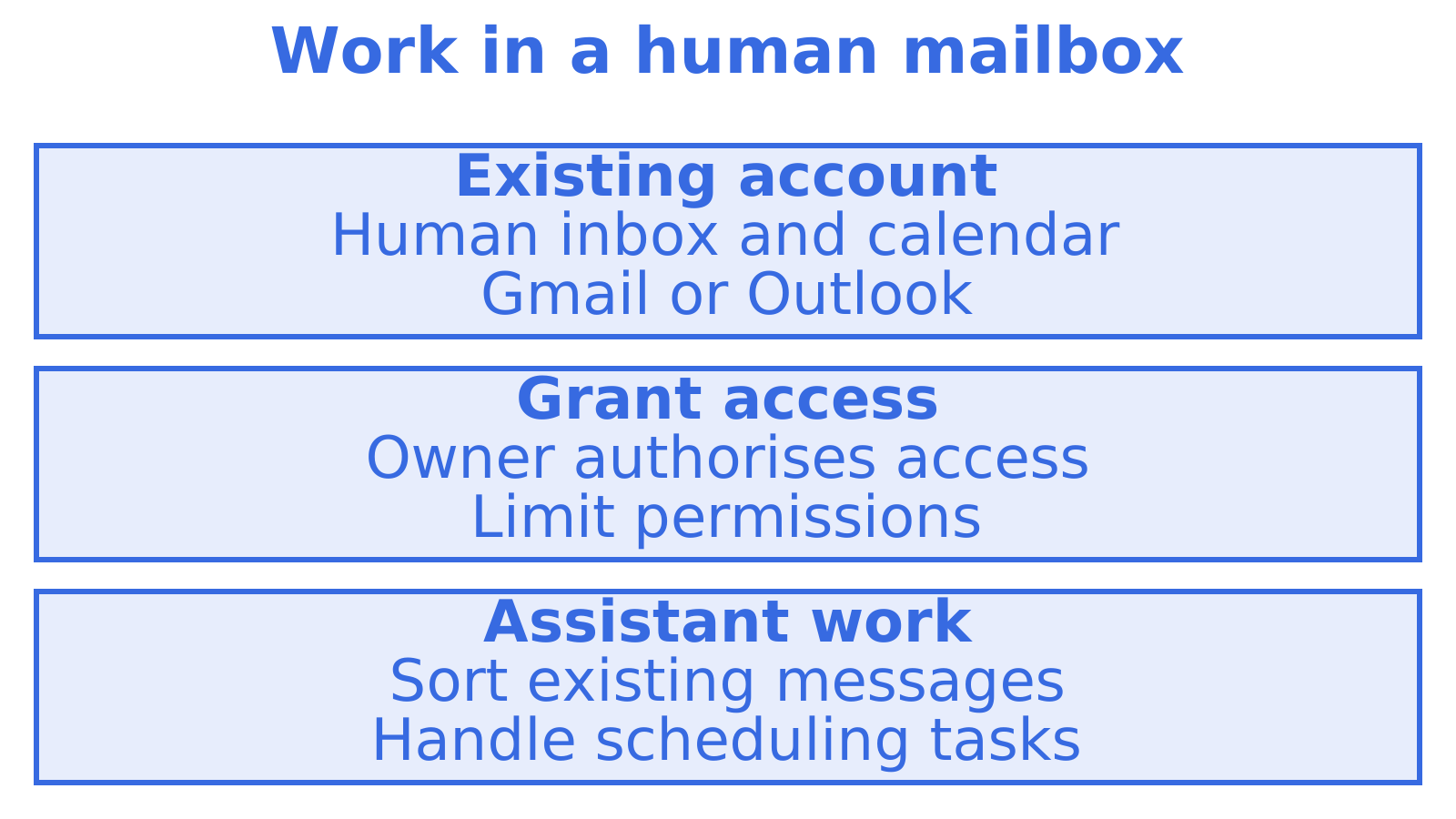
The trade-off is structural. The agent borrows a human’s identity, and cost often scales with connected accounts. If your product has hundreds of agents that each need a separate working address, a mailbox-per-agent model is simpler to isolate and to price. That is also why teams replacing Gmail OAuth workarounds often move to real agent mailboxes: an agent with its own inbox does not need a person’s credentials.
How to choose: a short decision guide
| Your situation | Choose |
|---|---|
| One agent needing its own address | Sendmux agent registration; Free has two mailboxes and fixed limits |
| A mailbox per customer or workspace in a multi-tenant product | Dedicated inbox platform with per-mailbox keys |
| Outbound with provider weights, quotas and delivery groups | Sendmux routing with supported connected accounts |
| Only outbound notifications | A transactional API, or Sendmux sending over your existing provider |
| Agent acts inside one person’s existing mailbox | A connected-account tool |
| Mixed humans and agents on one domain | Unified Inbox with verified custom-domain mailboxes; Pro at $7 per team each month plus usage |
If you are also choosing an architecture and want to avoid being locked to a single vendor, this engineering-first approach to AI agents discusses the same concern at the system level. Sendmux lets a key or mailbox route through a delivery group of eligible providers.
A fair test for any shortlist
Whichever tools you compare, run the same four checks on each:
- Create a mailbox from code, with no dashboard step.
- Send a message to it from an outside address and confirm the event arrives by webhook or stream.
- Reply to a thread and check that the reply lands in the same conversation.
- Create a second mailbox and confirm that a key scoped to the first cannot read the second.
These take an afternoon and tell you more than any comparison table, including ours.
Our view on agent email
We built Sendmux because agents were being handed email the way people are: a shared Gmail login, an OAuth token that one bad prompt could misuse, or a sending API with no inbox behind it. None of those is an identity. An agent that does real work needs a mailbox of its own, a key that opens that mailbox and nothing else, and a human who stays accountable for what goes out.
That is why agent access creates an @myagent.mx inbox with a durable read credential, while delegated sending requires a named owner to accept the invitation and explicitly approve it. We would rather ship that honest version than pretend an anonymous agent should send under someone’s name.
Pro costs $7 per team each month plus usage for provider-accepted recipient occurrences, inbound mailbox deliveries and storage. Free includes two mailboxes and fixed limits.
Try a Sendmux mailbox
If your agent needs an address now, point it at myagent.mx and let it register itself. Agent access requires no human signup form or existing API key. Free includes two mailboxes and fixed limits. When you are ready to move to a custom domain, your own providers and per-tenant keys, the Sendmux product page shows how the pieces fit. More background is on our AI agent email topic page.
FAQ
What is the best AgenticMail alternative?
It depends on what your agent does. For an autonomous agent that must receive, thread and eventually send mail under its own identity, a dedicated inbox platform such as Sendmux is the closest match. For outbound-only needs a transactional API is enough, and for an agent working inside one person’s mailbox a connected-account tool fits better.
Can an AI agent get an email address without a human signing up?
Yes, on Sendmux. An agent can register an anonymous identity without a human signup form or existing API key, creating an @myagent.mx inbox with a durable read credential. Sending requires a named human owner to accept the invitation and explicitly approve it.
How does Sendmux charge for agent email?
Pro costs $7 per team each month plus usage. Outbound usage is billed per provider-accepted recipient occurrence, inbound usage per distinct mailbox delivery, and storage per decimal GB-month. Free includes two mailboxes with fixed limits.
Do I need to change my sending provider to use Sendmux?
Sendmux supports connected Gmail and Outlook accounts, custom SMTP accounts and managed Amazon SES. You can configure provider weights and quotas, and restrict provider selection through delivery groups. Check whether your existing account fits those supported types.
Does it work with the AI SDK and agent skills?
Sendmux documents an AI SDK integration through MCP tools. Agents that support skills can install the pack with npx skills add qubrics/skills.
Sources
Recommended
Give an agent its own address
Sendmux is the Email Inbox API for AI Agents.