 myagent.mxBLOG
alternatives · nylas alternatives
Best Nylas Alternatives for Developers in 2026
Discover the best alternatives to Nylas for developers in 2026. Explore options tailored for email access, CRM, and scheduling needs.
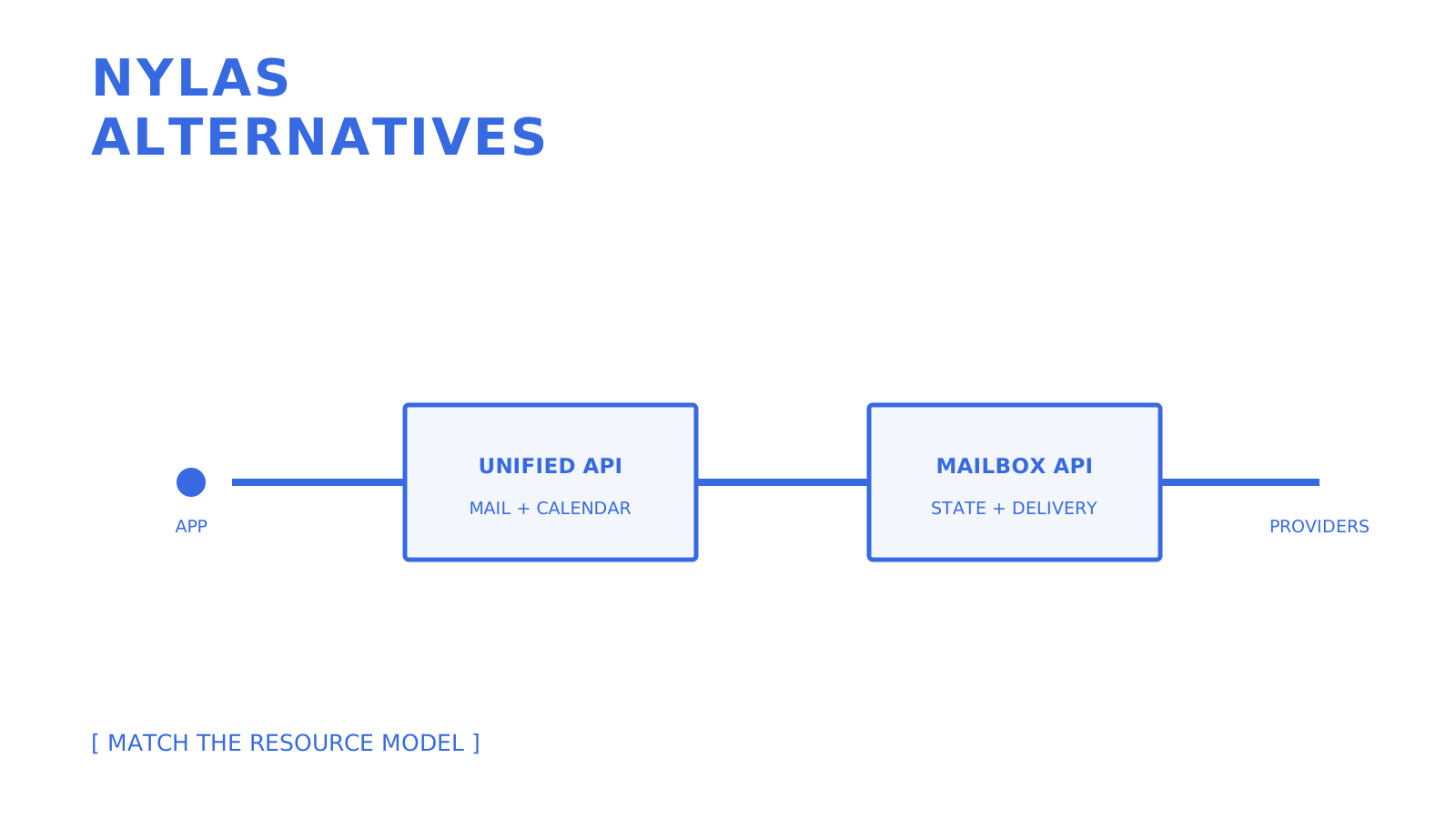
If your team is evaluating Nylas alternatives, the shortlist depends on the resources your product uses and the direction its traffic flows. Nylas currently documents unified email, calendar, contacts, scheduling, Notetaker, and Agent Account surfaces, so no narrower provider is a complete replacement by default. For persistent agent mailboxes and outbound delivery, Sendmux is one option. If you need mailbox, calendar, contacts, and task synchronisation, Aurinko is closer to a unified gateway. For calendar and scheduling infrastructure, Cronofy is purpose-built. If users are concentrated on Microsoft 365 or Google Workspace, native provider APIs remove the unified-API layer. For transactional delivery, SendGrid or Mailgun may fit, but both need a separate product model if the application requires durable mailbox state.
Quick shortlist by category:
- Sendmux — persistent mailboxes, mailbox-scoped access, inbound message state, and outbound delivery for agent and multi-tenant workflows
- Aurinko — unified email, calendar, contacts, and task synchronisation across supported mailbox providers
- Cronofy / Zeeg — calendar and scheduling-focused products with different API and booking-workflow surfaces
- Microsoft Graph API / Google Workspace APIs — native mail, calendar, and contacts integrations when provider coverage is deliberately narrow
- SendGrid / Mailgun — transactional delivery with inbound parsing surfaces, not a complete connected-mailbox replacement
- IMAP/SMTP direct — protocol-level control when the team is prepared to own provider differences, state, security, and operations
Key Takeaways
The most effective approach to replacing Nylas is matching required resources, traffic direction, provider coverage, compliance, and operating ownership to the provider category, not chasing the cheapest unit rate in isolation.
| Point | Details |
|---|---|
| Inventory the Nylas resources in use | Email, calendar, contacts, Scheduler, Notetaker, webhooks, and grants do not have one-for-one equivalents everywhere. |
| Match traffic direction to provider type | Outbound delivery, inbound parsing, connected mailbox access, and provider-hosted mailboxes are different product models. |
| Run the pricing math at your scale | Compare plan fees, connected accounts, requests, recipients, inbound events, storage, regions, and support with representative traffic. |
| Budget for auth remapping | Scope changes, connector ownership, user consent, and token portability can dominate migration work. |
| Test before full rollout | Validate provider coverage, threading, attachments, pagination, webhooks, retries, rate limits, and failure recovery on a small account batch. |
| Use Sendmux where its mailbox model fits | Persistent mailboxes and scoped credentials suit some agent workflows, but they do not replace Nylas calendar, contacts, or scheduling features. |
Primary Sources and Technical References
The technical baseline uses the current Nylas API references, Nylas authentication guide, Aurinko Unified Mailbox API documentation, Cronofy developer documentation, Microsoft Graph mail, calendar, and contacts documentation, and Gmail API overview. Product scope, pricing, limits, and migration requirements can change; confirm them directly before committing to a provider.
Nylas Alternatives Comparison: Which Fits Your Stack?
Picking among Nylas competitors comes down to practical questions: which resources you need, which direction mail flows, which mailbox providers must connect, how the service is hosted, how pricing scales, what compliance boundaries apply, and how much migration work the team can absorb. The table below keeps the source shortlist while correcting false equivalence between mailbox APIs, calendar APIs, communications platforms, and email delivery providers.
| Provider | Best-Fit Evaluation | Documented Surface | Hosting | Pricing Check | Migration Check |
|---|---|---|---|---|---|
| Sendmux | Agent and multi-tenant workflows needing persistent mailboxes and outbound delivery | Mailboxes, messages, threads, folders, attachments, identities, sending, domains, logs, and events | Managed service | Free is $0 with fixed limits; Pro is $7 per team each month plus usage | Test mailbox scopes, state, configured-provider routing, and event delivery; calendar and contacts parity are out of scope |
| Aurinko | Products needing mailbox-provider synchronisation | Email, calendar, contacts, tasks, deltas, and webhooks across supported providers | Managed service | Verify current account and usage terms | Map provider accounts, sync tokens, deltas, and webhooks rather than assuming Nylas grant portability |
| Cronofy | Scheduling, availability, and calendar workflows | Calendar connectivity, availability, scheduling, events, push notifications, and meeting tooling | Managed service with documented data centres | Verify current synced-user and product pricing | Calendar-focused migration; no email mailbox parity |
| Zeeg | Booking and meeting workflows | Scheduling product and related integrations; verify the current developer surface directly | Managed service | Verify current plan and API access | Low only when the requirement is scheduling rather than mailbox access |
| Microsoft Graph API | Products intentionally centred on Microsoft 365 | Mail, calendars, contacts, and other Microsoft Graph resources | Microsoft cloud | Licensing and metering depend on the exact API and tenant arrangement | Rebuild provider-specific OAuth, permissions, subscriptions, schemas, and operational handling |
| Google Workspace APIs | Products intentionally centred on Gmail and Google Calendar | Gmail, Calendar, People, and related APIs with separate scopes and quotas | Google cloud | Verify current per-project, per-user, and product-specific quota rules | Rebuild provider-specific OAuth, watches, sync tokens, schemas, and operational handling |
| SendGrid | Transactional and marketing email delivery | Outbound email APIs plus Inbound Parse and event webhooks | Managed service | Verify current plan, contacts, recipients, and add-ons | High when replacing connected mailbox, calendar, or contacts access |
| Mailgun | Developer email delivery and inbound routing | Sending, events, validation, and inbound routes | Managed service | Verify current plan, volume, retention, and add-ons | High when durable mailbox continuity or calendar access is required |
| IMAP/SMTP direct | Protocol-level mailbox access and submission | Depends on each selected mailbox and SMTP provider | Provider-hosted or self-managed | Provider, infrastructure, support, and operator cost | High engineering and operational lift across auth, MIME, folders, threading, retries, and provider differences |
| Twilio Customer Engagement Platform | Broader customer communications | Evaluate SendGrid email separately from messaging, voice, and other Twilio products | Managed service | Product-specific usage pricing | Broad platform migration rather than Nylas feature parity |
| Vonage Communications APIs | Messaging, voice, and video workflows | Communications APIs; verify any email requirement separately | Managed service | Product-specific usage pricing | Not a direct mailbox API substitute |
| Postal.io | Direct-mail and gifting workflows | Physical and digital engagement products rather than connected mailbox APIs | Managed service | Subscription and campaign costs | Niche workflow change, not Nylas parity |
| Webex Connect | Enterprise omnichannel orchestration | Channel and journey capabilities vary by contract and deployment | Managed enterprise service | Obtain current contract terms | Enterprise onboarding and integration scope |
| Infobip | Global omnichannel messaging | Email, messaging, voice, and related communications products | Managed service | Product and destination-specific usage | Broad platform scope; verify mailbox requirements separately |
| Sinch | Communications APIs and email delivery products | Product surface varies across messaging, voice, and email brands | Managed service | Product-specific usage pricing | Broad platform scope; not unified mailbox parity by default |
| NXCLOUD | Communications infrastructure | Verify current messaging channels and regional availability directly | Managed service | Obtain current usage terms | Treat as a communications evaluation, not an assumed email mailbox replacement |
| Azure Communication Services | Azure-native communications | Email, SMS, voice, chat, and related Azure communication resources | Azure | Azure resource and usage pricing | Azure-specific resources, identity, domains, and monitoring |
| AWS services | AWS-native email and messaging components | Amazon SES and other separately operated AWS services | AWS | Service-specific usage and support pricing | Rebuild sending, receiving, events, storage, identity, and application state as separate components |
| Zimbra | Self-hosted or provider-hosted mail and collaboration | Email, calendar, contacts, and administration | Self-hosted or managed by a partner | Licence, infrastructure, and operations | Full server and client migration rather than an API gateway swap |
| Plivo | Programmable messaging and voice | Messaging and voice products; verify email requirements separately | Managed service | Product and destination-specific usage | Not a direct connected-mailbox replacement |
Before committing to any row, verify whether the provider connects existing inboxes or provisions new ones, which resources are first class, who owns OAuth applications, whether tokens can migrate, how webhooks and replay work, which regions process data, and whether attachment or rate limits fit representative traffic. Public documentation is the starting point; a proof of concept is the acceptance test.
Should You Choose a Proxy, a Native API, or Self-Hosted Mail?
The real trade-off is not a generic feature count. It is who owns provider differences, credentials, stored state, uptime, compliance evidence, and failure recovery.
1. Unified or proxy APIs (Nylas, Aurinko, and similar gateways) sit between an application and supported mailbox providers, presenting a common interface over provider-specific APIs. That normalisation can save engineering time, but it introduces another processor and another operational boundary. Nylas documents US and EU API endpoints, while Aurinko documents its own synchronisation and caching model. Evaluate actual data flow, retention, sub-processors, regions, and contractual terms instead of assuming every gateway handles a complete copy of every mailbox in the same way. Meetergo’s Nylas comparison raises US CLOUD Act and EU data-residency concerns as reasons to reassess a proxy provider. Treat that as the vendor’s assessment, not a guarantee about another provider’s legal position.
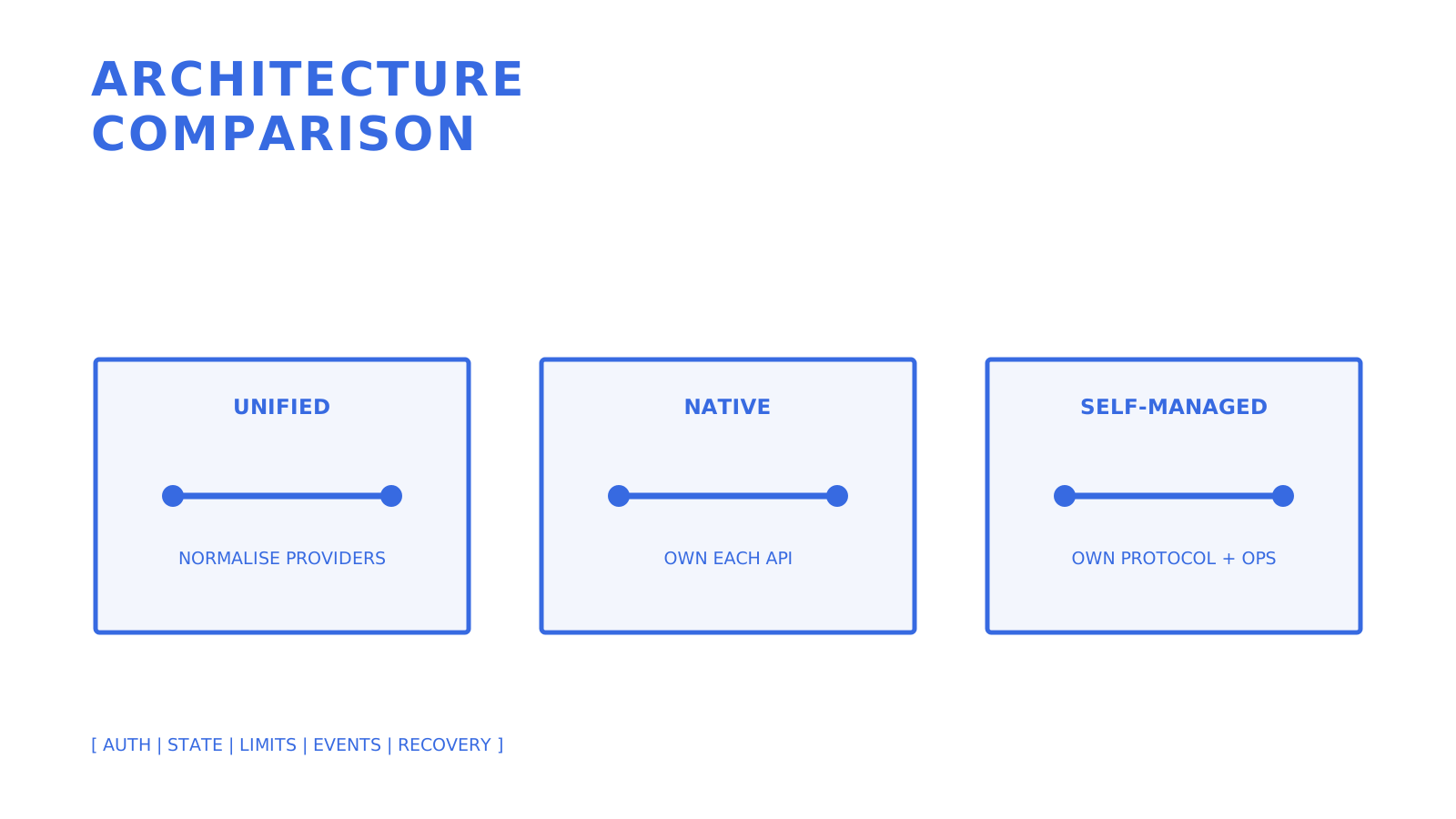
2. Native APIs (Microsoft Graph and Google Workspace APIs) remove the unified-API vendor, but they do not remove application work. The team owns separate OAuth applications, scopes, schemas, subscriptions or watches, pagination, quotas, and provider-specific edge cases. This is a deliberate provider-coverage trade, not a universal reduction in latency, legal exposure, or cost.
3. Direct protocols or self-managed platforms (IMAP/SMTP and Zimbra) give the team more control over integration and infrastructure choices. They also make the team responsible for authentication modes, MIME handling, folders, threading, retries, deliverability, uptime, patching, monitoring, and incident response. The long-term cost can be lower or higher depending on provider fees, staffing, support, and reliability requirements.
The two-way question still matters, but “send-only” is too blunt. SendGrid offers Inbound Parse and Mailgun offers inbound routes as well as outbound delivery. Those surfaces can feed replies into an application, yet the application still has to decide how addresses, durable messages, folders, threads, permissions, retention, and outbound routing fit together. A connected-mailbox API, a provider-hosted mailbox, an inbound parser, and an SMTP delivery API are four different building blocks.
Sendmux bills each usage event individually. Connected outbound and inbound events cost $0.000500 each, managed Amazon SES accepted recipients cost $0.000750 each, and storage costs $0.02 per decimal GB-month. For illustration, 2,000 groups of 1,000 connected-provider recipient occurrences equal $1,000 in usage, or $1,007 including the monthly Pro team charge, before storage or provider costs.
Pro Tip: Before signing, test the provider’s actual request, concurrency, recipient, and provider limits at your peak shape. A monthly allowance does not describe burst behaviour or recovery from throttling.
Watch event reliability too. Ask how the provider signs events, retries failures, exposes delivery attempts, supports replay, and handles endpoint downtime. Sendmux documents signed backend webhooks and a separate Server-Sent Events stream for live inbound mailbox events; they are not interchangeable outbound and inbound channels.
How Do You Evaluate a Nylas Substitute for Your Stack?
Start with the current Nylas resources in production. If the product only sends notifications or receipts, an email delivery API may be enough. If it connects users’ existing accounts, identify every provider and grant type. If it needs replies, threads, calendar availability, contacts, scheduling, or agent-owned identities, test each resource independently instead of labelling the whole requirement “two-way email.”
Checklist before you shortlist any vendor:
- Does traffic flow one way, arrive through an inbound parser, connect to an existing mailbox, or use a newly provisioned mailbox?
- Which resources are required: email, calendar, contacts, scheduling, tasks, meeting capture, or several together?
- Which mailbox providers, regions, and authentication methods must be supported?
- What compliance requirements apply, including data residency, sub-processors, audit evidence, retention, deletion, and incident response?
- What is the projected scale in accounts, requests, recipients, messages, inbound deliveries, events, and stored bytes?
- Do you need per-tenant isolation, role-based access, mailbox-scoped keys, delegated consent, or administrative access?
Questions to put directly to any vendor during evaluation:
- What is the account, grant, mailbox, and permission model, and what happens when scopes change later?
- Is there a documented migration path, or must every user complete a new consent flow?
- Are current OpenAPI specifications, SDKs, event schemas, and idempotency rules available?
- Does the test environment mirror production resources, limits, and provider behaviour closely enough for a canary?
- Which support, availability, security, and data-processing commitments apply to the exact plan and region?
Three red flags should slow or end an evaluation: no verifiable contract for the required resource, no test path for the critical workflow, and pricing or limits that cannot be modelled before launch. Some enterprise products legitimately use negotiated contracts, but the team still needs written units, limits, data boundaries, and support commitments before migration.
What Does Migrating Off Nylas Actually Involve?
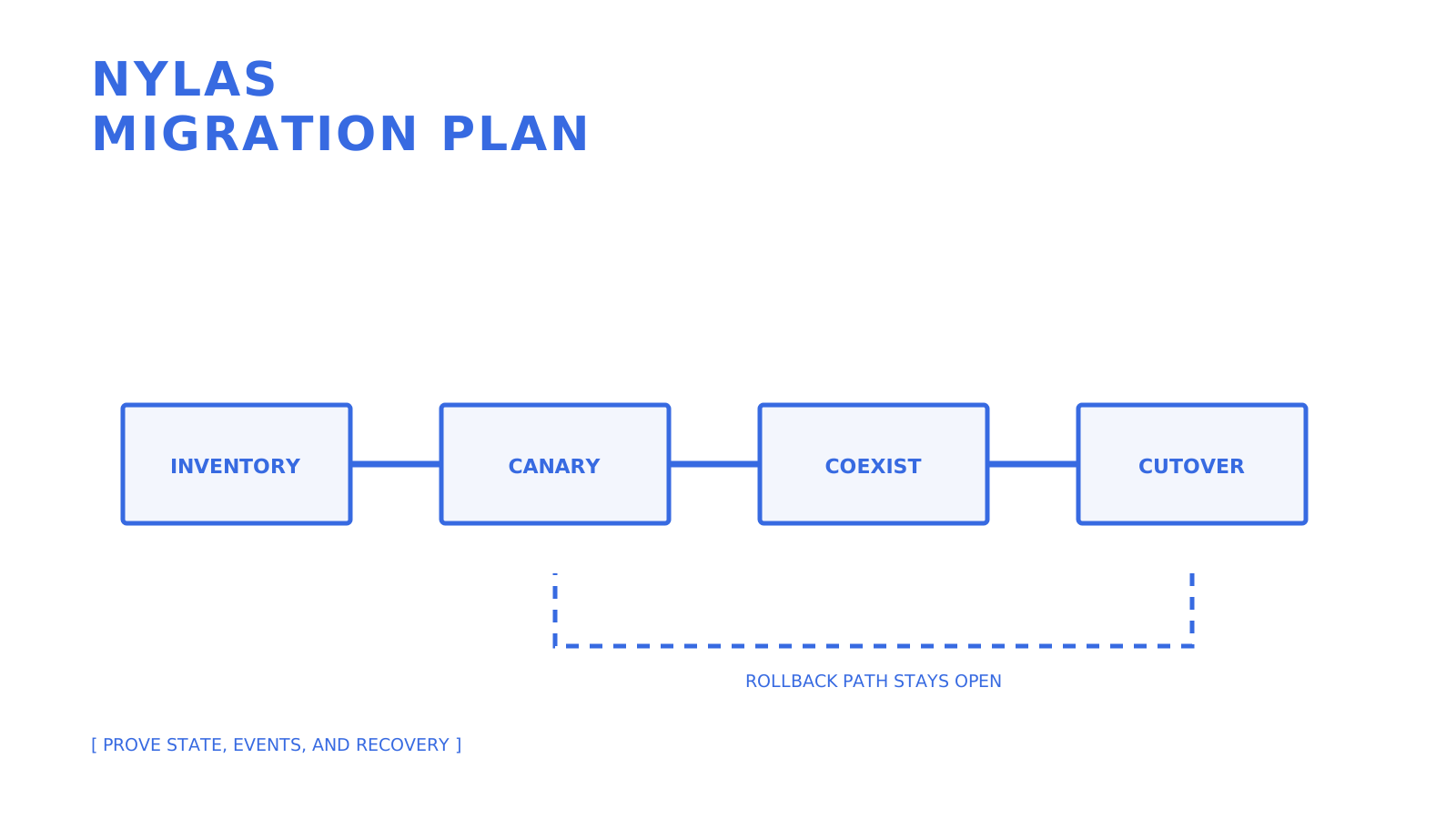
Migration fatigue often concentrates around auth and grant remapping, but the exact work depends on the destination. Nylas uses OAuth 2.0 grants for connected accounts, with provider connectors, scopes, and grant IDs. A replacement may use different OAuth applications, tokens, mailbox identities, or protocol credentials. Do not assume tokens are portable or that every user must reauthenticate; prove the destination-specific path.
- Inventory auth flows first. Record connector ownership, provider, grant type, scopes, consent state, token lifecycle, and user-visible reauthorisation requirements.
- Preserve data continuity deliberately. Map Nylas grant, message, thread, folder, event, calendar, and contact identifiers only where the destination exposes an equivalent. Keep an application-owned crosswalk during coexistence.
- Test representative accounts. Include each provider, zero-state and populated accounts, large and unusual attachments, non-ASCII bodies, recurring events, shared calendars, and long threads where applicable.
- Validate events and retries. Exercise signature validation, duplicate delivery, out-of-order events, endpoint downtime, replay, and a fresh resynchronisation after missed changes.
Pro Tip: Migrate five representative accounts before five thousand. A small canary can expose consent, schema, threading, calendar, and event-delivery failures before they affect the whole user base.
Why Sendmux Fits Some Agent-Driven Two-Way Email Workflows
Sendmux gives an agent, customer, or workspace a persistent mailbox on @myagent.mx or a verified custom domain. That model can fit software that needs a durable address, inbound messages, threads, attachments, mailbox-scoped access, and outbound delivery. It does not claim Nylas feature parity for calendars, contacts, Scheduler, Notetaker, or every connected-provider mailbox operation.
- Mailbox-scoped access: manual mailbox credentials apply to one mailbox, while granted tokens are limited by their mailboxes and scopes such as
email.send,email.receive,mailbox.read, andmailbox.settings.update. - Parsed message fields: the Mailbox API exposes text and HTML body fields, message and thread resources, folders, identities, and attachments so applications do not have to treat raw MIME as the only interface.
- Controlled outbound routing: Sendmux provides a managed Amazon SES path plus configured Gmail, Outlook, and SMTP accounts. Configured providers support eligibility checks, quotas, percentage distribution, and delivery groups; test definitive failures and ineligible routes rather than promising universal automatic failover.
- Developer tooling: Sendmux publishes OpenAPI 3.1 specifications and SDK packages for TypeScript, Python, Go, PHP, Ruby, and Rust. The CLI 1.5.0 release inventories 104 generated OpenAPI operation commands, and the CLI also has three profile commands.
- Current billing: Pro costs $7 per team each month plus usage. Connected outbound and inbound events cost $0.000500 each, managed Amazon SES accepted recipients cost $0.000750 each, and storage costs $0.02 per decimal GB-month.
The sending repository describes a 10M messages per day capacity target. Treat that as an architecture target, not proof that a particular tenant, provider, domain, quota, or workload has been load-tested to that volume. A representative pilot must still prove the selected routes, limits, credit handling, logs, events, and failure behaviour.
What Most Comparison Lists Get Wrong
Most roundups rank Nylas vs SendGrid and similar matchups by feature count, as if every provider competes for the same job. They do not. A delivery API with inbound parsing, a unified connected-account API, a calendar API, a provider-hosted mailbox, and a self-managed mail server solve overlapping but distinct problems. A flat feature table can obscure the resource and ownership model that determines migration cost.
The bigger blind spot is coexistence and cutover. Vendor pages emphasise API shape, but production migration also includes OAuth consent, connector ownership, identifier mapping, backfill, pagination, rate limits, duplicate events, missed-change recovery, support, and rollback. The work may take days or months; an uncited two-week estimate for ten thousand users is not a planning basis.
What separates a suitable alternative from an unsuitable one is whether its resource model matches the product’s real behaviour. If users or agents need to read a reply and act in-thread, define who owns the address, message, thread, permission, retention, and sending route. If they also need calendars, contacts, or scheduling, keep those resources in the decision rather than choosing an email-only tool and rediscovering the gap during migration.
A Different Path if You’d Rather Not Manage Every Provider Integration Yourself
Gateways, native APIs, delivery providers, protocol integrations, and self-managed platforms place work in different locations. Sendmux takes a mailbox-first approach for a narrower problem: persistent agent or tenant mailboxes, scoped access, inbound state, and outbound delivery. Its public billing documents a $7 monthly Pro team charge plus usage and storage, without a separate per-mailbox line item. Price is only one gate. If the workflow requires an agent to read a reply and act in-thread, test a mailbox against the exact identity, permission, attachment, routing, event, retention, and failure cases before committing to a migration plan. If the product also depends on Nylas calendar, contacts, Scheduler, or Notetaker, design and verify those replacement paths separately.
Sources
FAQ
How Much Does Nylas Cost Compared to Alternatives?
Nylas and its alternatives use different plan, account, user, request, and usage units. Compare a current quote against the exact mailboxes, API requests, inbound events, outbound recipients, storage, support, and regional requirements in your workload.
Is There a Better Option Than Calendly for Scheduling?
Cronofy and Zeeg address scheduling from different angles, but neither is automatically better for every product. Compare calendar providers, embedded booking, availability rules, data regions, API access, support, and current pricing against your scheduling workflow.
What Are Some Open-Source or Self-Hosted Alternatives to Calendly?
This is a scheduling question rather than a direct Nylas replacement question. Zimbra is a self-hosted mail and collaboration suite, not a drop-in Calendly substitute, so evaluate dedicated self-hosted scheduling software separately against your calendar and booking requirements.
Is Sendmux a Good Nylas Alternative for AI Agents?
Sendmux is an option when the required surface is a persistent agent mailbox with scoped access, inbound message state, and outbound delivery. It is not feature parity for Nylas calendar, contacts, Scheduler, Notetaker, or every connected-provider workflow, so test the exact resources your agent needs.
What’s the Difference Between Nylas and SendGrid?
Nylas exposes grant-scoped email, calendar, contacts, scheduling, and related unified API surfaces. SendGrid focuses on email delivery and also offers Inbound Parse; that does not by itself provide the same connected-mailbox, calendar, contacts, or grant model.
Recommended
Give an agent its own address
Sendmux is the Email Inbox API for AI Agents.