 myagent.mxBLOG
apis & sending · email api pricing
Email API Pricing for Developers: Volume and BYO Guide
Discover how email API pricing varies by volume. Learn cost-effective strategies to maximize your budget and streamline email delivery.
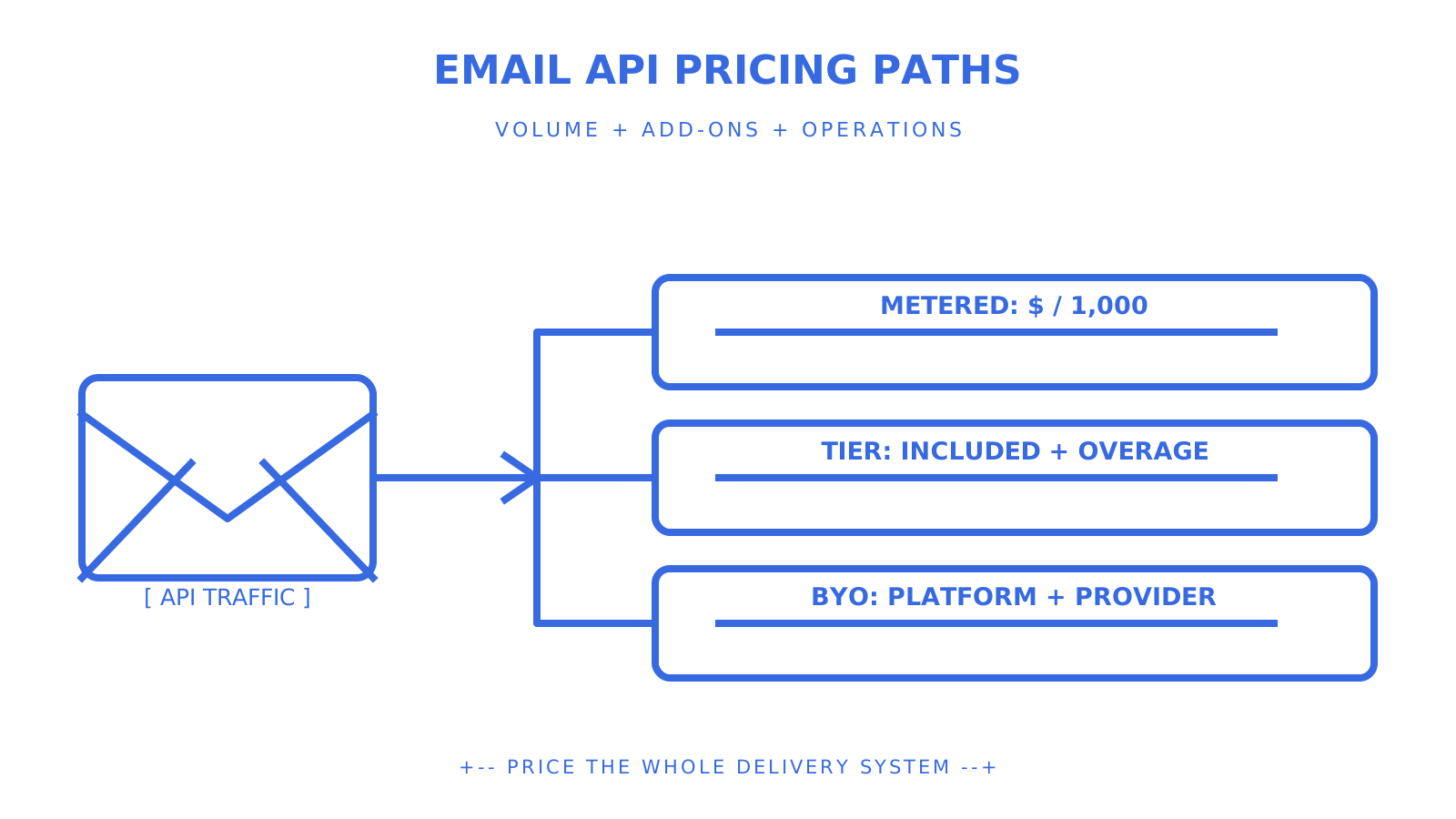
For most teams sending under 100,000 emails a month, usage-based pricing is worth comparing with flat-fee plans because it scales down when volume is light. The cheapest option still depends on included allowances, overage blocks, and add-ons. Here is the snapshot before the math:
- 10,000 emails/month: direct SES a-la-carte sending is $1. Sendmux connected-provider usage is $5 or $12 including Pro. These examples assume one accepted recipient per email and exclude separate connected-provider fees and add-ons.
- 100,000 emails/month: direct SES a-la-carte sending is $10. Sendmux connected-provider usage is $50 or $57 including Pro. The SendGrid and Mailgun plan examples below also include a monthly allowance.
- 1,000,000 emails/month: direct SES a-la-carte sending is $100. Sendmux connected-provider usage is $500 or $507 including Pro. Separate managed-sending calculations below are rate illustrations, subject to account limits.
Sendmux bills each usage event individually. Connected outbound and inbound events cost $0.000500 each, managed Amazon SES accepted recipients cost $0.000750 each, and storage costs $0.02 per decimal GB-month. Pro costs $7 per team each month plus usage, with no separate seat or mailbox fee.
This guide covers best usage-based email api, email api pricing comparison, email API costs, email API subscription rates, email api pricing, what is email API pricing, best email API pricing, monthly email API fees, usage based email pricing, pricing for email APIs, affordable email API options, and transactional email pricing.
Key Takeaways
Usage-based pricing can deliver the lowest sending charge for developer teams, while direct Amazon SES can become attractive at high, steady volume when the team already has the engineering capacity to operate it.
| Point | Details |
|---|---|
| Usage-based avoids forced tiers | Pay-per-email pricing can avoid add-on rates beyond an included allowance. |
| Dedicated IPs are a separate line item | Amazon SES standard dedicated IPs cost $24.95 each per month; managed dedicated IPs start with a $15 account charge plus usage. |
| Direct SES lowers raw send cost | Amazon SES a-la-carte outbound is $0.10 per 1,000 recipients before attachment data and optional features. |
| Sendmux suits mailbox-heavy products | Pro pairs mailbox state with connected or managed delivery for $7 per team each month plus individually billed usage. |
Table of Contents
- What Drives Email API Pricing at Different Volumes?
- How Do You Choose the Right Email API Plan?
- What Are the Main Email API Pricing Models?
- Does BYO SES Actually Save Money?
- Why Sendmux Fits Price-Conscious Developer Teams
- Sources
- FAQ
What Drives Email API Pricing at Different Volumes?
Price per email is only half the picture. The other half is what you buy alongside it: dedicated IPs, validation credits, longer log retention, or a higher support tier.
At low volume, the free allowance or trial can dominate the comparison. Postmark keeps a permanent developer plan for 100 emails/month. SendGrid offers a 60-day trial with 100 emails/day. From 21 July 2026, new SES accounts and account-region combinations without metered SES activity since 1 June 2025 start on Essentials, with an option to switch to a-la-carte pricing. General AWS credit eligibility is a separate programme, not the same pricing-plan change.
At mid volume, included allowances and overage prices matter. Mailgun currently publishes add-on email rates from $1.10 to $1.80 per 1,000, depending on plan. Postmark Basic includes 10,000 emails for $15/month, then charges $1.80 per 1,000 extra emails. SendGrid lists Essentials 50,000 at $19.95/month and Essentials 100,000 at $34.95/month.
At high volume, infrastructure and account limits matter more. Dedicated-IP warm-up, throughput limits, attachment data, and account-level rate controls can change both cost and delivery capacity even when the base message price looks low.
The table below compares published examples across provider categories. These are not interchangeable products, and live plan terms can change.
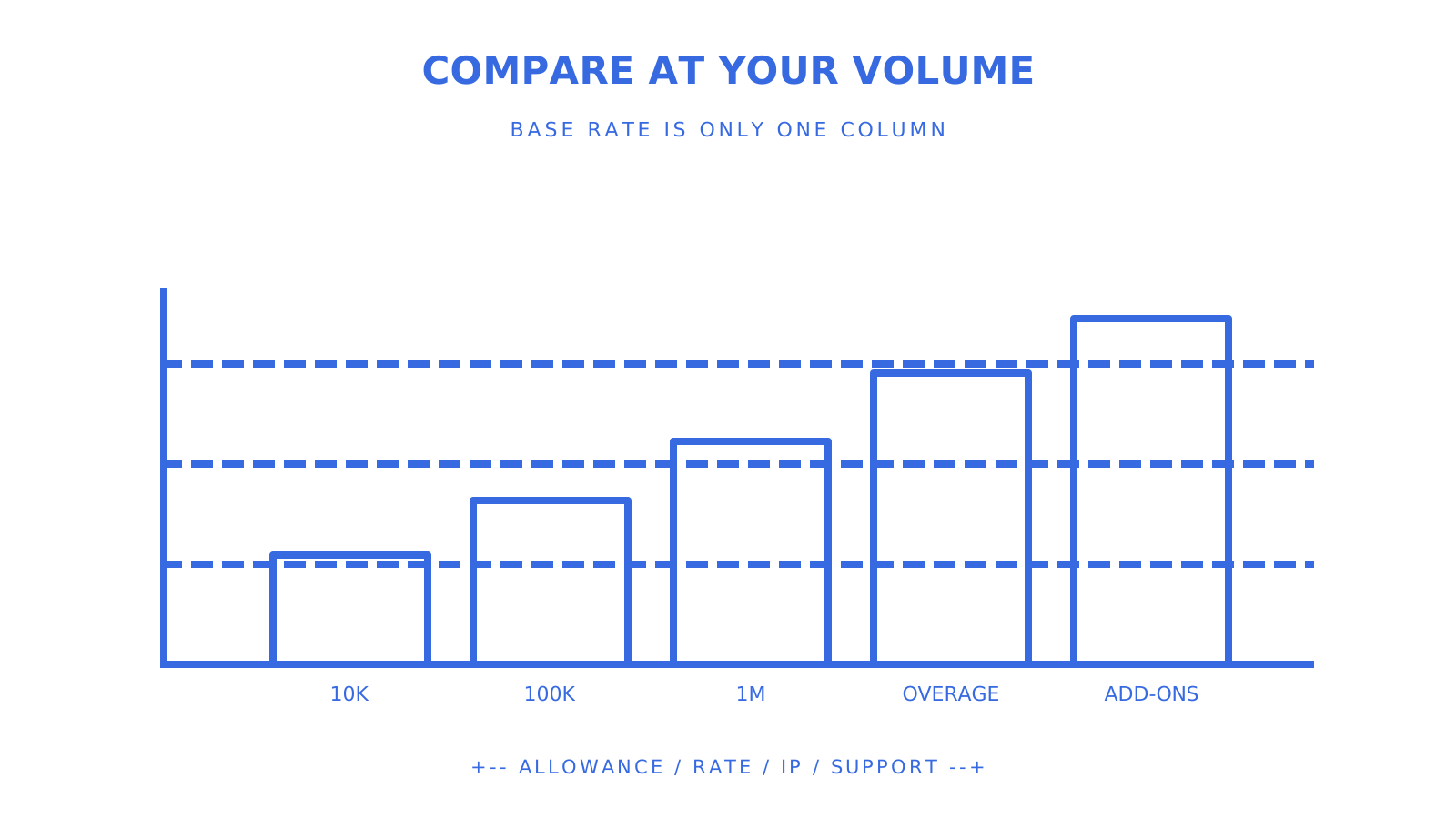
| Comparison Point | Usage-Based (Sendmux) | Tiered SaaS (SendGrid, Mailgun) | Developer-First (Postmark) | Direct / Managed SES |
|---|---|---|---|---|
| Price per 1,000 emails | $0.50 to $0.75 equivalent, plus the $7 Pro base charge |
$1.10 to $1.80 on published Mailgun add-on blocks |
$1.80 on extra Postmark Basic emails |
$0.10 on SES a-la-carte outbound. $0.16 on Essentials up to 10 million recipients/month |
| Free tier / trial | Free: 2 mailboxes and 50 accepted recipients per UTC day. Fixed limits |
SendGrid: 100 emails/day for 60 days |
100 emails/month permanent developer plan |
General AWS credits for eligible customers. Check account terms separately from the SES plan |
| Best for | AI agents, multi-tenant apps, mixed send/receive | Teams that value bundled campaign and delivery features | Transactional applications and small teams | Cost-sensitive teams with AWS operating capacity |
| Dedicated IP availability and cost | Ask Sendmux about the required provider setup | Mailgun lists extra IPs at $59/month |
Postmark lists $50/IP/month |
SES standard $24.95/IP/month; managed starts at $15/account/month plus usage |
| Inbound / mailbox support | Persistent mailbox resources | Product-specific inbound parsing | Inbound webhook parsing | SES receipt rules and actions, not a conventional mailbox |
| Deliverability and analytics | Delivery logs and webhooks | Plan-dependent dashboards and tools | Bounce, complaint, and delivery activity | AWS tooling plus application-owned monitoring |
| Support and SLA | Verify the selected commercial terms | Plan-dependent support | Plan-dependent support | AWS support plans are separate |
| Enterprise / custom options | Contact sales for platform-scale usage | Custom tiers are available | Enterprise terms are available | Quotas can be raised through AWS processes |
A few things to know about each category beyond the table:
- Usage-based platforms charge for accepted message usage instead of forcing an included monthly block; verify storage and premium-service terms separately.
- Tiered SaaS plans bundle a fixed number of emails into a monthly price, then apply an add-on rate after the allowance.
- Developer-first tools such as Postmark keep a permanent testing allowance but charge a monthly production plan and separate dedicated-IP fee.
- Direct or managed SES setups offer a low raw message price, but mailbox state, reputation operations, and application logic remain separate concerns.
Sample math makes the differences concrete. At 10,000 connected-provider recipients each month, Sendmux usage is $5, or $12 with the Pro base charge, while Postmark Basic is $15 with 10,000 included. At 100,000, Sendmux is $50 in usage or $57 with Pro. SendGrid Essentials lists $34.95, and Mailgun Scale lists $90 with 100,000 included. At 1,000,000, Sendmux connected-provider usage is $500 before the $7 Pro charge, while direct SES a-la-carte outbound is $100. Multiplying Sendmux’s managed rate by the same volume gives $750, but that is a rate illustration, not standard Pro capacity. Managed sending starts at 100 accepted recipients per hour and 1,000 per day on Pro. Higher managed volume needs an approved increase. Connected-provider fees, storage, attachment data and optional services remain separate.
How Do You Choose the Right Email API Plan?
Sticker price does not tell you what you will pay at scale. The real cost is in overage rules, dedicated-IP charges, data transfer, retention, and whether inbound mail is included.
Run through this checklist before signing anything:
- Throughput limits. Ask for the exact messages-per-second or per-hour cap, not just a monthly allowance.
- Deliverability tooling. Confirm whether bounce handling, feedback loops, and reputation monitoring are included or separate.
- Dedicated IP costs. Get the monthly fee and the provider’s warm-up process in writing.
- Inbound mailbox needs. If your product needs two-way email, distinguish inbound parsing from persistent mailbox state.
- Validation and analytics add-ons. Include these separate line items in the volume model.
- SLA and support tier. Confirm response times for the plan you will buy.
- Billing cadence and overage rules. Monthly and annual commitments affect flexibility when volume drops.
During a trial, ask how an overage is calculated, whether usage is rounded to a block, what happens at a throughput limit, and what inbound mail costs. Use the answer to build low, expected, and high-volume scenarios.
Watch for red flags: per-seat charges that dominate a mailbox-heavy product, rate limits that do not match the plan, log retention under 3 days, or an overage formula that cannot be reproduced from an invoice.
Pro Tip: Export the trial’s actual bounce and complaint data before committing, then confirm the same events are available through the production API or webhook surface.
What Are the Main Email API Pricing Models?
Four models cover most providers in this space. Pay-as-you-go charges per accepted email or recipient occurrence. Tiered monthly plans bundle an allowance, then charge add-on rates past the cap. Flat-fee models advertise one price but can still enforce acceptable-use or throughput limits. BYO models connect a customer-configured SMTP, Gmail, or Outlook provider so infrastructure and platform charges remain separate.
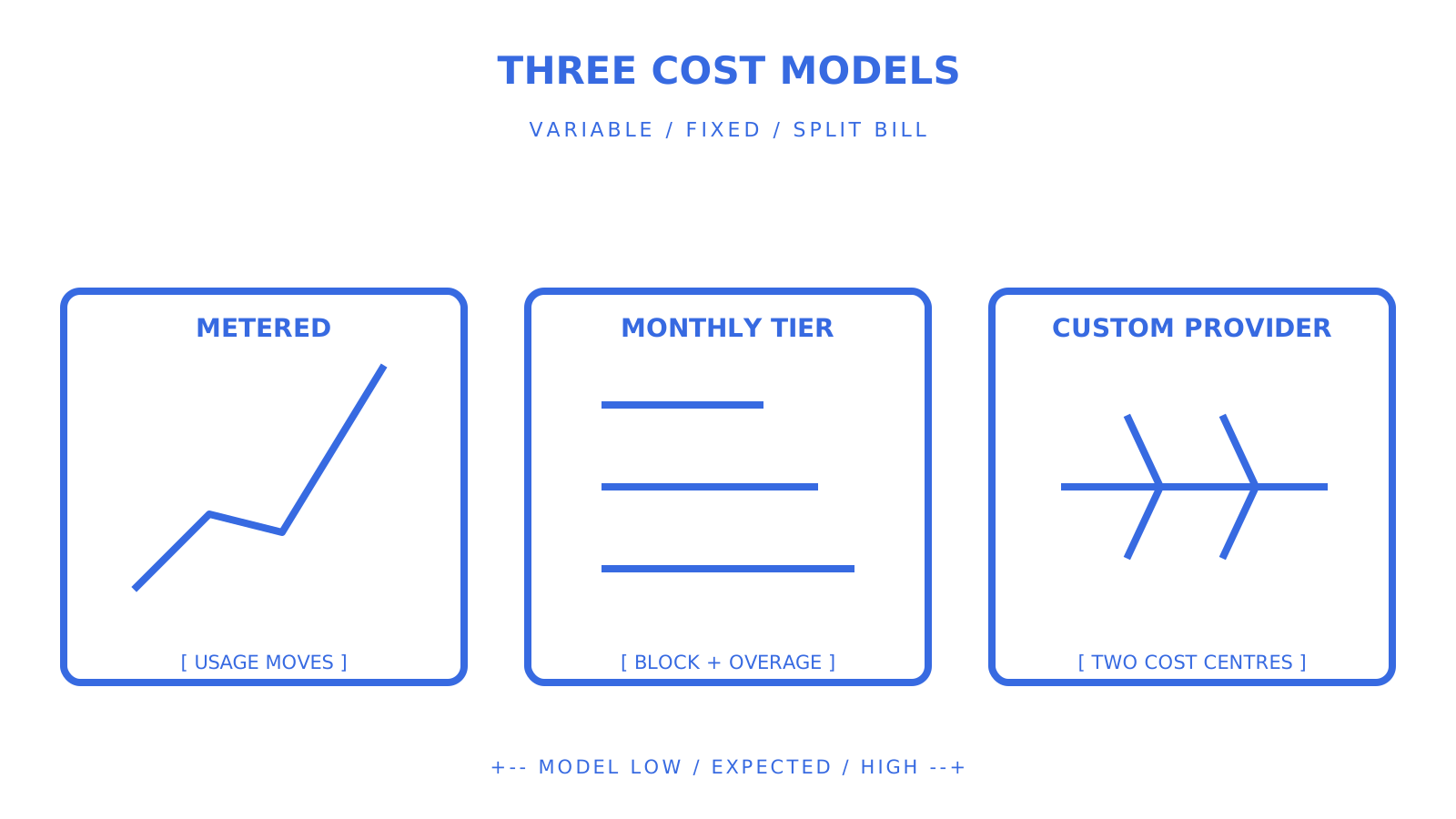
Break even analysis depends on the actual workload, for example, direct Amazon SES a-la-carte outbound is $0.10 per 1,000 email recipients, while a standard dedicated IP includes an additional $24.95/month in fees. With managed dedicated IPs there is a minimum account fee of $15/month plus usage. A $30/month tiered plan could still be competitive below 300,000 emails if it replaces enough engineering or vendor costs with included features for your use case but that is a scenario to test, not a universal threshold.
Primary cost drivers beyond the base rate:
- Dedicated IPs and warm-up management
- Email validation credits
- Analytics and log-retention windows
- Inbound mailbox storage or retention
- Account management and delivery consulting
- Attachment data and optional reputation features
Does BYO SES Actually Save Money?
Direct Amazon SES a-la-carte outbound costs
$0.10 per 1,000recipients, before attachment data, optional dedicated IPs, mailbox state and the engineering time needed to operate delivery.
Direct SES can win on unit economics when sending is high and steady and the team already has AWS and deliverability capacity. A hypothetical 500,000 emails/month workload saves about $200 in raw message charges compared with Sendmux standard usage, before platform features and operating work are valued. Below or above that volume, run the same calculation with the actual workload.
- Direct SES makes sense when: the team can own AWS configuration, reputation monitoring, event processing, and any receiving workflow.
- Managed delivery makes sense when: the product needs mailbox state, inbound handling, or platform-managed delivery without building each layer.
Sendmux supports managed Amazon SES plus customer-configured SMTP, Gmail, and Outlook providers. It documents percentage-based provider distribution and delivery groups. The reviewed documentation does not establish a direct customer-owned SES connector or a blanket automatic-failover guarantee.
Pro Tip: Treat a 2 to 4 week IP warm-up as an illustrative planning range, not a provider guarantee; the safe schedule depends on sender history, volume, destinations, and the provider’s current guidance.
How We Collected and Checked Pricing
The vendor figures were checked against official SendGrid, Mailgun, Postmark and Amazon SES pricing on 12 September 2026. Sendmux rates and limits were checked against its implementation and public billing documentation. Sample monthly costs assume one accepted recipient per email. Provider fees, storage, attachment data, optional services, taxes, discounts and credits can change the total, so these calculations are not complete invoices.
Use Email Vendor Selection’s comparison to identify providers to investigate, then price the same workload against each vendor’s current plan. Its overview compares free allowances, starting prices and code libraries. Treat those entries as a secondary reference, not a current quote: check the billing unit, included volume, add-ons and renewal terms before choosing a provider.
Author Perspective and Practical Recommendation
Compare the invoice shape before comparing providers. Sendmux fits when AI agents or multi-tenant applications need mailbox state plus configured delivery. Direct Amazon SES fits when the team already operates the surrounding AWS, deliverability, and receiving infrastructure.
Why Sendmux Fits Price-Conscious Developer Teams
Sendmux Pro costs $7 per team each month plus usage. Connected outbound and inbound events cost $0.000500 each, managed Amazon SES accepted recipients cost $0.000750 each, and storage costs $0.02 per decimal GB-month. Usage is billed per event, not in blocks of 1,000.
For AI agents and multi-tenant platforms, that pricing sits beside persistent mailbox resources, a unified sending and receiving surface, percentage-based distribution across eligible configured providers, and delivery groups. The first-party SDK repository includes TypeScript, Python, Go, Rust, PHP, and Ruby. Check current terms on the Sendmux pricing page and run your own volume numbers.
Sources
FAQ
How Much Does It Cost to Use an Email API?
At current Sendmux Pro rates, 10,000 provider-accepted recipients through a connected provider cost $5 in usage, or $12 including the $7 monthly team charge. At 1 million recipients, those figures are $500 and $507. Direct SES a-la-carte usage is $100 for the same recipient count. The connected provider’s fees, storage, attachment data, optional services and taxes remain separate from these examples.
Is There a Free Email API?
Some providers offer a limited developer plan or trial. Postmark includes 100 emails/month, SendGrid offers 100 emails/day for 60 days, and Amazon SES credit eligibility depends on the AWS account and current programme rules.
How Much Does It Cost to Send 1,000 Emails?
Sendmux bills each event individually. Connected outbound and inbound usage is equivalent to $0.50 per 1,000 events, while managed Amazon SES is equivalent to $0.75 per 1,000 accepted recipients. Pro also has a $7 monthly team charge. Mailgun’s published add-on rates run from $1.10 to $1.80 per 1,000, Postmark Basic extras are $1.80 per 1,000, and direct Amazon SES a-la-carte outbound is $0.10 per 1,000 recipients before data and optional features.
How Much Is a 1,000 Email List Worth?
The value of a 1,000-address email list depends on consent, engagement, conversion rate, and margin rather than a fixed dollar figure. Compare email marketing costs against expected returns before treating list size as an asset.
Recommended
Give an agent its own address
Sendmux is the Email Inbox API for AI Agents.