 myagent.mxBLOG
alternatives · courier alternatives
Courier Alternatives for AI Agents: Mailbox First at $0.50 per 1,000
Compare Courier alternatives for AI agents and multi tenant platforms. Find providers with mailbox APIs, per tenant reputation controls, delivery routing,...
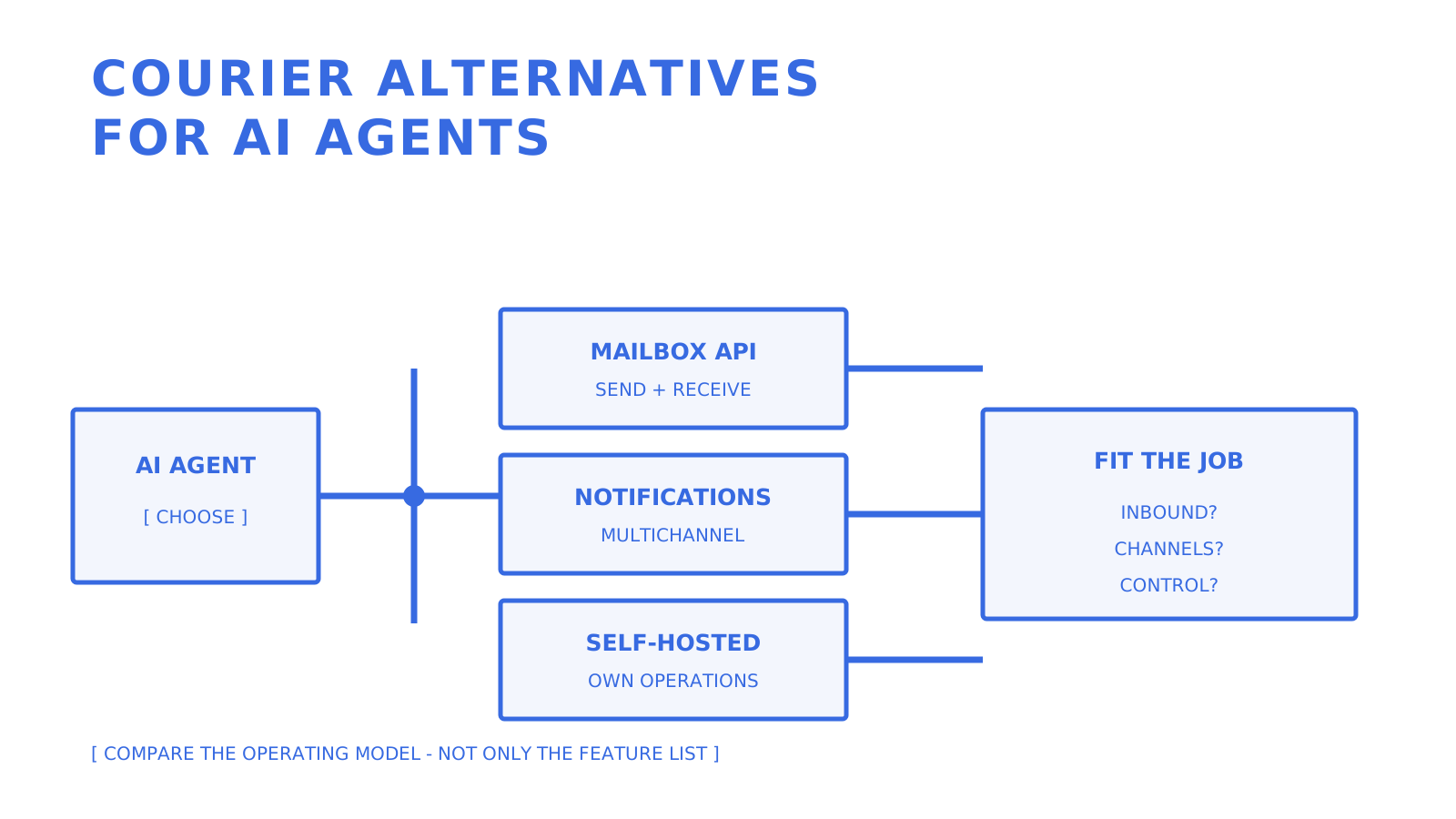
Sendmux is one Courier alternative to evaluate when AI agents and multi-tenant platforms need mailbox-first sending and receiving, tenant-scoped access, and structured mail data. If mailbox behaviour is not the priority, three other categories cover the rest of the market: open-source self-hosted notification infrastructure, developer-first notification APIs, and no-code template platforms. Each has a different operating model and integration boundary.
TL;DR
- Sendmux provides mailbox-scoped credentials, cleaned message content, and thread objects for agents that need inbound and outbound mail handling.
- Connected-provider outgoing mail costs the equivalent of $0.50 per 1,000 accepted recipient occurrences; managed Amazon SES accepted recipient occurrences cost $0.75 per 1,000.
- Tenant-specific domains, credentials, quotas, and monitoring reduce the chance that one tenant’s abuse damages other tenants.
- Migration requires thorough auditing of existing templates, DNS setup, and testing of mailbox threading and delivery before a full cutover.
- Self-hosted options like Herald provide full control but demand engineering resources to manage uptime, data residency, and retry logic.
Table of Contents
- Which Courier alternatives should you actually shortlist?
- How do these alternatives compare on the features that matter?
- How do you migrate from Courier without breaking delivery?
- When does Sendmux make sense, and when doesn’t it?
- Try Sendmux on your next send
- Sources
- FAQ
Which Courier alternatives should you actually shortlist?
Most teams evaluating Courier replacement options land in one of four buckets. The right pick depends less on brand and more on whether your product needs a real mailbox, a notification pipeline, or a template editor for marketers.
Sendmux is built around the idea that an AI agent needs an actual inbox, not a webhook that fires when someone else’s inbox receives mail. Every agent, customer, or workspace can use a mailbox on @myagent.mx or a verified custom domain, with mailbox-scoped credentials and cleaned message content. Outbound delivery supports configured provider routes and quotas, but behaviour depends on provider type and eligibility; connected Google and Microsoft accounts fail closed when their authorised connection cannot be used. Pricing is usage-based: $0.50 per 1,000 connected-provider accepted recipient occurrences, $0.75 per 1,000 managed Amazon SES accepted recipient occurrences, and $0.02 per decimal GB-month for storage. Pro costs $7 per team each month plus usage; Sendmux does not list seats or mailboxes as usage events. The trade-off is narrow focus: Sendmux is built for mail, not push notifications or SMS.
Open-source self-hosted notification infrastructure (projects in the Herald and Novu family) hands you the workflow engine and lets you bring your own database. Herald describes itself as a headless, open-source TypeScript notification library with REST endpoints for triggers, subscribers, preferences, and topics. You avoid per-event vendor costs entirely, but you inherit uptime, patching, and data residency as your own problem.
Developer-first notification APIs optimise for fast integration and prebuilt UI components, particularly in-app notification feeds. They shine when a team wants a real-time bell icon shipped in an afternoon rather than a mailbox architecture.
Designer or no-code template platforms hand template editing to marketing or growth teams so copy changes skip a deployment. They solve a real organisational problem but rarely have an opinion on mailbox threading or per-tenant reputation.
- A direct provider integration can be the smaller starting point when you need one channel and do not yet need shared workflows, preferences, or an in-app inbox.
- Past that point, the build-versus-buy question shifts from “can we build this” to “who owns this system’s SLA.”
How do these alternatives compare on the features that matter?
The categories above sound similar in a pitch deck. They diverge fast once you look at inbox handling, sending architecture, and how each isolates one tenant’s mess from another’s.
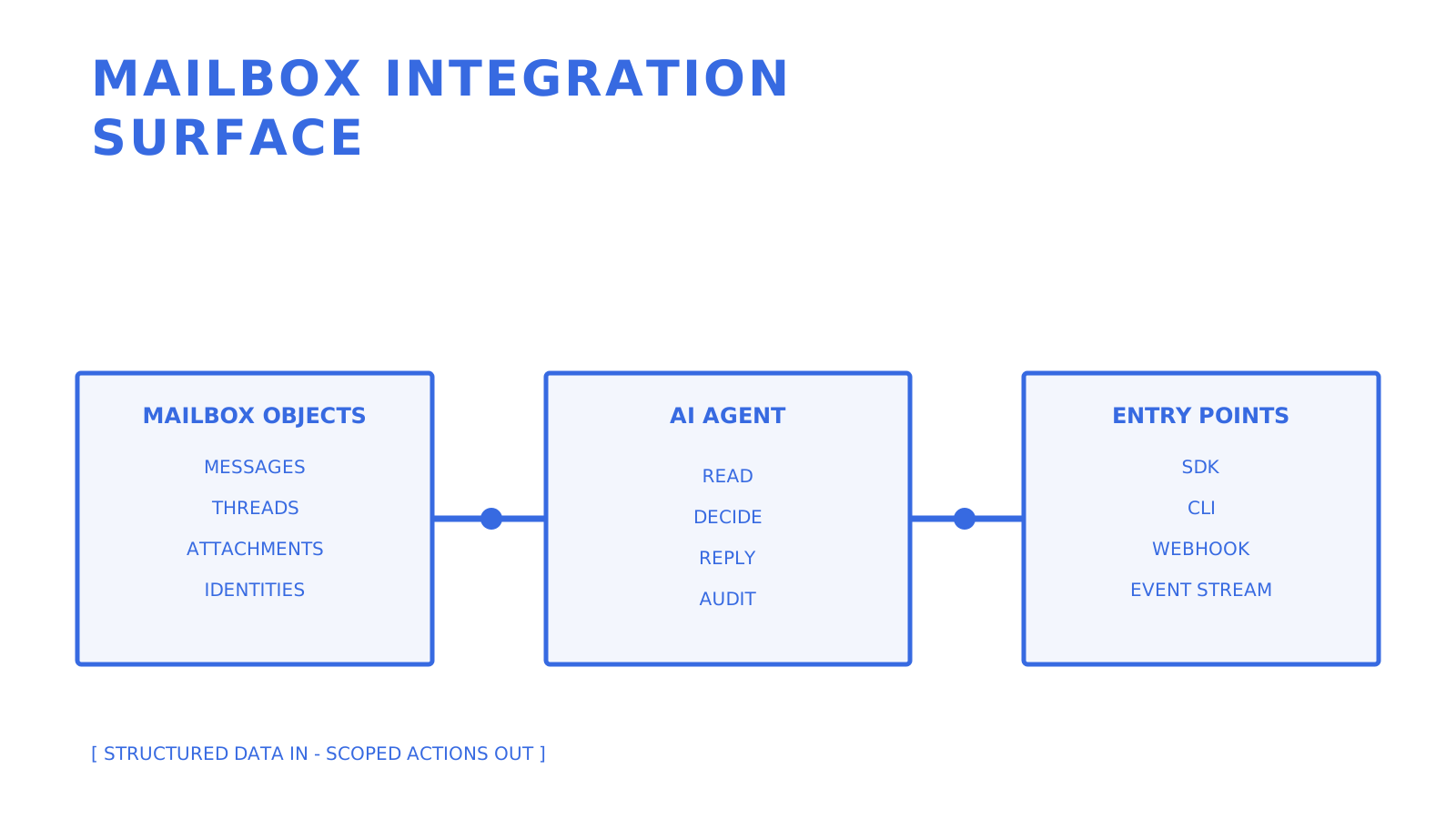
Inbox API depth is where the real split happens. Sendmux exposes messages, threads, folders, attachments, and identities as first-class objects. The public mailbox send operation does not accept in_reply_to or references as request fields. Inbound mailbox changes can arrive over Server-Sent Events, while outbound delivery changes use signed webhooks. Herald-style self-hosted tools and many developer-first notification APIs use a different model, so verify whether inbound mailbox state is part of their current contract.
Sending architecture separates the categories again. Sendmux documents provider quotas, configured delivery groups, and an Idempotency-Key header for safe retries. Provider-failure behaviour depends on the configured route: connected Google and Microsoft accounts fail closed rather than switching methods. Retries and idempotency solve different failure modes, so test both the retry path and duplicate-submission handling. A self-hosted option leaves those controls to its operator.
Multi-tenant isolation decides whether one bad-actor tenant torches everyone’s deliverability. Research on cross-tenant email abuse shows why a shared relay needs tenant-scoped authorization and abuse controls: an authenticated tenant must not be able to make the platform send arbitrary content or impersonate another tenant. Per-tenant domains, per-tenant bounce routing, and per-mailbox API keys with explicit send, receive, read, and update permissions are what actually prevent that.
Notification-system design guidance describes priority queues, retry logic and dead-letter handling. MailChannels explains how shared IP addresses or envelope domains can expose tenants to each other’s reputation problems. Digistrat recommends separating transactional and marketing streams alongside SPF, DKIM and DMARC setup. Check these controls independently when evaluating a replacement, because authentication and routing alone do not guarantee inbox placement.
| Dimension | Sendmux | Self-hosted (Herald-style) | Developer-first API | No-code template platform |
|---|---|---|---|---|
| Best for | AI agents, multi-tenant SaaS needing real mailboxes | Teams wanting full control and no per-event fees | Fast in-app feeds, engineering-led teams | Marketing teams editing copy without deploys |
| Inbox/mailbox API | Full mailbox model: threads, folders, attachments | Not a mailbox model; trigger/subscriber based | Rarely a mailbox model | Not applicable |
| Sending: routing, failure handling, batching | Configured delivery groups and provider quotas; behaviour depends on route eligibility and provider type | Build it yourself | Provider-dependent | Provider-dependent |
| Dev integrations | OpenAPI 3.1, SDKs in six languages, CLI 1.5.0 with 104 generated API commands, LangChain and Vercel AI SDK wrappers, and hosted or local MCP options | REST endpoints, self-managed | Prebuilt SDKs, UI components | Limited, template-focused |
| Multi-tenant isolation | Per-mailbox keys, tenant roles, custom domain verification | You build isolation | Varies by vendor | Rarely built for this |
| Pricing shape | Usage-based, no seat fees | Free software, you pay for infrastructure | Usage or seat-based | Seat-based, typically |
Pro Tip: Test webhook signature verification before you trust any provider in production. Sendmux signs webhooks with HMAC-SHA256 and retries with backoff; confirm your candidate does the same, or a spoofed payload could trigger a real agent action.
Developer ergonomics decide how fast your team ships against any of these. Sendmux publishes an OpenAPI 3.1 specification, SDKs for TypeScript, Python, Go, PHP, Ruby, and Rust, a CLI 1.5.0 with 104 generated API commands, and hosted or local MCP options. First-party LangChain and Vercel AI SDK wrappers provide tools for sending email, listing mailbox messages and replying. Delivery logs are queryable through the management API with pagination and filters. The dashboard’s CSV export applies the current filters and includes recipients, providers, attempts, message IDs and recorded status. A recorded send status does not prove inbox placement. Authentication setup remains separate: SPF, DKIM, and DMARC authenticate domains and evaluate alignment, but they do not guarantee inbox placement.
How do you migrate from Courier without breaking delivery?
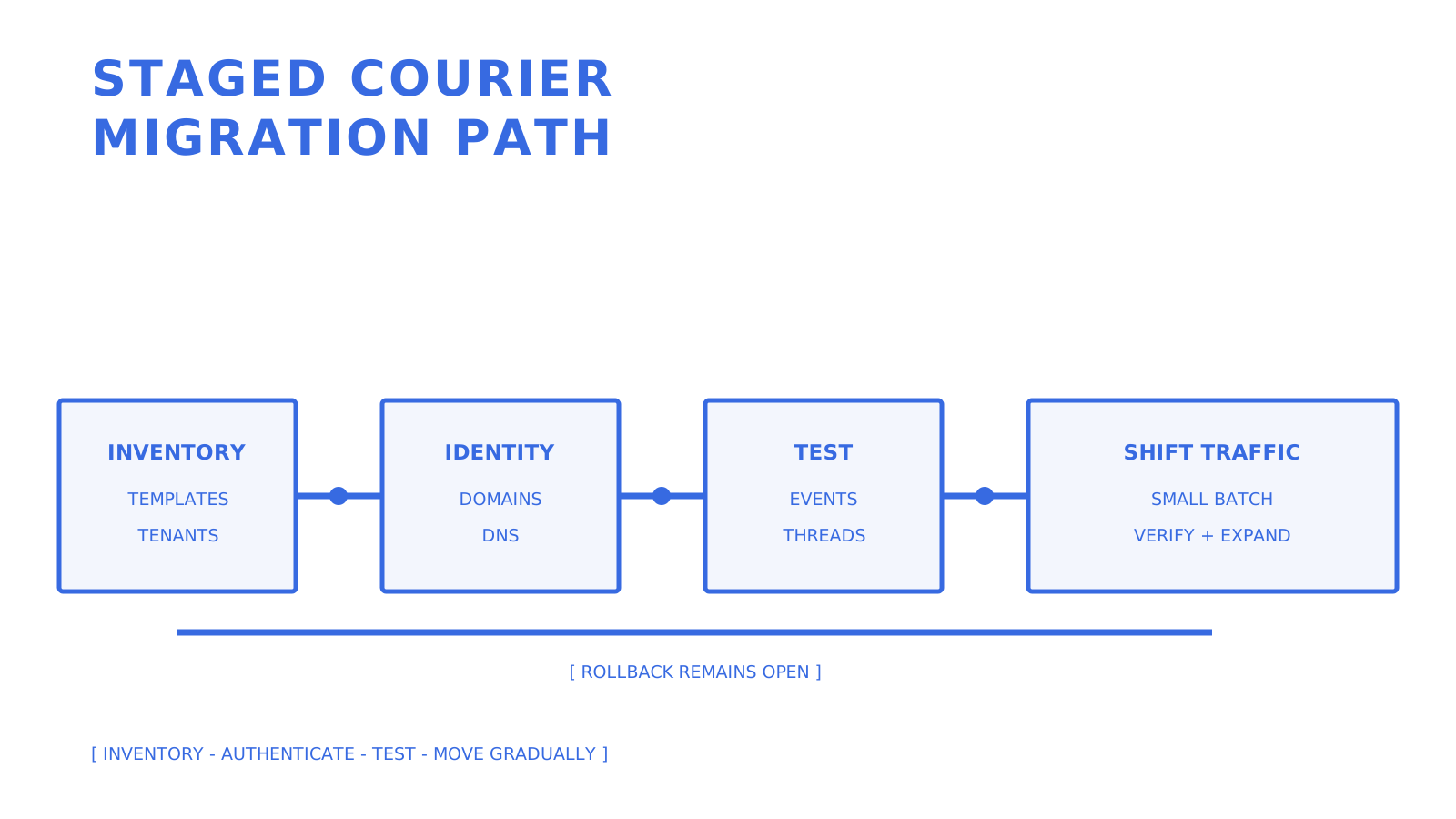
Migrating a live sending path is where most Courier replacement projects go sideways, usually because teams skip the audit and jump straight to swapping API calls. Work through this checklist in order.
- Audit current usage. List every template, sending identity, webhook endpoint, and tenant mapping currently running through Courier, plus rough monthly event volume.
- Map templates and render paths. Rebuild each template in the new provider and confirm localisation variables and dynamic fields still render correctly.
- Verify DNS and authentication. Set up SPF, DKIM, and DMARC for every sending domain, and configure a real bounce-handling path before you send a single production message.
- Configure routing and quotas. Set provider failover rules, per-provider send quotas, and idempotency keys, then run staged test sends across every template.
- Validate mailbox behaviour. Confirm reply threading works with
In-Reply-ToandReferencesheaders intact, and that inbound mail parses into clean text an agent can read without a custom parser. - Run a staged cutover. Move a small percentage of traffic first and watch bounce rate, delivery latency, and webhook error rate before flipping the rest.
Notification delivery needs an explicit owner. Define retry, idempotency, failure visibility, and recovery behaviour before traffic moves, then verify those paths under staged load. SuprSend’s scaling guide describes why retry policies and dead-letter queues need monitoring and a recovery path. Check what happens after retries are exhausted and who can inspect or replay the failed notification.
When does Sendmux make sense, and when doesn’t it?
Sendmux earns its place when your product is fundamentally about agents that send and receive mail: multi-tenant AI platforms, AI SDR tools, or any workflow where an agent needs its own inbox and mailbox-scoped permissions matter more than a generic notification pipeline.
Self-hosting makes more sense under strict data residency rules or when you genuinely want zero vendor dependence and have the engineering headcount to own uptime. For an MVP with one simple channel, calling that provider’s API directly can be the smaller starting point. The rule of thumb: prioritise developer ergonomics and mailbox depth once inbound mail becomes part of your product’s logic, not just an afterthought.
Try Sendmux on your next send
Sendmux is the direct route to mailbox-first sending for AI agents and multi-tenant platforms, without stitching together a sending provider, a mailbox hack, a parser, and a webhook relay yourself. If your roadmap includes agents that need their own inbox, isolated per-tenant identities, or structured replies without hand-rolled MIME parsing, connected-provider outgoing usage is billed at the equivalent of $0.50 per 1,000 accepted recipient occurrences.
Start by creating a free mailbox on the Sendmux platform, verify a custom domain if you need one, then run a staging send through the API to check threading and delivery status before you touch production traffic. Developers moving from raw SMTP setups can also review the transactional email integration guide for a faster path to a working send.
Sources
FAQ
What is the best Courier alternative for AI agents?
Sendmux is a strong fit when an AI agent needs a real mailbox with mailbox-scoped credentials, parsed message text and HTML, and reply threading. Courier and notification platforms solve a different problem: orchestrating outbound and in-app notifications across channels.
Is self-hosting a viable Courier replacement?
Yes, when your team can own deployment, uptime, upgrades, data residency, provider configuration, and retry operations. Open-source notification infrastructure removes a hosted control plane, but it does not remove those engineering responsibilities.
How do multi-tenant platforms avoid deliverability damage from one bad tenant?
Use tenant-scoped authorization and separate sending identities where the risk warrants it, enforce quotas, and monitor bounces and complaints per tenant. Shared identities can couple one tenant’s behavior to other tenants’ reputation.
What should I check before migrating off Courier?
Inventory templates, routing, tenant context, preferences, identities, and webhooks first. Then configure authenticated sending domains, test idempotent sends and signed events, and move production traffic gradually.
Does Sendmux support inbound email parsing for agents?
Yes. Sendmux’s mailbox API exposes message text and HTML together with threads, attachments, folders, and identities, so an agent can work with mailbox data without parsing raw MIME itself.
Give an agent its own address
Sendmux is the Email Inbox API for AI Agents.