 myagent.mxBLOG
alternatives · Parseur alternatives
Trial Parseur Alternatives in 7–14 Days for Developers
Developers: compare Parseur alternatives by schema enforcement, APIs, OCR support, and throughput. Run a 7–14 day, 20–30 document POC checklist to decide...
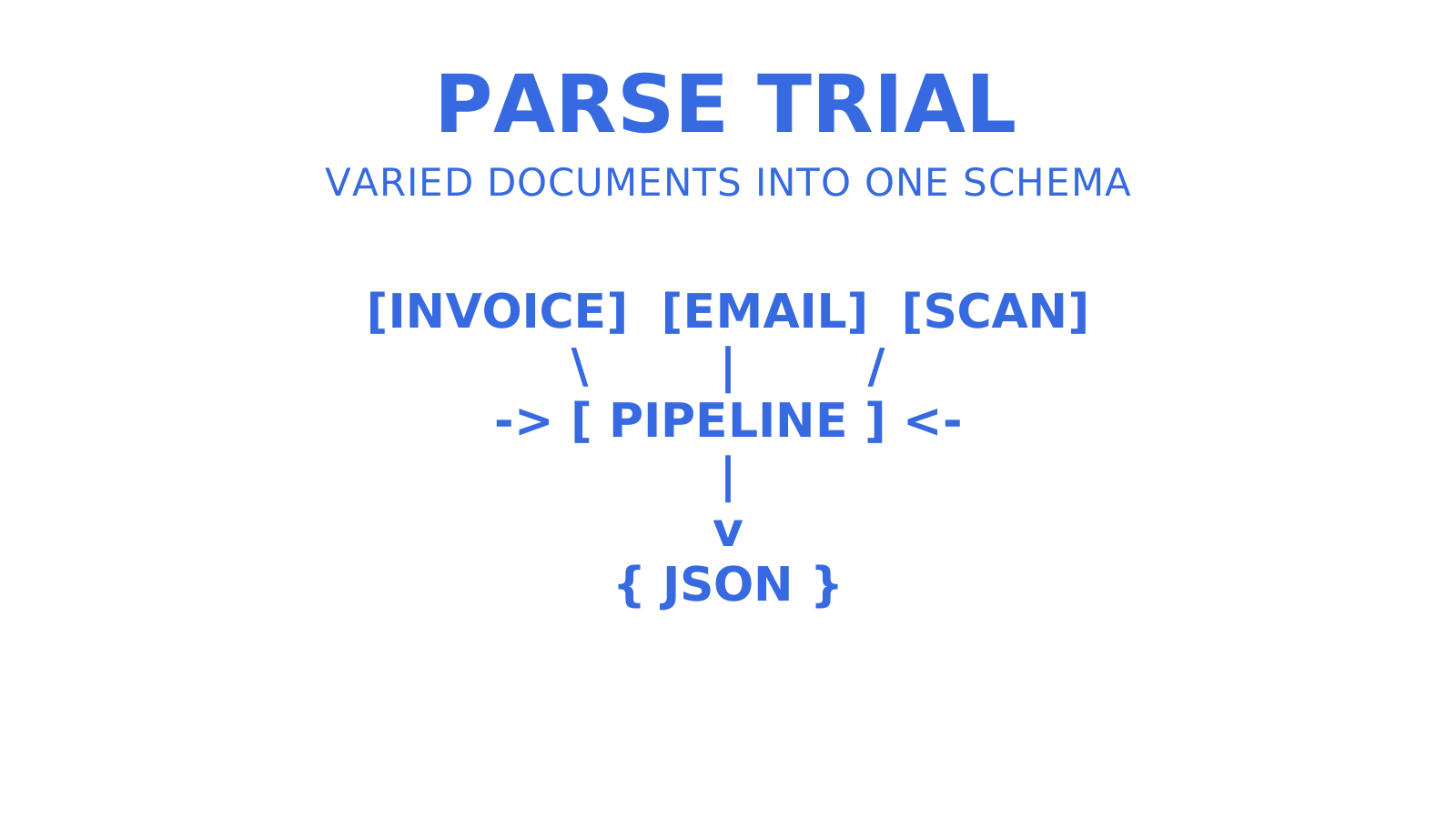
For teams building agent-native or high-volume extraction pipelines, Sendmux is the strongest starting point among Parseur alternatives, thanks to persistent agent mailboxes, scoped API keys, and webhook-driven delivery of schema-friendly JSON. Two other categories are worth trialling alongside it: AI-native platforms like LlamaParse and LandingAI, which skip templates entirely, and enterprise trainable-model suites like Nanonets and ABBYY FlexiCapture for compliance-heavy document ops. What follows compares them on the axes that actually matter for a production pipeline, then gives you a trial checklist you can run in under two weeks.
TL;DR
- Sendmux excels for pipelines requiring persistent agent mailboxes, with secure, scoped API keys and real-time webhook delivery, but it does not perform OCR or document parsing itself.
- For stable, recurring document layouts, Docparser offers a quick, low-cost zonal OCR solution, while enterprise users with compliance needs should consider ABBYY FlexiCapture.
- AI-native platforms like LlamaParse and LandingAI handle new layouts without templates, making them ideal for high-turnover sources, but may require more setup for complex documents.
- Conduct a two-week proof of concept by testing with representative documents, enforcing schema validation, and validating error handling before scaling.
- Choose a tool based on schema enforcement, AI vs template approach, language support, throughput, API maturity, integration options, and pricing structure to match your specific pipeline needs.
Table of Contents
- Parseur alternatives compared: which tool fits which job?
- What each tool actually does well (and where it falls short)
- How to choose the right Parseur alternative
- Why teams look for Parseur alternatives
- Who’s behind this comparison
- Try Sendmux inbox: run a short proof of concept
- Rolling out a new extraction pipeline without breaking production
- Sources
- FAQ
Parseur alternatives compared: which tool fits which job?
Nine tools cover most of what teams reach for when Parseur’s templates stop scaling. The shortlist runs from agent-native mailboxes through to zonal-OCR veterans and pre-trained financial extractors, and no single one wins on every axis.
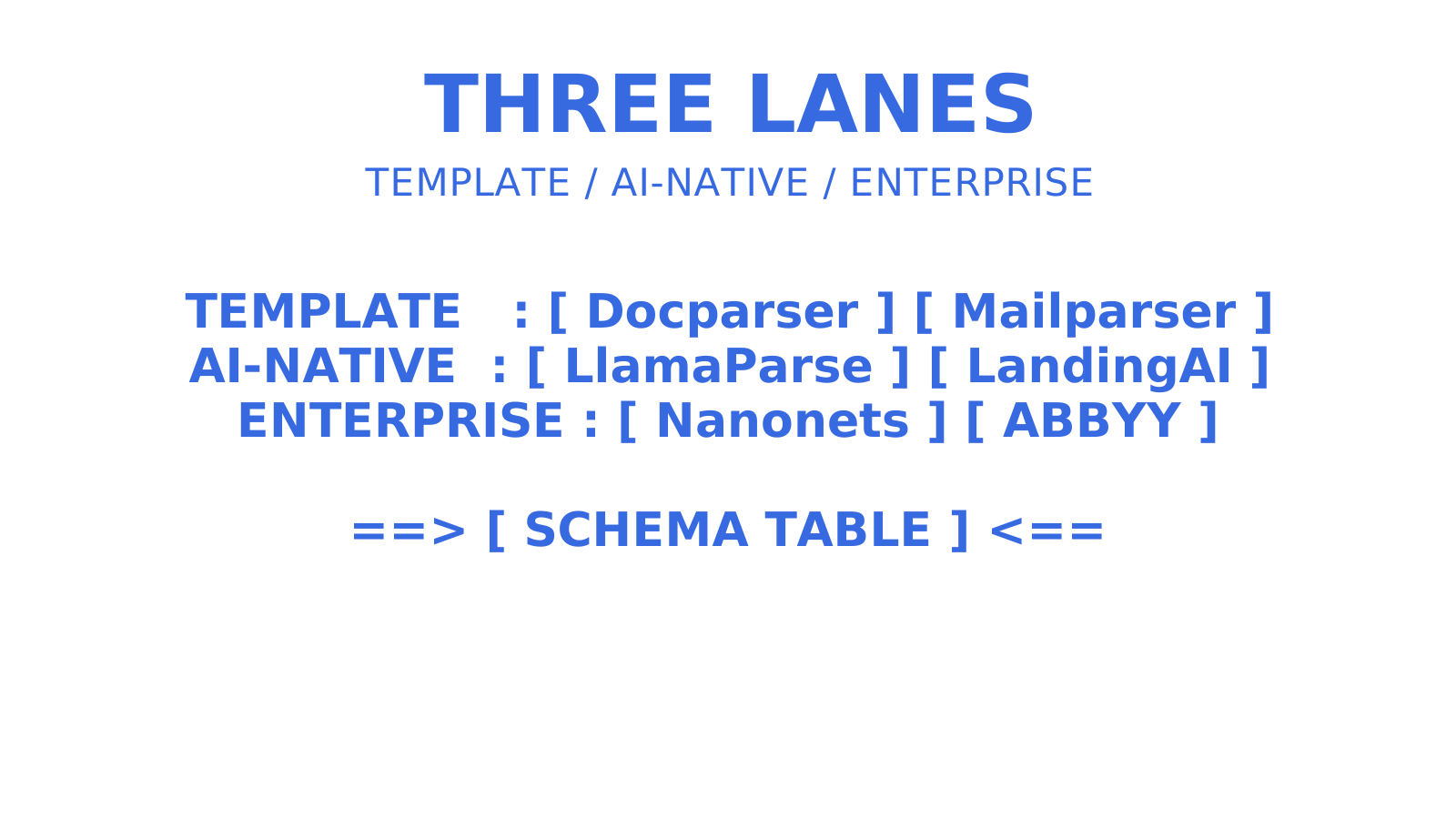
Sendmux inbox leads this list because it solves a problem the others don’t touch: giving an agent or pipeline its own persistent, addressable mailbox rather than a one-shot parsing endpoint. Docparser and Mailparser are the template-based incumbents, strong on predictable layouts. Nanonets and ABBYY FlexiCapture target enterprise document operations with trainable models and review workflows. LlamaParse and LandingAI represent the AI-native wave, built to handle a document on first upload with no template setup. Text Blaze is a lightweight snippet tool that shows up in some comparisons but solves a narrower problem. DocuClipper specialises in financial documents with direct pushes to QuickBooks and Xero.
| Tool | Best for | Pricing shape | AI-native vs template | OCR/handwriting | Developer APIs | Native integrations |
|---|---|---|---|---|---|---|
| Sendmux inbox | Agent-native workflows, developer-first integrations | Usage-based, no per-seat fees | AI-adjacent, schema-driven mailbox outputs | Not a parsing engine | Full REST, SMTP, SDKs, MCP | LangChain, Vercel AI SDK, webhooks |
| Docparser | Stable scanned PDFs, recurring layouts | Tiered subscription | Template-based | Zonal OCR | Yes | Zapier, common business apps |
| Mailparser | High-volume structured email | Tiered subscription | Rule-based | None (no image or scanned-document OCR) | Yes | Zapier, webhooks |
| Nanonets | Complex or custom formats needing training | Credit/run-based | Trainable AI | OCR incl. signature and barcode detection | Yes | ERP and workflow tools |
| ABBYY FlexiCapture | Enterprise capture, compliance | Enterprise contract | Template + AI hybrid | Enterprise-grade OCR and ICR incl. handwriting | Yes | On-premises or cloud deployments |
| LlamaParse | AI-first, no-template extraction | Usage-based | AI-native | Varies by document | Yes | Developer-oriented |
| LandingAI (Extract) | Long, complex documents, nested tables | Usage-based | Schema-driven AI-native | Strong on structured docs | Yes | Cloud, on-premises or virtual private deployment |
| Text Blaze | Lightweight text automation | Low-cost tiers incl. free | Template-driven | None | Limited | Browser-based snippets |
| DocuClipper | Financial documents, accounting pushes | Tiered subscription | Pre-trained models | Financial-document OCR | REST API, webhooks, MCP | QuickBooks, Xero |
If your pipeline needs an agent to receive, hold, and act on inbound documents over time, not just parse a single upload, Sendmux is the only entrant built around that job. If your documents are stable and scanned, Docparser’s zonal OCR still does the job cheaply. Enterprises with compliance requirements gravitate to ABBYY FlexiCapture or Nanonets, while finance teams doing accounts payable at volume lean toward DocuClipper for the accounting handoff.
What each tool actually does well (and where it falls short)
Sendmux inbox gives every agent, workspace, or document stream a real, persistent mailbox rather than a webhook that fires once and forgets. Inbound mail arrives as cleaned message text with quoted history stripped, attachments come through as base64 or presigned links, and mailbox-scoped API keys (smx_mbx_) mean a compromised credential exposes one mailbox, not the whole team. Retrieval endpoints filter on sender, subject, date range, and attachment presence, and a sync endpoint hands back state tokens so an agent polls for changes instead of re-listing everything. The limitation: it’s an email and mailbox layer, not an OCR or document-classification engine, so if your source data is scanned paper rather than structured mail or attachments, you’ll still pair it with an extraction step upstream.
Docparser runs on zonal OCR and layout rules, which makes it fast and cheap on scanned PDFs and recurring shapes like fixed-format invoices. The limitation shows up the moment a vendor changes their invoice template, since every layout needs its own rule set maintained by hand.
Mailparser parses structured emails using filtering rules rather than OCR, which suits high-volume formats like order confirmations or shipping notices. It struggles with anything that isn’t a well-behaved email body.
Nanonets trains custom models on your documents and adds a staged review-and-approve workflow, useful when a human needs to sign off before data hits production. Pricing tends to run credit or per-run based, which can get expensive at high volume without careful monitoring.
ABBYY FlexiCapture is the enterprise veteran, with deep OCR, handwriting recognition through ICR, and on-premises or cloud deployment for teams that can’t send documents to a public cloud. It comes with enterprise-grade complexity and pricing to match.
LlamaParse targets teams wanting zero-template, AI-first extraction, handling a new layout without configuration. As an emerging platform, its ecosystem of integrations and enterprise tooling is still thinner than the incumbents.
LandingAI’s Extract emphasises schema-driven structured output with traceability, tracing every extracted value back to its exact location in the source document, which matters for audits. It’s built for genuinely complex, long documents, so it can be more setup than a simple one-page receipt needs.
Text Blaze is a snippet and lightweight automation tool that occasionally appears on Parseur-alternative lists, but it solves text expansion, not document parsing at scale.
DocuClipper ships pre-trained financial extractors that skip template building entirely and push straight into QuickBooks or Xero, which removes a chunk of integration work for accounts payable teams. Outside financial documents, it’s not built to generalise.
How to choose the right Parseur alternative
Run the evaluation on concrete engineering criteria, not vendor marketing copy. Score each candidate against:
- Schema enforcement — does the output conform to a fixed schema, or can field names and types drift between runs?
- AI-native vs template-based — AI-native tools handle new layouts on first upload, while template systems need manual configuration for every new document shape.
- OCR and language support — check handwriting support and multi-language coverage against your actual document mix, not a demo sample.
- Throughput and latency — measure time-to-result under your real document sizes, not a vendor’s clean test PDF.
- API and SDK maturity — look for versioned SDKs, webhook signing, and rate limits documented in public API references.
- Integration options — native pushes to your accounting, CRM, or workflow tools save real engineering hours.
- Pricing model — usage-based, per-seat, or per-run, and whether that shape matches your volume curve.
Pro Tip: Run your POC with the ugliest documents in your queue, not the cleanest ones. A tool that handles a pristine sample invoice tells you nothing about how it copes with a skewed scan or a vendor who changed their template last month.
For the trial itself, run a 7 to 14 day proof of concept: upload 20 to 30 representative documents, assert the output schema with unit tests against the API response, wire up webhooks and confirm delivery under retry conditions, measure error rate per document type, check logs for silent failures, test how the tool handles a document type it hasn’t seen before, and confirm pricing at your expected monthly volume before committing.
Red flags to walk away from: no schema guarantee on output, pricing that’s opaque until you’re mid-invoice, no developer API or SDK, and no review or validation interface for a human to catch mistakes before they hit production.
Why teams look for Parseur alternatives
Template maintenance is the most common trigger. Every layout change from a vendor or customer means someone manually rebuilds a rule set, and that cost compounds as document sources grow. AI-native extraction avoids this by handling unfamiliar layouts without pre-built templates, which is why teams with high document-source turnover move toward LlamaParse or LandingAI.
Other teams move because they need auditable, schema-enforced JSON flowing into downstream systems. Prompt-based extraction without schema enforcement causes output drift that breaks pipelines quietly. Some searches for “Parseur alternative” actually mean an order-capture or integration-automation tool rather than another parser, so it’s worth confirming which job you’re actually replacing before you shortlist.
Who’s behind this comparison
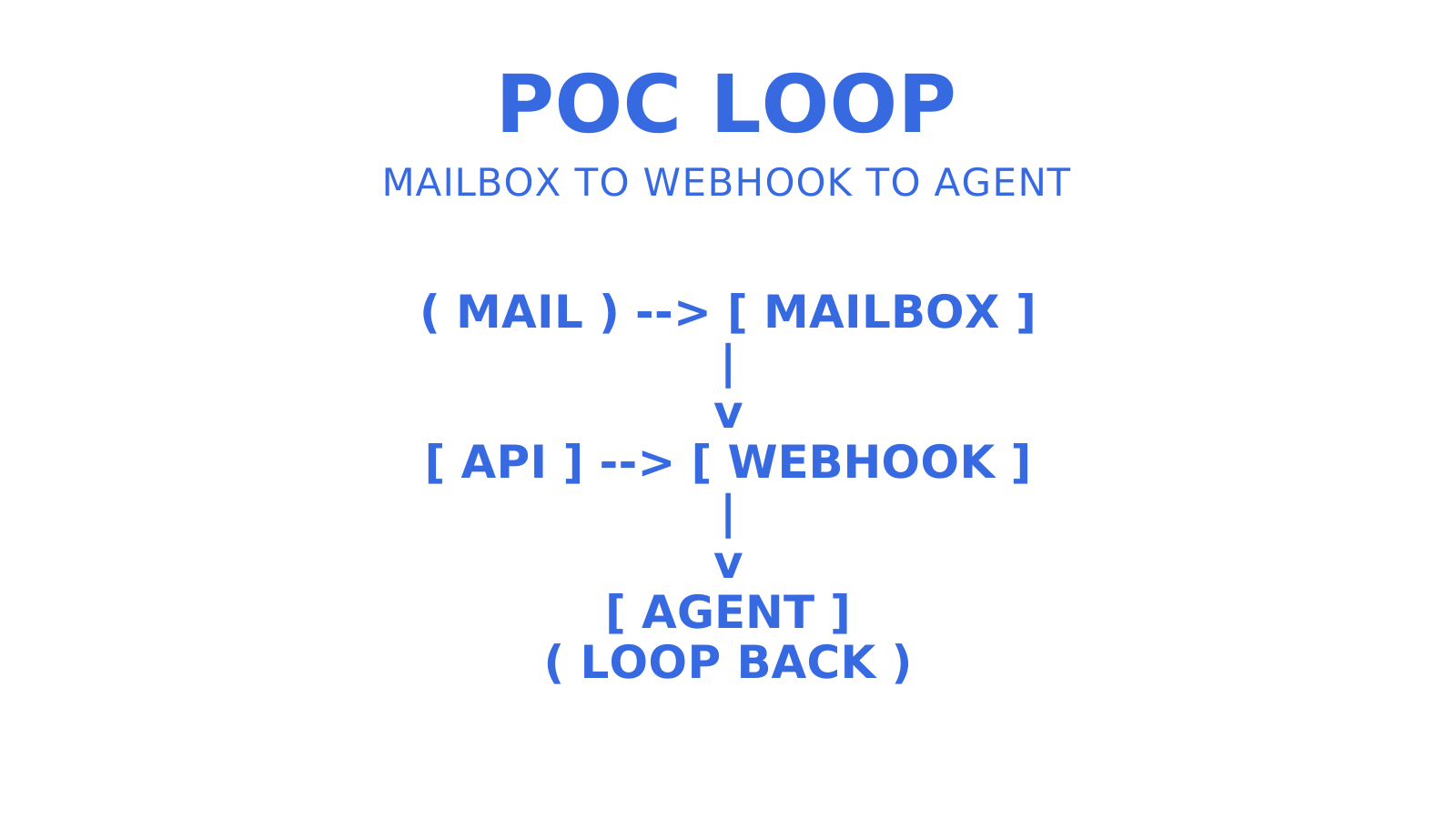
myagent.mx is the sign-up surface for Sendmux, the email API built for AI agents. Sendmux’s relevant capabilities here are concrete: persistent mailboxes per agent or entity, mailbox-scoped API keys, real-time delivery through Server-Sent Events or signed webhooks, and structured access to message data through a documented Mailbox API.
Sendmux is a direct alternative when your workflow needs an agent to own an inbox over time, receiving, threading, and replying to mail as part of a longer-running workflow. A dedicated parser like Nanonets or LandingAI is the better pick when the core job is extracting structured fields from a static batch of scanned documents with no ongoing mailbox relationship involved.
Try Sendmux inbox: run a short proof of concept
Sendmux gives developers a real mailbox, not a webhook that fires once and disappears. Every agent or workflow gets its own address on the included domain, scoped API keys for send, receive, and read permissions, and delivery through webhooks or a Server-Sent Events stream for clients that can’t host a public endpoint.
A short POC looks like this: create a mailbox through the Sendmux inbox sign-up flow, forward or send a batch of representative documents into it, pull messages through the Mailbox API and confirm attachments and body text arrive cleanly, wire a webhook and check signed delivery under retry conditions, and measure latency from send to webhook fire. Billing runs on accepted recipients and inbound deliveries rather than per-seat fees, so a small pilot costs little to run. For a deeper look at how agent-native mailboxes compare against other developer email approaches, the AgentMail alternatives comparison is a useful next read before you commit engineering time.
Rolling out a new extraction pipeline without breaking production
Start narrow. Pick three to five representative document types and a single downstream consumer, not your whole document fleet at once. Enforce schema checks on every extracted output, log raw inputs so you can debug silently failing cases, and keep a human-review fallback for anything that fails validation. Only expand to new document types once your automated error rate stays below an agreed threshold for a full week, not a single lucky batch.
Sources
- AI data extraction (Box blog)
- Agentic APIs incl. Extract — LandingAI
- The Best Parseur Alternatives - 2026 Comparison — Parseur
FAQ
What is the best AI tool for data extraction?
The best tool depends on your document mix. Teams needing agent-native mailboxes and schema-friendly JSON output tend to trial Sendmux first, while those with complex, static document layouts often lean toward AI-native platforms like LlamaParse or LandingAI, which handle new layouts without pre-built templates.
What is the best PDF parsing software?
For stable, scanned PDFs with predictable layouts, Docparser’s zonal OCR approach remains a solid, low-maintenance option. For complex, long-form PDFs with nested tables, LandingAI’s schema-driven extraction handles more structural variation.
What is Parseur’s pricing?
Parseur’s current pricing is published on its own site and not something this article can quote reliably given how often vendor tiers change. Check Parseur’s pricing page directly for current tiers before comparing it against usage-based alternatives.
How much does Docparser cost?
Docparser runs on tiered subscription pricing rather than usage-based billing, with tiers scaling by document volume and parsing rules. Exact current rates are published on Docparser’s own pricing page rather than fixed here, since subscription tiers shift over time.
Is Sendmux a replacement for a document parser?
Sendmux is a replacement when your workflow needs a persistent, addressable mailbox for an agent or entity, not a one-off document parse. Sendmux publishes its pricing: a free tier and a $7-per-team monthly Pro plan plus usage, with no per-seat or per-mailbox fees on either plan, and it’s best paired with a dedicated parser like Nanonets when the core job is field extraction from static scanned batches.
Give an agent its own address
Sendmux is the Email Inbox API for AI Agents.