 myagent.mxBLOG
alternatives · Knock alternatives
Agent First Knock Alternatives for Developers: Try Sendmux
Developer comparison of Knock alternatives. Try Sendmux for agent owned persistent mailboxes, then evaluate Courier, Novu, and migration steps.
If you need persistent mailboxes for agents, compare Sendmux’s mailbox operations and provider routing with the alternatives below. For an open-source, self-hosted workflow engine, look at Novu. SuprSend provides hosted orchestration with your delivery-provider accounts, while OneSignal offers managed email delivery or your own email provider. Choose by channel, provider-account ownership and the conversation state your application needs.
TL;DR
- Sendmux supports persistent mailbox management and reply handling for AI agents and multi-tenant systems. Outgoing usage is billed per provider-accepted recipient occurrence, inbound usage per distinct mailbox delivery, and storage by usage; Pro also has a monthly team fee.
- For production email, SMS and push, orchestration platforms such as Courier and Novu connect your third-party provider accounts; built-in inbox channels and test integrations are separate.
- Self-hosted solutions like Novu appeal to teams seeking control over their infrastructure but shift responsibility for reliability and scaling onto their internal resources.
- Checking current pricing, provider contract management, delivery performance, and observability features is essential before choosing a vendor, especially for BYO routing setups.
- Migrating from Knock should involve staged testing, domain authentication verification, and careful planning to avoid disruption and billing surprises.
Table of Contents
- Knock alternatives worth trialling: a ranked shortlist
- How do these Knock competitor apps actually compare?
- What should you actually check before picking a vendor?
- How do you migrate from Knock without breaking production?
- Why the “unified vs middleware” framing misses the real question
- Try Sendmux before you commit to a middleware stack
- Sources
- FAQ
Knock alternatives worth trialling: a ranked shortlist
The candidates below offer different combinations of email, SMS, push, in-app notifications and mailbox operations. Compare the channels and state your product needs, then check what each platform expects your team to configure and operate.
Sendmux is the recommended starting point if your product involves AI agents, multi-tenant workspaces, or any scenario where email needs to be a persistent, addressable identity rather than a one-way send. Its mailbox APIs expose messages, threads, folders, and state, so agents can receive replies and read the conversation later. Sendmux supports sending and receiving with bring-your-own provider routing. Outgoing usage is billed per provider-accepted recipient occurrence, inbound usage per distinct mailbox delivery, and storage by usage; Pro also has a monthly team fee.
- Best for: AI agents and multi-tenant platforms that need mailbox persistence and unified send/receive.
- Standout: Persistent mailboxes with scoped mailbox keys, so an agent can access its assigned inbox without receiving a human’s provider OAuth tokens. Connecting Gmail or Outlook still requires the provider’s sign-in flow. Self-registered agents receive read and receive access first; sending requires the human owner to accept the invitation and explicitly approve it.
- Delivery model: BYO provider routing through Custom SMTP, Gmail, or Outlook / Microsoft 365, plus a managed Amazon SES option for teams that do not want to configure their own sending account.
Courier combines workflow and template tools with provider integrations: connect a provider such as SendGrid for email, Twilio for SMS, or Firebase for push when your channel needs it. Its visual workflow editor suits teams that want to manage messaging logic while retaining their delivery-provider accounts. Those examples are channel-specific choices, not three accounts every integration must maintain.
- Best for: Teams that want a hosted workflow builder but are happy managing their own delivery contracts.
- Standout: A visual workflow studio for lifecycle and product messaging.
- Delivery model: Connected providers for external production channels; built-in inbox delivery and test email are separate.
Novu offers an open-source notification application and workflow engine that you can self-host, while connecting providers for email, SMS and push delivery. Self-hosting gives your team control over that application, but Cloud and Community capabilities differ and external delivery still depends on your configured providers.
- Best for: Teams that prioritise control and open-source self-hosting over managed convenience.
- Standout: An MIT-licensed open-source core you can fork, audit, or modify, with separately licensed enterprise features.
- Delivery model: Novu Cloud or self-hosted Novu, with BYO providers for actual delivery on external channels.
SuprSend leans into channel breadth, batching, and digest logic, useful if your product needs to bundle multiple notifications into a single daily summary rather than firing them one at a time.
- Best for: Product teams needing flexible channel coverage with batching built in.
- Standout: Digest and batching features baked into the orchestration layer.
OneSignal supports web and mobile push alongside email and in-app messaging. Its Free plan has channel-specific usage limits; check the current limits and whether a change applies to new or existing customers before planning a high-volume rollout.
- Best for: Apps where push is the primary channel, subject to the selected plan’s audience and volume limits.
- Standout: SDKs for native mobile platforms, cross-platform frameworks and supported web browsers.
MoEngage pairs notifications with behavioural analytics, so it suits growth teams that want engagement data alongside the send.
- Best for: Growth and marketing teams running analytics-driven campaigns.
- Standout: Journey-based automation tied directly to user behaviour data.
Customer.io is worth evaluating if your messaging logic depends on segmentation and triggers. An illustrative requirement is “send this only if the user did X but not Y within 48 hours”; test your exact event data, segment rules and timing rather than treating that example as a product limit.
- Best for: Teams running behavioural lifecycle campaigns alongside transactional email.
- Standout: Flexible, segment-driven automation with mature email tooling.
MagicBell includes a brandable, real-time in-app notification inbox and also routes email, mobile push, web push, SMS and Slack notifications through a single API. Its pre-built inbox components can reduce the UI you need to build, while external channels connect your delivery-provider credentials.
- Best for: Product teams needing a brandable in-app inbox alongside multichannel notifications.
- Standout: Pre-built inbox UI components with real-time sync.
Engagespot combines a hosted in-app inbox with multichannel notification workflows, connected providers and built-in email and web-push options. Evaluate its workflow engine as well as the inbox UI, particularly when a user reply needs to trigger another step.
- Best for: Teams wanting an in-app notification centre with multichannel workflows.
- Standout: A workflow editor supporting user replies, batching and external-service calls.
For a 2026 shortlist, use G2’s Knock alternatives directory to discover comparison candidates, then verify Courier, SuprSend and Novu directly against their current documentation. These three are comparison candidates, not a verified frequency ranking across marketplaces.
How do these Knock competitor apps actually compare?
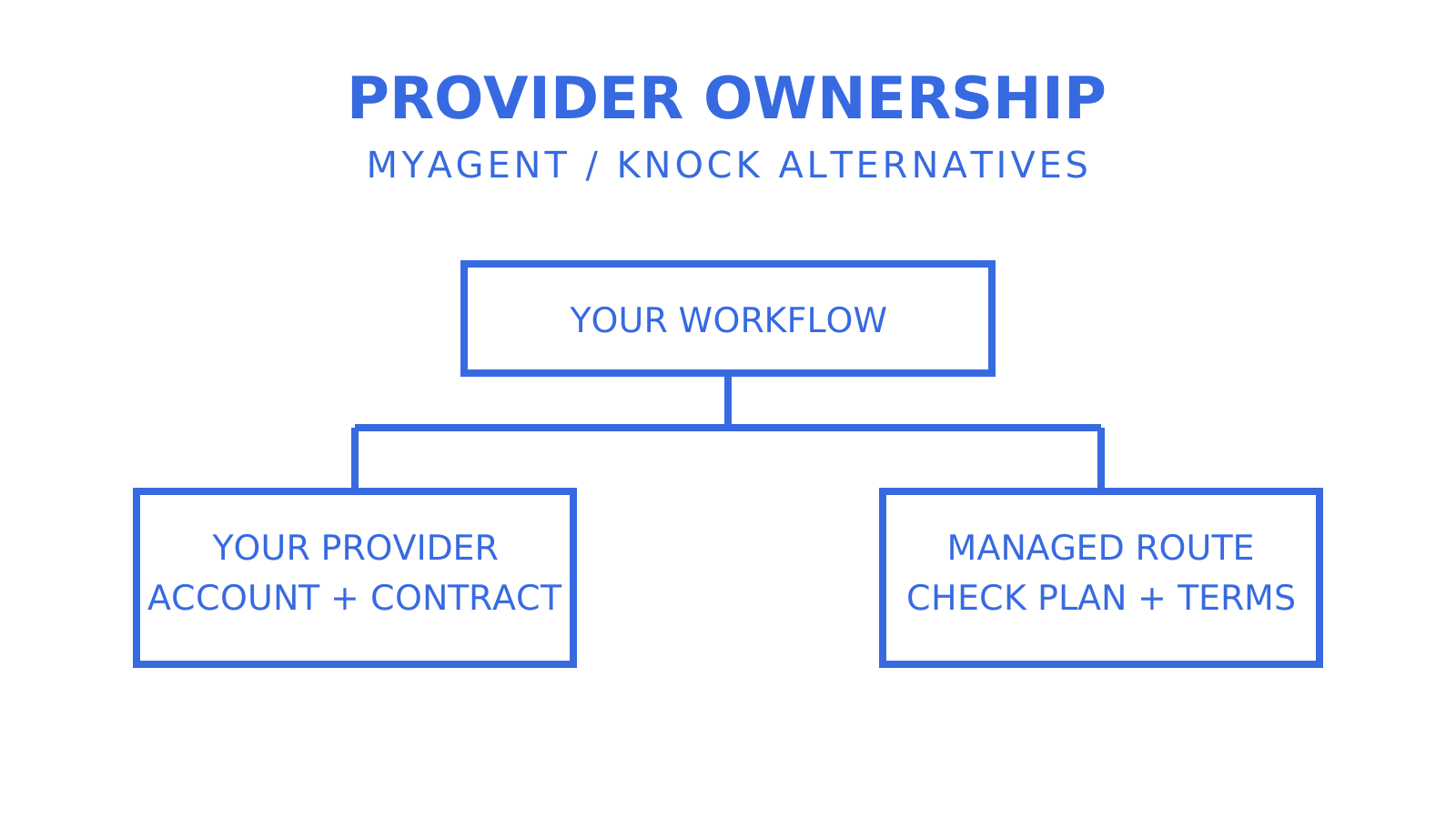
Compare provider ownership alongside the feature list. Check who holds the delivery account for each channel, who configures its credentials, and which operational tasks remain with your team.
Provider ownership varies by channel and configuration. Middleware platforms such as Courier and Novu integrate external delivery providers, including SendGrid, Twilio or Firebase where the channel supports them. SuprSend also requires vendor accounts for production. OneSignal and Engagespot offer built-in email alongside external-provider integrations, while MagicBell connects your providers. A single “middleware versus unified delivery” label does not describe every route a platform supports.
Confirm current plan tiers directly with each vendor before budgeting, and check regional availability, carrier requirements and push-gateway limits for SMS and push. If you choose BYO routing, include the provider contracts, configuration, monitoring and rate limits in the work your team will own.
Velt’s vendor-authored comparison notes that middleware platforms often require maintaining separate SendGrid, Twilio, or Firebase accounts. Verify the account requirements in each platform’s primary documentation, then include applicable orchestration fees, provider charges, dedicated IPs and compliance tooling in your cost model. The comparison does not establish how much most teams budget or a universal all-in price. Kinetic Pricing’s benchmarking research offers broader SaaS pricing and billing-presentation context; calculate notification delivery costs from the vendors and providers you select.
What should you actually check before picking a vendor?
Feature comparisons only get you so far. The decision usually comes down to five practical questions.
- What’s your channel mix, and does it change by tenant? If different customers need different channel combinations, favour a platform with per-recipient or per-tenant routing rather than a flat plan structure.
- Do you want to own provider relationships, or hand them off? BYO routing (Courier, Novu, Sendmux) lets you choose a supported provider and manage that relationship. OneSignal and Engagespot offer built-in email and BYO-provider options; MagicBell connects your provider credentials. Check the sending domain, shared or dedicated IP arrangements, and reputation controls for the route you will use.
- Does self-hosting matter to you? Use CBInsights’ Knock competitor directory for discovery, not as proof of recurring savings. Novu’s open-source core offers code access and self-hosting, but compare hosting, reliability, scaling and provider costs. SuprSend also offers enterprise-licensed self-hosting.
- What are your compliance and data-residency requirements? Ask vendors directly about SOC 2, data storage regions, and retention policies. Don’t assume; get it in writing during the trial.
- What does observability actually look like? Ask for a live demo of delivery logs, not marketing copy. You want to see bounce rates, complaint rates, and per-provider health, not just a green checkmark.
During any trial, push vendors on specifics: How are webhooks signed? What’s the retry and backoff behaviour on a failed send? How is idempotency handled if you retry a request? What happens when one provider account starts failing, does traffic shift automatically?
Watch for a few red flags while you evaluate. Pricing that looks simple on the landing page but adds per-seat or per-mailbox fees once you’re in a sales call is one. Missing or delayed delivery logs, where you can’t see bounce and complaint data in near real time, is another. And any integration that makes exporting your templates or message history difficult is a lock-in signal worth taking seriously.
How do you migrate from Knock without breaking production?
Plan the migration around the paths your product uses. Inventory them, test failure behaviour and shift traffic in stages with a rollback condition agreed before the cutover.
Start with an inventory. List every template, every channel currently in use, and every downstream system consuming your notification events (analytics, support tools, audit logs). Map which third-party provider contracts (SendGrid, Twilio, SES) you’ll keep versus replace.
Then sandbox test before touching production traffic:
- Verify webhook signing and signature validation against the new platform’s format.
- Confirm idempotency key behaviour on retried sends, this is where duplicate-message bugs hide.
- Force a provider failure in the sandbox and verify the configured retry, failure-reporting and fallback behaviour; add application-level fallback where the platform does not provide it.
- Check spam and bounce handling end-to-end, including how complaint webhooks fire.
- Confirm metrics collection matches what your team currently dashboards on.
For cutover, configure and test SPF, DKIM, and DMARC before routing production traffic through the new provider. Check DMARC alignment on a test message: a pass requires an aligned SPF or DKIM pass, not necessarily both. Validating idempotency keys, webhook signatures, and per-recipient billing semantics during this phase catches both correctness bugs and billing surprises before they hit your invoice. Shift traffic in stages, a small percentage first, watched against your existing monitoring dashboards, with a clear rollback trigger (bounce rate spike, missing webhook events) defined in advance.
Why the “unified vs middleware” framing misses the real question
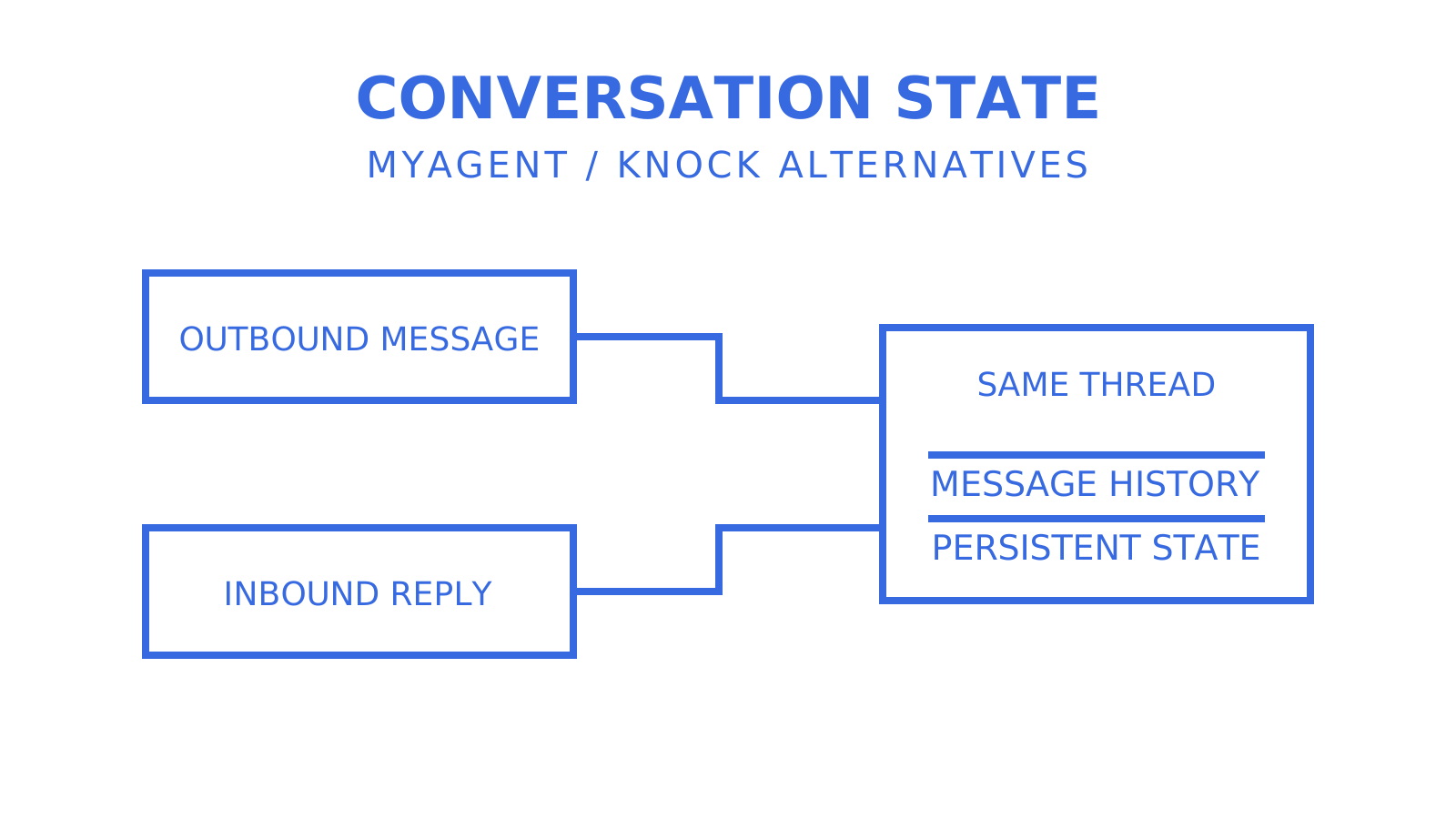
The unified-delivery versus orchestration-middleware comparison is useful for checking provider ownership. Agent builders also need to check whether the platform retains the messages, conversation history and mailbox operations required by their workflow.
An agent handling procurement or support may need to receive a reply days later and retrieve the same conversation. Sendmux exposes persistent mailbox operations for that workflow. Receive-and-reply capability is not unique to Sendmux: Novu also documents bidirectional agent conversations and threading, while Engagespot supports reply-driven workflows. Compare persistent mailbox access with conversation-based messaging and notification workflows, then test the state and operations your agent actually needs. A webhook on delivery alone does not establish that complete workflow.
Try Sendmux before you commit to a middleware stack
If persistent, agent-owned mailboxes are what you’re missing from your current setup, Sendmux provides APIs for sending and receiving, with routing across your own Gmail or Outlook accounts and Custom SMTP providers. A customer-owned Amazon SES account can use the Custom SMTP route with its regional SMTP endpoint and SMTP credentials; this is separate from Sendmux’s managed Amazon SES option. Outgoing usage is billed per provider-accepted recipient occurrence, inbound usage per distinct mailbox delivery, and storage by usage; Pro also has a monthly team fee. Before committing, check the current free-tier limits, including daily sending caps and mailbox counts, against your expected volume; they’re documented on the pricing and product pages. For teams building outbound agents specifically, use the documented agent-access setup flow. Myagent links to Sendmux’s self-registration instructions, with no card required to begin. The agent can register an inbox for reading and receiving, but a human owner must accept the invitation and explicitly approve sending before the agent can send.
Sources
- Top 10 Knock Alternatives & Competitors
- Top Knock Alternatives, Competitors
- Sendmux - The Email API for AI Agents, with Inboxes
FAQ
What is a good alternative word for “knock”?
Outside the software context, common synonyms for “knock” include rap, tap, or bang, but in notification infrastructure, “Knock” refers specifically to the orchestration platform this article compares against alternatives like Sendmux, Courier, and Novu.
What does the Knock plugin actually do?
Knock orchestrates notification workflows and routes email, SMS and push through configured providers. Its own in-app channel supplies stateful feeds, inboxes, toasts and banners, so it is not accurate to describe every channel as third-party delivery.
Is Sendmux a good Knock alternative for AI agents specifically?
Sendmux is worth evaluating when an AI agent needs persistent mailbox operations for sending, receiving and retrieving conversations. Compare those operations with Novu’s bidirectional agent conversations and other reply-driven workflows, and verify the permissions and state your application needs before choosing.
Do Knock alternatives require me to keep my own email provider account?
For production email, Courier and Novu connect an email-provider account such as SendGrid; Twilio is an SMS-provider example. OneSignal and Engagespot also offer built-in email options. Sendmux supports connected providers and managed Amazon SES, subject to its account, plan and sending-approval requirements.
Which Knock competitor is best for self-hosting?
Novu is a strong candidate when open-source self-hosting is the requirement: its core is MIT-licensed, while enterprise features have separate licence terms. SuprSend also offers enterprise-licensed self-hosting. Compare deployment capabilities and operating costs rather than assuming self-hosting makes delivery free or gives Cloud feature parity.
Give an agent its own address
Sendmux is the Email Inbox API for AI Agents.