 myagent.mxBLOG
alternatives · gmail api alternatives
5 Gmail API Alternatives for Developers When Agents Need an Inbox
Five Gmail API alternatives for developers building AI agents, plus a migration checklist for auth, threading, MIME and deliverability.
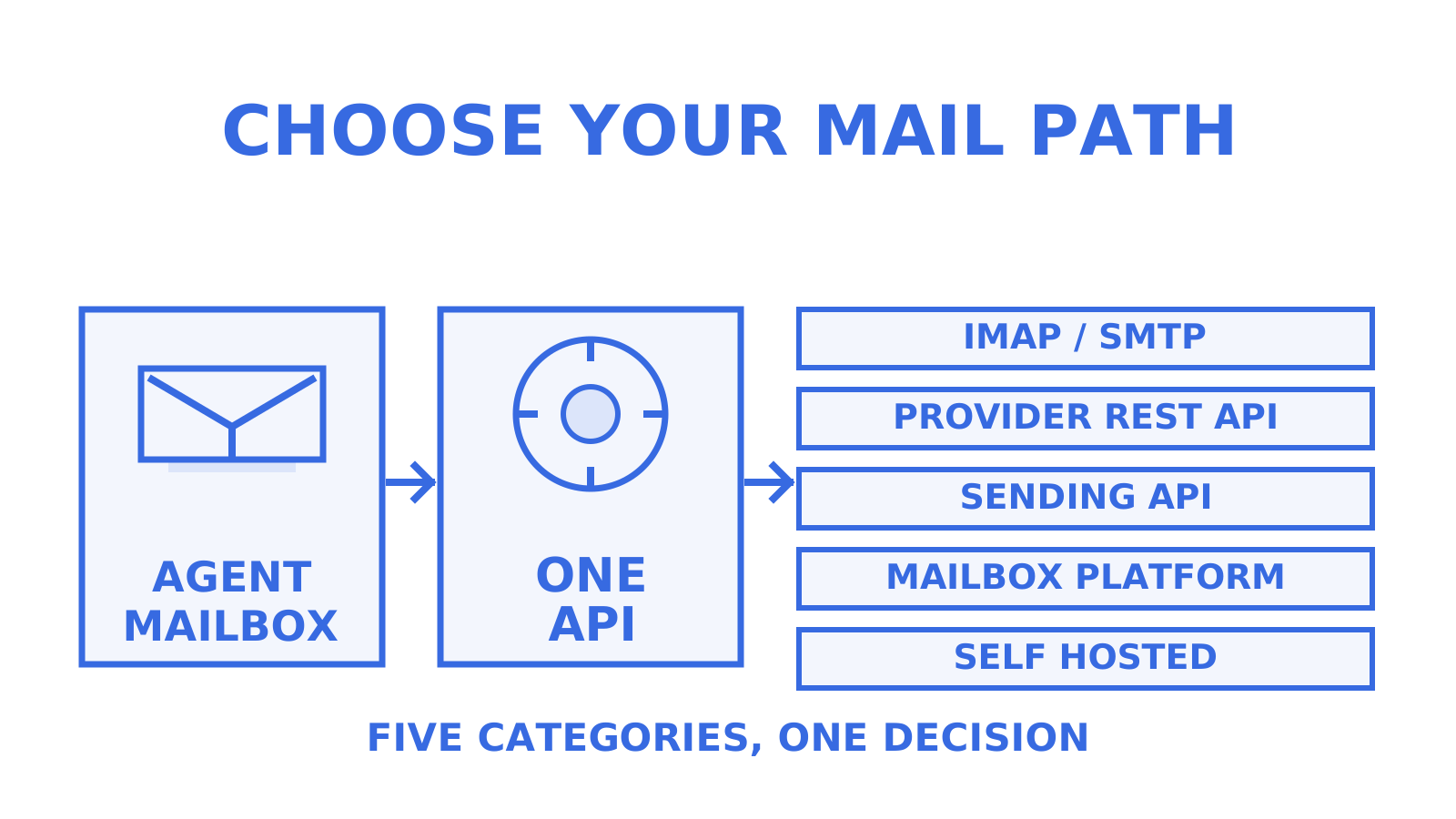
The practical alternatives to the Gmail API fall into five categories: IMAP/SMTP, other provider REST APIs, transactional sending APIs, mailbox-first agent platforms, and self-hosted mail servers. Each trades portability against feature parity and operational effort. Picking one depends on whether you need broad compatibility, deep Gmail-specific features, or a mailbox built for an agent rather than a person.
TL;DR
- Using IMAP or SMTP for Gmail offers broad compatibility but requires managing connection states, OAuth tokens, and MIME encoding manually.
- Provider REST APIs like Microsoft Graph provide richer features but necessitate custom integrations, lacking cross-provider consistency.
- Transactional APIs excel at outbound delivery and analytics but do not support inbox reading, threading, or search functions.
- Mailbox-first platforms deliver persistent inboxes with threading and event handling, ideal for managing multiple agents or mailboxes efficiently.
- Proper setup of authentication, MIME headers, and monitoring is essential to ensure stable, compliant email integration.
Table of Contents
- What each category of Gmail API alternative actually gives you
- Which alternative fits your product’s needs
- Getting the integration right: auth, threading, MIME and quotas
- Tooling that shortens the path from prototype to production
- How a mailbox-first platform handles agent-specific requirements
- What actually matters once you move past the prototype
- A ready-made mailbox for agents that need one now
- Where to read more
- Sources
- FAQ
What each category of Gmail API alternative actually gives you
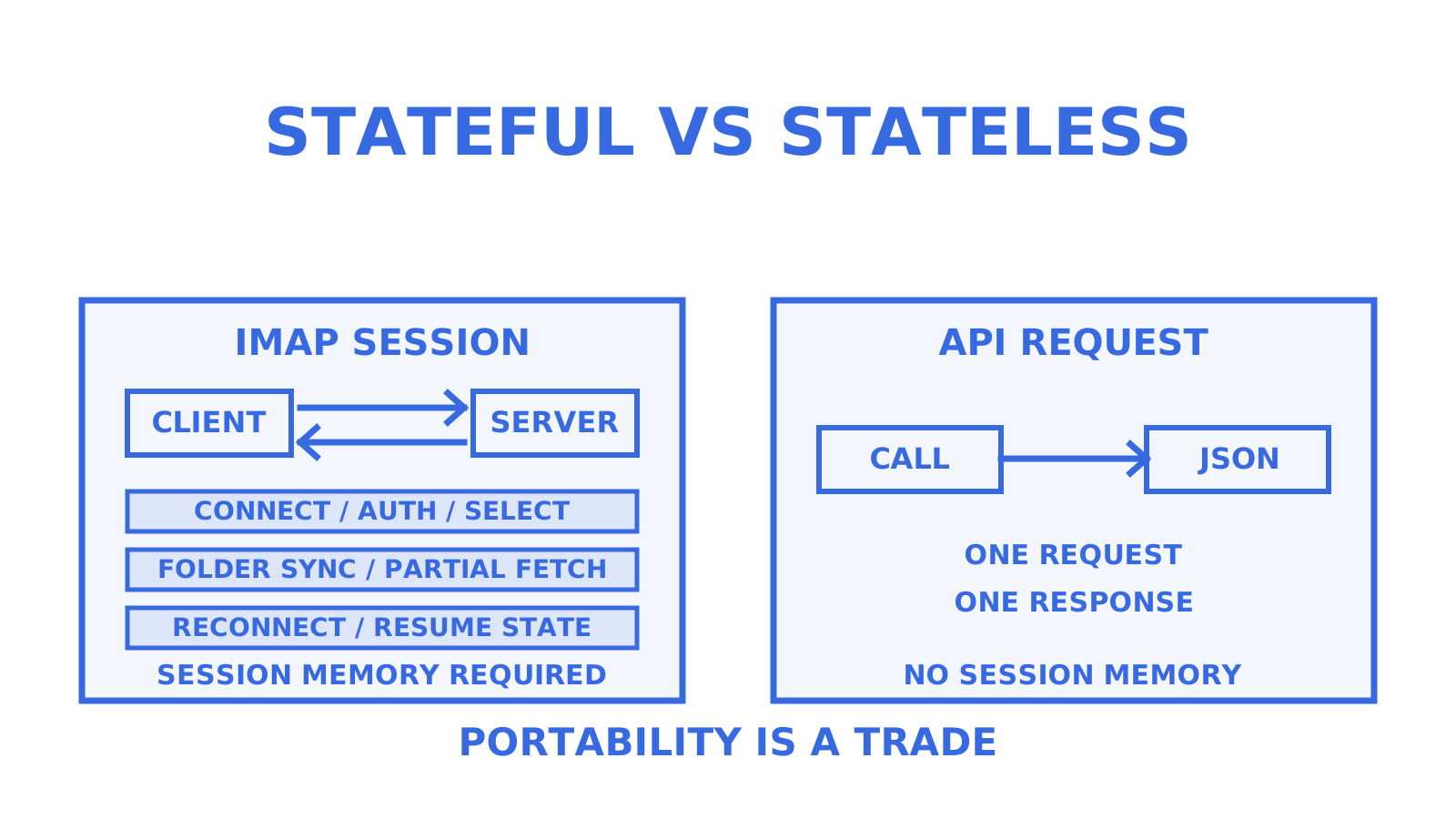
IMAP and SMTP are the oldest options and the most portable. They work against almost any provider, but Gmail’s own IMAP/SMTP documentation makes clear that portability comes with stateful session handling: you manage reconnects, folder sync and MIME parsing yourself, and modern Gmail access over these protocols still needs OAuth 2.0 via SASL XOAUTH2 rather than a plain password for authentication.
Other provider REST APIs, such as Microsoft Graph for Outlook and Microsoft 365, give you richer semantics: native threading, search and label-like structures. The catch is that every provider models mail differently, so you end up writing a provider-specific integration rather than one that generalises.
Transactional sending APIs, including Mailgun, SendGrid and Amazon SES, are built for one job: getting outbound mail delivered reliably at volume. They come with deliverability tooling and analytics, but they were never designed to hold mailbox state, so they are the wrong layer if your product needs to read, thread or search incoming mail.
Mailbox-first agent platforms take a different starting point. Instead of a sending pipe, they give an agent a persistent inbox with real threading, so the agent can read history and reply in context rather than treating every message as a stateless event.
Self-hosted, open-source mail servers such as Postfix and Dovecot give you full control over storage, retention and routing, at the cost of running and securing mail infrastructure yourself, patching, monitoring and scaling included.
- IMAP/SMTP: broadly compatible, but stateful and OAuth-dependent for Gmail access.
- Provider REST APIs: richer per-provider features, no cross-provider consistency.
- Transactional APIs: strong outbound deliverability, no mailbox state.
- Mailbox-first platforms: persistent inboxes and threading built for agents.
- Self-hosted servers: complete control, full operational ownership.
Which alternative fits your product’s needs
Run your requirements against five axes before choosing: inbox persistence, thread fidelity, whether you need multi-provider sending, how much ops capacity you have, and what cost model suits your usage pattern.
- Prototyping a single feature, such as reading one inbox to test a workflow: IMAP/SMTP or a provider REST API is fast enough to start with.
- Shipping a single-provider product where users already live in one ecosystem: the native provider API (Gmail’s or Microsoft Graph) usually gives the best feature match.
- Running many agents or many mailboxes, one per customer, case or workflow: a mailbox-first platform avoids rebuilding threading and state management per integration.
- Sending at high volume with deliverability as the priority: a transactional API earns its keep here, provided you do not also need inbound mailbox state.
Pro Tip: Before committing, write down whether your product needs to remember conversation history across sessions. If the answer is yes, a stateless sending API is the wrong foundation no matter how good its outbound tooling looks.
Getting the integration right: auth, threading, MIME and quotas
The details that break integrations rarely show up in a quick demo. They surface once you are handling real volume, real threads and real failures.
Authentication is the first trap. Gmail’s XOAUTH2 mechanism replaces plain IMAP/SMTP passwords with OAuth tokens, and picking too broad a scope, such as full mail access when you only need to send, creates unnecessary risk and a token lifecycle you have to manage on top of the mail logic itself.
Threading and message construction come next. The Gmail API’s sending guide requires outbound messages to be RFC 2822 MIME, encoded as base64URL, for both messages.send and drafts.send. If you want a reply to thread correctly rather than land as a new conversation, you need to carry over the References and In-Reply-To headers from the original message, something that is easy to get wrong when you are assembling MIME by hand.
Session management is the quieter cost. IMAP is a stateful protocol: you track connections, handle partial syncs, and reconcile history when a client reconnects after being offline. Mailbox APIs that hand back state tokens for delta sync remove that burden, but plain IMAP does not.
- Deliverability depends on correct SPF, DKIM and DMARC records, plus routing and failover across providers when one account degrades.
- Rate limits and batching matter at scale: design for idempotent retries so a network blip does not duplicate a send.
- Duplicate detection and MIME parsing are your responsibility on protocol-based integrations, not the provider’s.
IMAP/SMTP portability is not free. Gmail’s own IMAP/SMTP guidance frames it as a trade: broad compatibility in exchange for session handling, reconnect logic and MIME parsing that a mailbox API would otherwise absorb for you.
Tooling that shortens the path from prototype to production
Most of the friction in switching away from the Gmail API is plumbing, not logic. The tools you pick determine how much of that plumbing you write yourself.
Look for an SDK in your language, an OpenAPI specification you can generate clients from, and a CLI for quick testing without writing code first. These narrow the gap between “it works in a script” and “it works in production”.
Event delivery is the other decision point. Signed webhooks suit backend services that can host a public endpoint and want to verify payload authenticity via an HMAC signature. Server-Sent Events suit clients that cannot expose a public endpoint, streaming inbound events directly to a running process instead.
A typical agent workflow looks like receive, parse, then route: an event arrives, the payload is parsed into a clean message object, and the agent acts on it or hands it to a human. A typical transactional workflow is send, track, then log: a message goes out, delivery status comes back, and the outcome lands in a log you can query later.
- Sandbox environments let you test send and receive flows without touching real recipients.
- Idempotency keys on outbound calls make retries safe after a timeout or dropped connection.
- Batch testing catches MIME and threading bugs before they reach production volume.
How a mailbox-first platform handles agent-specific requirements
An agent needs an inbox, not just a delivery pipe. Sendmux, built for this at Myagent, gives each agent a persistent mailbox with real threading, so an agent reads cleaned message text with quoted history stripped rather than re-parsing raw MIME on every reply.
Access is scoped by design. Mailbox tokens carry only the permissions they need, and an agent can self-register through Sendmux’s agent-facing discovery document, receiving a constrained mailbox before any human joins the team. Sending stays gated behind a human owner’s approval, which keeps control of outbound mail with the person whose name it goes out under.
- Persistent inbox state and threading remove the need to rebuild sync logic per integration.
- Signed webhooks and a Server-Sent Events stream cover both backend and client-side event delivery.
- SDKs, an OpenAPI specification and a CLI cover typical integration and testing workflows.
- A free tier includes starter mailboxes and sending limits before usage-based billing applies.
Pro Tip: If your product’s bottleneck is agents needing an inbox rather than outbound volume, evaluate a mailbox-first platform before reaching for a transactional sending API. The two solve different problems.
Evaluate this category when you are provisioning many mailboxes per customer or per agent instance, not when you need one high-volume sending pipe for a single account.
What actually matters once you move past the prototype
Most teams get the prototype right and the production version wrong, because IMAP looks like a REST API if you squint. It is not. It is a stateful protocol with sessions, partial syncs and reconnection logic, and treating it like a stateless HTTP endpoint is a common mistake in Gmail API migrations.
The migration checklist that actually matters is short: sort out auth and token lifecycle first, get threading headers right second, lock down SPF, DKIM and DMARC third, and put monitoring on delivery and bounce rates last, before you scale. Skip step one and everything downstream is unstable. Skip step three and your mail lands in spam regardless of how clean your code is.
Start with the simplest thing that answers your actual question. Harden it once you know the product is worth the operational cost.
A ready-made mailbox for agents that need one now
If your agent needs its own working inbox rather than another sending pipe to wire up, Myagent gets you there without writing IMAP session handling or MIME assembly yourself. Agents can self-register and hold a working mailbox on the shared @myagent.mx domain in the same session, with no card and no human present for the setup.
Sending stays gated behind a human owner’s approval, so the person accountable for outbound mail keeps that control while the agent reads, searches and threads from day one. Check the Sendmux inbox product overview to see the SDKs, CLI and API docs before you commit to a build.
Where to read more
- Gmail sending guide: MIME and base64URL requirements.
- Gmail XOAUTH2 mechanism: OAuth for IMAP/SMTP.
- Deliverability failure modes: why sending fails silently.
Sources
- Create and send email messages | Gmail | Google for Developers
- OAuth 2.0 mechanism | Gmail | Google for Developers
FAQ
Is there a Google API for Gmail?
Yes, Google publishes the Gmail API as a RESTful interface for reading, sending, organising and migrating Gmail messages. Outbound messages must be RFC 2822 MIME encoded as base64URL for both messages.send and drafts.send.
Why are people looking at Gmail API alternatives?
Teams building multi-tenant products or fleets of AI agents often need mailboxes that are not tied to one person’s Gmail account, plus multi-provider sending and simpler operational handling than raw IMAP/SMTP. Gmail’s own IMAP/SMTP documentation notes that protocol access shifts session management and MIME parsing onto the integrator, which pushes some teams toward mailbox-first platforms instead.
Is there a free email API?
Several providers offer free tiers with limited sending volume or a limited number of mailboxes, and terms vary by provider. Sendmux, for example, offers a Free plan with starter mailboxes and capped daily sending before usage-based pricing applies, detailed on the Sendmux inbox page.
Are Gmail APIs free to use?
The Gmail API itself has no separate licence fee, but it operates within Google’s API quota system and OAuth consent requirements described in its developer documentation. Actual limits and eligibility depend on your Google Cloud project configuration, so check the current quota details before relying on a specific number.
Give an agent its own address
Sendmux is the Email Inbox API for AI Agents.