 myagent.mxBLOG
alternatives · CloudMailin alternatives
Developers: CloudMailin Alternatives That Preserve Mailbox State
A developer-first comparison of CloudMailin alternatives focused on payload shape, attachment workflow, and webhook semantics, plus when Sendmux fits.
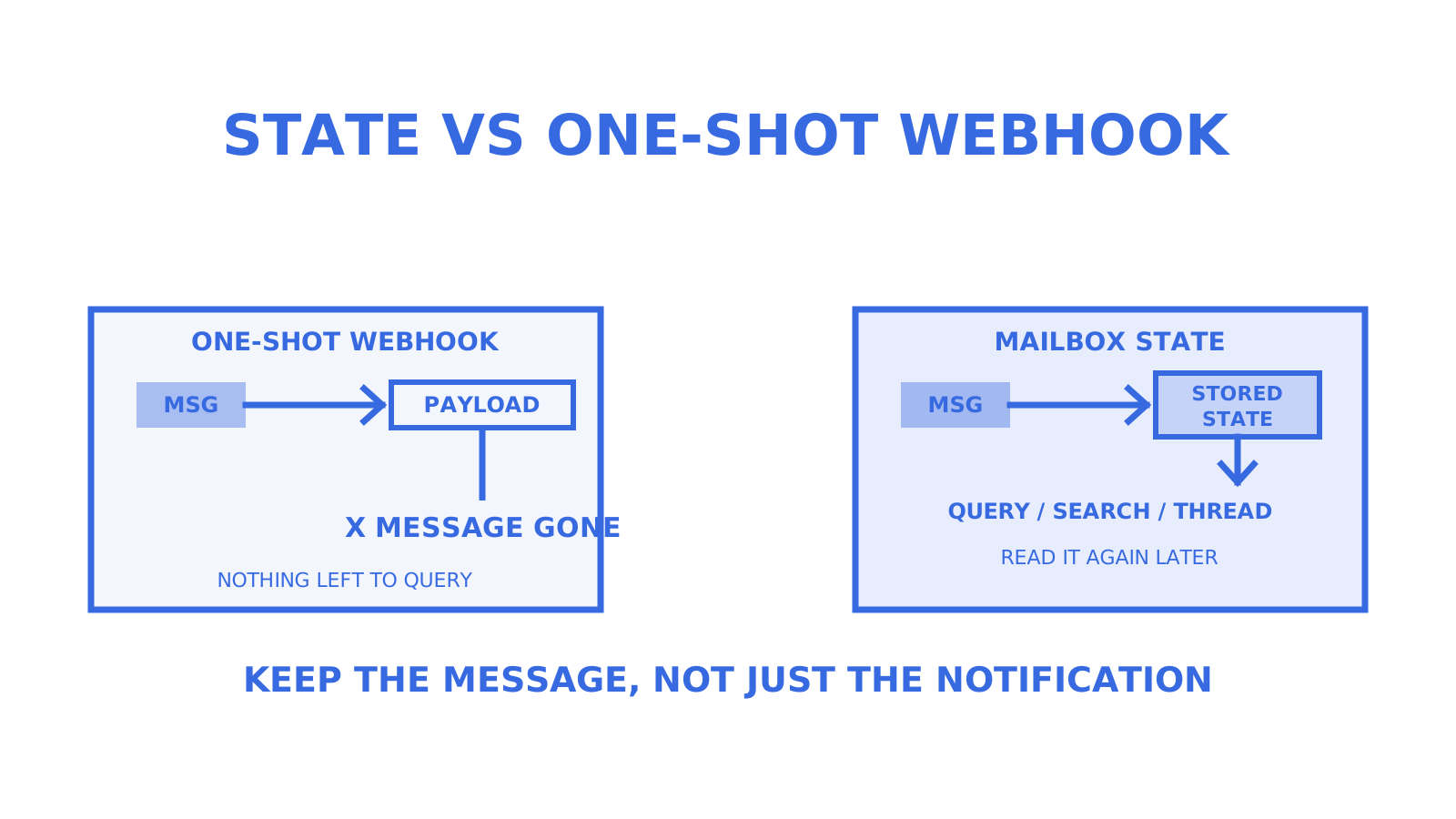
For most developer teams outgrowing a webhook-only inbound service, Sendmux is the strongest CloudMailin alternative, because it pairs persistent mailbox state with bring-your-own sending and full developer tooling: SDKs, a CLI and an OpenAPI spec. Scan the comparison table below to match your constraints to a category before you commit.
TL;DR
- Persistent mailbox support with queryable message state is essential for reliable inbound email handling and reduces long-term engineering costs.
- Webhook reliability features such as retries, signed payloads, and replay support are critical to prevent data loss and simplify migration processes.
- Attachment handling that stores files in remote storage avoids the inline base64 transfer and processing overhead of delivering attachments inside the webhook request.
- Thorough testing with sample messages, large attachments, and simulated failures is necessary to ensure the new provider’s webhook response and attachment workflows are correct before switching live.
- Prioritising mailbox persistence and webhook semantics over pricing can save significant engineering effort and prevent costly operational issues later.
Mapping the CloudMailin alternative categories
CloudMailin alternatives split into four practical categories, and picking the right one matters more than picking the right vendor inside it. G2’s CloudMailin alternatives page lists a wide range of competitors, and for teams migrating inbound mail the axes that matter most are reliability and ease of use.
- Webhook-to-JSON services convert inbound mail to a webhook payload and nothing more; CloudMailin, Mailgun and SparkPost sit here, with no persistent mailbox behind the webhook.
- Email API providers such as Twilio SendGrid, Postmark, Mailjet, MailerSend and Resend focus on deliverability and outbound sending, with inbound parsing as a secondary feature.
- Self-hosted servers, including the open source Postal, commercial options like Atmail, or a plain self-hosted SMTP server paired with a client library such as Nodemailer, give you full control of the mail path in exchange for running and patching your own infrastructure.
- Agent-native mailbox platforms, where Sendmux sits, keep messages, threads and attachments as queryable state rather than firing a payload once and discarding the message.
Amazon SES, Mandrill and sendwithus lean outbound-first with limited inbound handling, while marketing-suite tools such as Mailchimp, Brevo, Act-On, Maropost, WebEngage, Copernica, Sendio, Waypoint and Cybersolutions Inc. solve campaign delivery rather than developer-facing inbound integration, so they rarely compete on the dimensions that matter for this migration.
| Alternative | Inbound formats | Attachment handling | Webhook reliability | Mailbox state | Pricing model |
|---|---|---|---|---|---|
| Sendmux | JSON push payloads; raw and clean bodies | Base64 or reference upload | Signed HMAC, retries, logs | Persistent mailbox | Usage-based, free tier |
| Mailgun | Form, multipart or JSON | Inline or stored | Retries | Stateless webhook | Usage-based |
| Postmark | JSON | Inline | Retries | Stateless webhook | Per-volume |
| Postal | Form or JSON; raw or processed | Inline | Self-managed | Stateless webhook | Self-hosted |
Pick a webhook service when you only need a one-shot parse, an email API when outbound deliverability is the real problem, self-hosted when compliance forces it, and an agent-native mailbox when your application needs to read, search and thread mail after the fact.
The developer’s checklist for choosing an alternative
Before signing up for a trial, work through these checks in order. They surface the differences that matter more than a features page ever will.
- Inspect the webhook payload shape. Confirm whether MIME parts, headers and the envelope sender arrive separately, since reply detection depends on distinguishing headers from the SMTP envelope.
- Check attachment ownership. Decide whether you want attachments inline as base64 or handed to you as a reference to remote storage, and confirm the size ceiling either way.
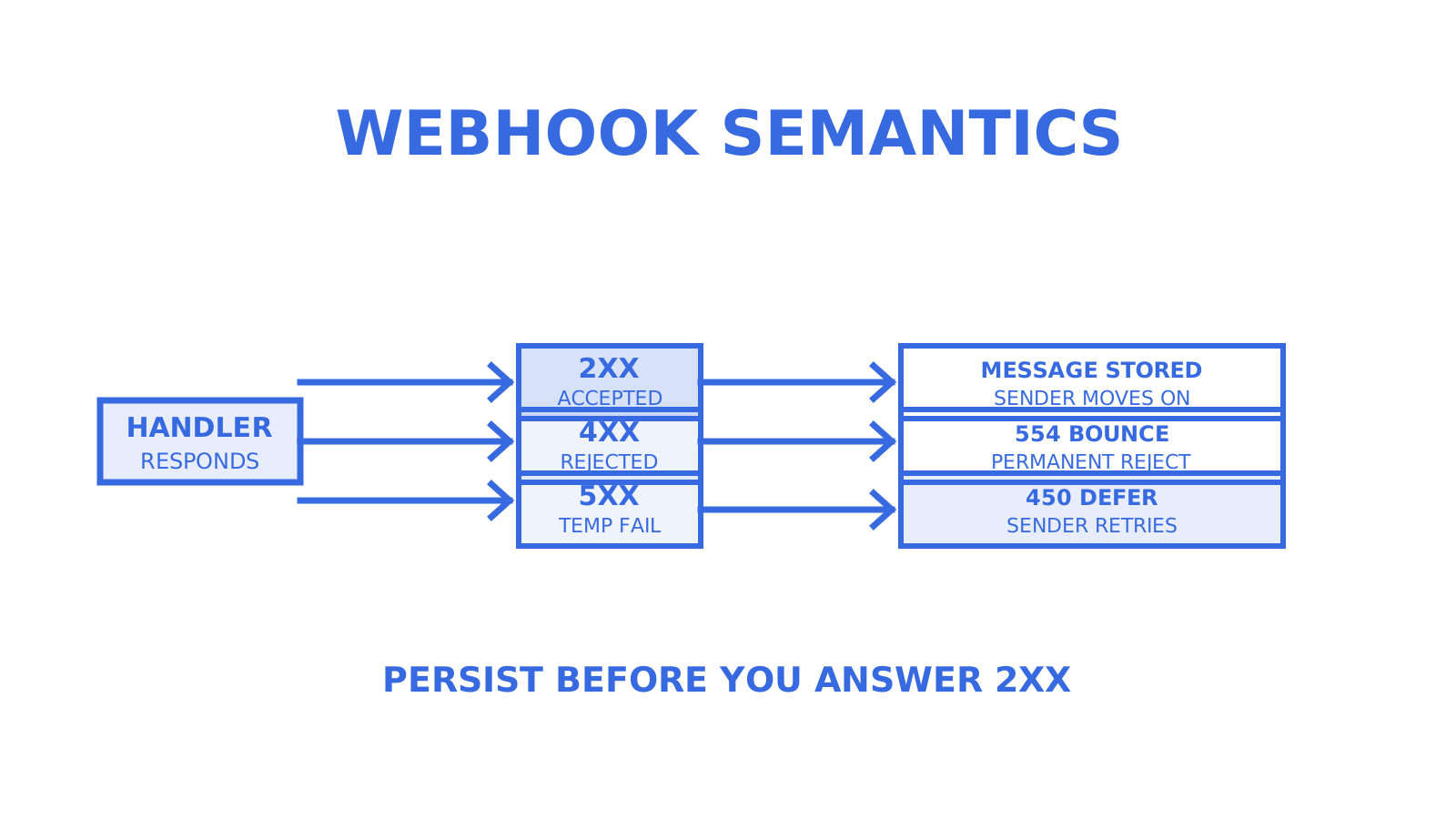
- Test webhook semantics directly. Send a message and observe what the provider expects back: CloudMailin’s HTTP status documentation shows that a 2xx confirms acceptance, a 4xx tells the sender to bounce, and a 5xx triggers a retry, and it pays to check whether a replacement provider documents the same HTTP-to-SMTP semantics rather than assuming them.
- Confirm replay support. A provider that can replay historic messages against a new endpoint makes cutover far less risky than one that cannot.
- Check developer ergonomics. Look for SDKs and examples in the languages your team actually uses, plus a CLI and a Postman collection, not just a curl snippet buried in a getting-started page.
- Review operational limits. Confirm log retention windows, rate limits and tenant isolation before you commit, since these surface only under load.
Pro Tip: Run the same test message through your shortlisted providers and diff the resulting payloads side by side before writing a single line of parsing code.
Where migrations quietly break
Check three places first when the demo worked but production is unstable: payload shape, attachment handling and webhook response codes.
- JSON versus multipart versus raw. CloudMailin’s PHP and Laravel documentation recommends a normalised multipart format for PHP frameworks like Laravel, and any replacement provider will make the same trade-off differently, so your parser needs to be format-aware rather than hardcoded.
- Attachment strategy. CloudMailin’s storage documentation describes uploading attachments straight to S3, Google Cloud Storage or Azure rather than inlining them, which avoids memory spikes on large messages; a provider that only offers inline base64 forces you to build that upload step yourself.
- HTTP status codes changing SMTP behaviour. CloudMailin’s status code guide maps a 4xx response to a permanent 554 rejection that bounces the message, while a 5xx response defers with a 450 code that asks the sending server to retry instead of bouncing, so persisting the message before you answer 2xx and deferring with 5xx during a transient failure are both load-bearing decisions.
- Signing and replay prevention. Prefer HMAC-signed webhooks over basic auth, and check the timestamp and signature together to block replayed requests.
Attachment handling that skips inline base64 for remote storage avoids the transfer and processing overhead that trips up naive parsers with long request times, according to CloudMailin’s own guidance on attachment storage.
Build a minimal staging test suite before cutover: one message with a large attachment, one with no attachment, one deliberate bounce, and one duplicate delivery, then confirm your handler responds correctly to all four.
Migration steps and what it will cost you
A CloudMailin migration is mechanical if you sequence it correctly, and most of the risk is in skipping a step rather than in the step itself.
- Verify your receiving domain with the new provider before touching DNS in production.
- Stand up the new webhook endpoint and get it responding with the correct HTTP codes on test traffic first.
- Map your attachment handling: decide upfront whether you want base64 or a presigned upload URL.
- Run both providers in parallel against a staging subdomain and replay a batch of historic messages for parity.
- Add monitoring for bounce and complaint rates before you cut DNS over for good.
Pricing shapes vary more than the marketing pages suggest. Usage-based providers bill per inbound or outbound event, per-recipient billing charges each accepted recipient on a message separately, and some providers still charge per mailbox regardless of volume. Watch for two early warning signs that costs will climb faster than expected: messages with many recipients on the To, Cc and Bcc lines, and workloads with heavy attachments that push you into storage tiers you did not budget for.
What backs this recommendation
This comparison is written from the integration layer up: payload shapes, attachment workflows and webhook semantics, not marketing copy. Sendmux publishes engineering notes on inbound mail architecture at Myagent, including a developer’s integration guide to transactional email APIs covering why real-time webhook delivery beats polling, and a comparable look at AgentMail alternatives for teams weighing agent-native inbox providers more broadly.
On the product side, Sendmux exposes messages, threads, folders and attachments through a Mailbox API rather than a single webhook fire, with signed HMAC-SHA256 webhooks retried on failure and webhook delivery metadata and payloads retained for seven days. Developer tooling covers SDKs in TypeScript, Python, Go, PHP, Ruby and Rust, a CLI with over 100 commands, and published OpenAPI 3.1 specifications for both the Mailbox and Sending APIs, alongside published usage-based pricing with no per-seat or per-mailbox fees.
Where the standard advice on this misses the point
Compare CloudMailin alternatives on mailbox persistence as well as deliverability numbers and pricing tiers when building anything an agent or a support workflow needs to read later. The question that actually predicts pain six months in is whether the message still exists as queryable state after the webhook fires once, or whether you are rebuilding a mailbox out of a database table you never meant to own.
Webhook reliability gets treated as a nice-to-have when it should be a gating requirement: a provider without signed webhooks, retries and replay is asking you to build your own reliability layer on top of theirs. Test attachment handling with large messages before production; for example, a customer might send a 20 MB PDF your parser has never handled.
If you take one thing from this, prioritise mailbox persistence and webhook semantics before you look at price. A cheaper provider that forces you to rebuild threading, search and retry logic will cost more in engineering time than the invoice ever saves.
Try Sendmux as your next inbound mail provider
If persistent mailboxes, bring-your-own sending across providers like Gmail, Outlook or Amazon SES, and real developer tooling are what you need, Sendmux is built for exactly that. The free plan includes limited mailboxes, domains, sending accounts, and webhook support, with no per-seat or per-mailbox fees on any plan. Start at Myagent and connect your first mailbox to a staging webhook today.
Sources
For the webhook semantics and payload formats discussed above, check CloudMailin’s HTTP status code documentation, its PHP and Laravel inbound examples, and its attachment storage guide. For a broader landscape cross-check, see G2’s CloudMailin alternatives list.
- Top 10 CloudMailin Alternatives & Competitors
- Receiving email with PHP and Laravel
- Receiving email via HTTP: HTTP status codes
- Store email attachments in S3/Azure/Google Storage
- AgentMail Alternatives for Developers: Inbox & API Picks
- 12 Solid Mailgun Alternatives for Developers in 2026
- Build Mailboxes From $0.50 per 1,000: Six Novu Alternatives for Devs
FAQ
Which email API is the best for free?
There is no single provider that is objectively best for free use, since free tiers differ in mailbox count, recipient caps and attachment limits. Sendmux’s free tier includes two mailboxes, one domain and one connected sending account with no per-seat fees, which suits small teams testing an integration before committing to paid usage.
What is the best free webmail?
“Best” depends on whether you need a human-facing inbox or a developer-facing mailbox your application can query through an API. For developer integrations, look for a free tier that exposes messages, threads and attachments programmatically rather than just a web interface.
What are the top 3 webmail providers?
Consumer webmail (Gmail, Outlook and Proton Mail) dominates human inboxes, but none of them are built as multi-tenant infrastructure for applications or agents that need their own addresses. For that job, developer-facing mailbox APIs are a separate category worth evaluating on their own terms.
Is there a free and open source email server available?
Yes, Postal is a free, open source option you host yourself, and commercial vendors such as Atmail offer self-hosted or managed deployments as well. Either way you take on running and patching the mail path yourself (or paying a vendor to), which suits teams with strict compliance needs more than teams optimising for fast integration.
How do webhook HTTP status codes affect email delivery?
For CloudMailin inbound delivery, returning a 2xx confirms your application accepted and stored the message, a 4xx tells the sender to bounce the message permanently, and a 5xx signals a temporary failure and prompts a retry, so returning the wrong code can cause silent data loss or duplicate deliveries. Other providers may map response codes differently, so check each provider’s contract before you rely on the same behaviour.
Give an agent its own address
Sendmux is the Email Inbox API for AI Agents.