---
title: "Team Inbox Management for AI Agents and Platforms"
description: "Streamline your AI agents' communication with team inbox management, ensuring reliability and efficiency through API-driven solutions."
canonical: "https://myagent.mx/blog/team-inbox-management"
publishedAt: "2026-08-14T00:00:00.000Z"
updatedAt: "2026-08-14T00:00:00.000Z"
category: "agents"
topic: "how to streamline team inbox"
author: "Roshan Jonnalagadda"
authorProfile: "https://myagent.mx/blog/author/roshan-jonnalagadda"
keywords:
- "how to streamline team inbox"
- "managing team emails"
- "team email management tips"
- "collaborative inbox solutions"
- "shared inbox best practices"
- "effective team communication"
- "inbox organization tools"
- "shared inbox strategies"
- "Hiver alternatives"
- "Hiver vs Front"
- "shared inbox for support"
- "Hiver competitors"
- "team inbox management"
---
# Team Inbox Management for AI Agents and Platforms
Streamline your AI agents' communication with team inbox management, ensuring reliability and efficiency through API-driven solutions.
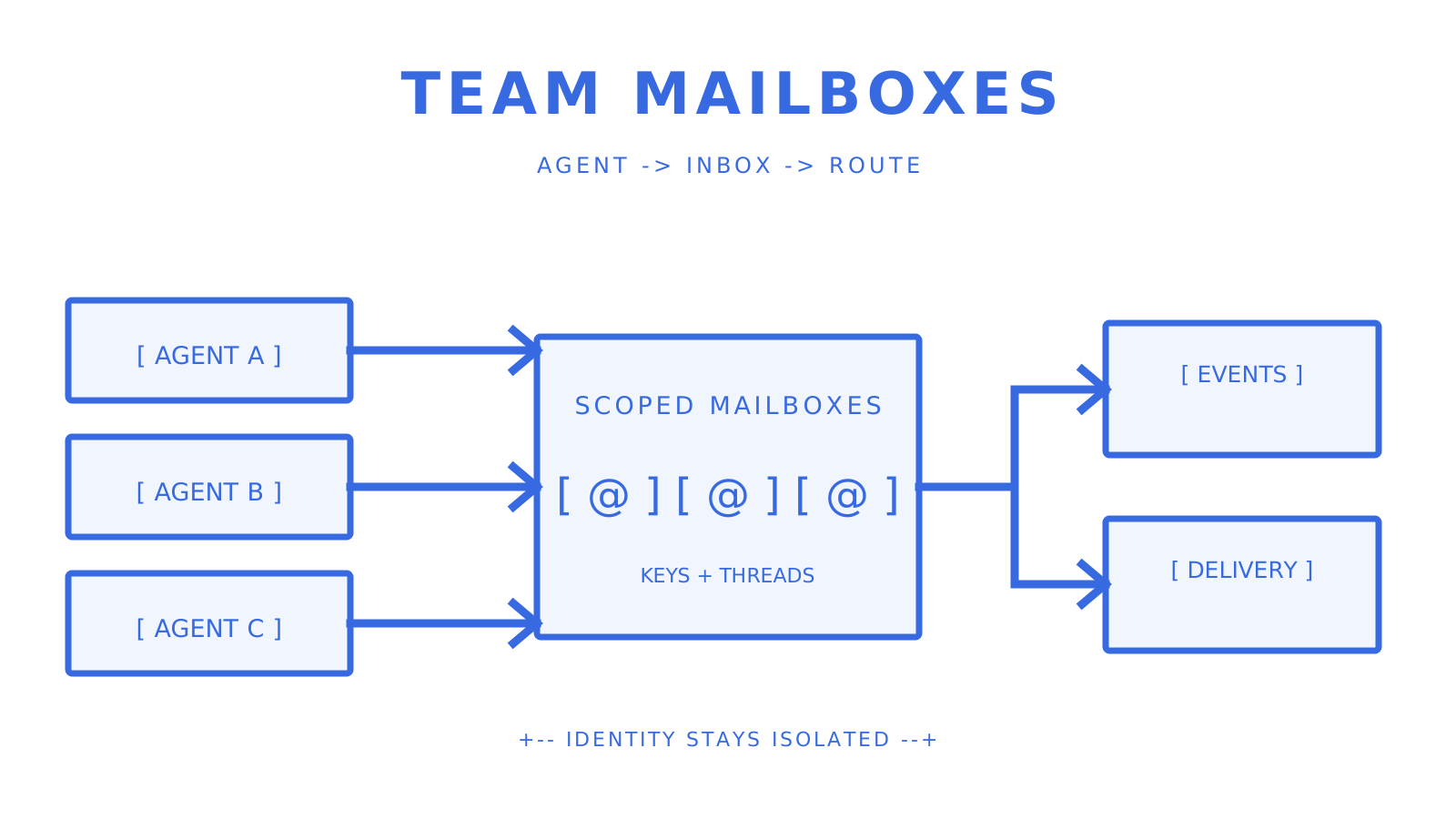
Scoped mailbox identities connect agents to inbound events and controlled outbound routes.
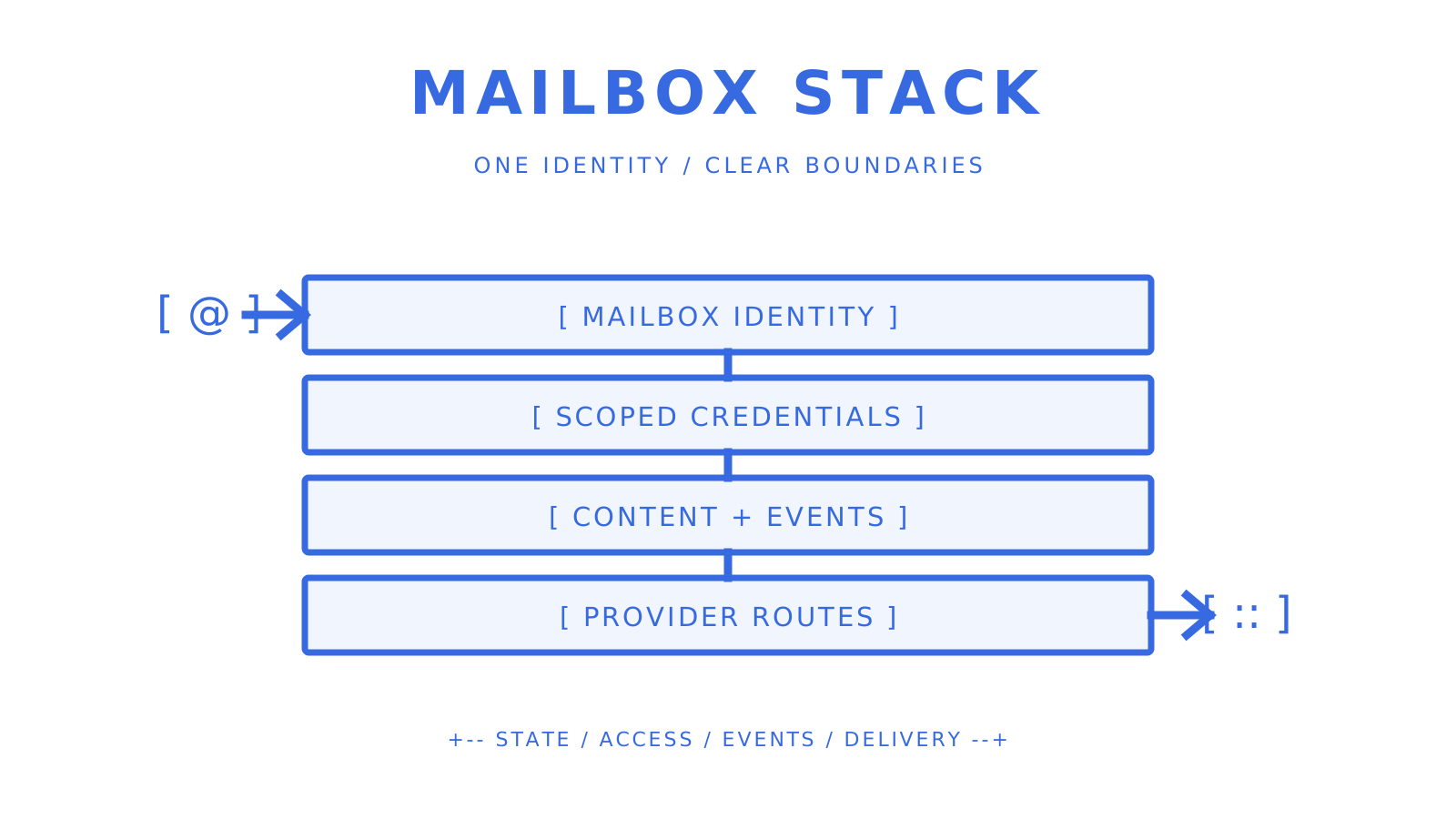
For AI agents and multi-tenant platforms, team inbox management is the programmable boundary around mailbox identity, message state, access, events, and delivery. A production design needs explicit ownership: which mailbox belongs to which agent or tenant, which credential may act on it, and which system records each message outcome.
This guide covers **how to streamline team inbox**, **managing team emails**, **team email management tips**, **collaborative inbox solutions**, **shared inbox best practices**, **effective team communication**, **inbox organization tools**, **shared inbox strategies**, **Hiver alternatives**, **Hiver vs Front**, **shared inbox for support**, **Hiver competitors**, and **team inbox management** for developers. Human support products and mailbox APIs solve different jobs, so compare them by operating model rather than by a shared-inbox label.
The reviewed Sendmux contracts expose real mailboxes, mailbox-scoped credentials, deterministic clean message and thread content, inbound SSE, HMAC-SHA256 signed outbound webhooks, configured sending accounts, quota windows, and delivery logs with CSV export.
What the architecture must make explicit:
- Mailbox identity and tenant ownership
- Scoped credentials and permission boundaries
- Clean message and thread retrieval
- Push-based inbound notification and signed delivery events
- Reply headers, idempotent sends, quotas, and delivery observability
- Domain authentication and recipient-policy handling
## Key Takeaways
Treat the mailbox as a stateful application resource, not as a shared alias. Keep identity, access, thread state, provider routing, and delivery evidence independently testable.
| Point | Details |
| --- | --- |
| Mailbox ownership | Map every mailbox to one agent, workflow, or tenant boundary. |
| Scoped access | Mailbox credentials should expose only the permissions the workload needs. |
| Inbound events | Sendmux exposes inbound mailbox events over SSE; outbound delivery changes use signed webhooks. |
| Thread context | Preserve RFC 5322 Message-ID, In-Reply-To, and References when replying. |
| Delivery routing | Configured sending accounts expose weights and quota windows; selection excludes unavailable accounts before choosing by weight. |
## What "team inbox management" actually means for developers
For developers, the useful definition is programmatic mailbox infrastructure for agents and platforms. It covers mailbox lifecycle, clean content, thread state, event delivery, sending, and least-privilege access. A human-facing support inbox may add assignment, collision detection, and agent dashboards, but those UI workflows do not prove a mailbox API contract.
**In scope:** mailbox identities, mailbox-scoped credentials, message and thread content, inbound SSE, outbound webhooks, provider accounts, quotas, logs, and tenant controls.
**Out of scope:** deciding whether Hiver alternatives, Hiver vs Front, or other collaborative inbox solutions have the right human support UI. Evaluate those products against their current official contracts when the buyer is a support team.
Current Sendmux API primitives include:
- POST /api/v1/mailboxes to provision a mailbox through the Management API
- POST /api/v1/mailboxes/{public_id}/keys to mint another mailbox credential
- GET /api/v1/mailbox/messages/{message_id}/content for deterministic clean JSON content
- POST /api/v1/mailbox/messages/send for a mailbox send with optional idempotency
- GET /api/v1/mailbox/events for inbound SSE with Last-Event-ID reconnection
One mailbox stack keeps identity, access, events, and delivery paths distinct.
**Pro Tip:** *Trace one complete flow before comparing feature lists: provision a mailbox, mint a scoped credential, receive a message, fetch its clean content, reply with the original thread headers, and observe the delivery result.*
## Engineering checklist: what your mailbox API stack must support
Use it as an integration pass/fail gate.
1. **Mailbox lifecycle** — Provision, list, suspend, resume, and inspect mailboxes through a documented API.
2. **Mailbox-scoped credentials** — Verify that one mailbox key cannot read or send as another mailbox.
3. **Thread-aware sending** — Preserve Message-ID, In-Reply-To, and References; [RFC 5322](https://www.rfc-editor.org/rfc/rfc5322) defines those identification fields.
4. **Clean message content** — Fetch deterministic text and HTML content plus attachment metadata without making the agent parse raw MIME for its normal path.
5. **Inbound notification** — Use SSE or another documented push mechanism with reconnect and deduplication behavior.
6. **Outbound event verification** — Validate signatures over the raw webhook body before parsing or acting.
7. **Provider selection** — Verify account types, weights, quota windows, blacklisting, and the exact behavior when no account remains available.
8. **Delivery evidence** — Query message-level logs and test CSV export before production.
9. **Safe retries** — Use Idempotency-Key on supported create and send requests.
10. **Tenant controls** — Keep team roles, mailbox ownership, provider access, and recipient policy explicit.
The reviewed Sendmux permission taxonomy includes email.send, email.receive, mailbox.read, and mailbox.settings.update. Its Management API provisions a mailbox and initial credential atomically, while the Mailbox API separates clean content, sends, events, quotas, and usage into documented operations.
## Questions to ask providers before you commit
Ask for exact contracts and artifacts, not yes-or-no feature answers.
**Mailbox model:** Which API creates the mailbox, and which credential can read, receive, send, or update it?
**Inbound delivery:** Which events use SSE or webhooks? How does a client reconnect, deduplicate, and fetch full content?
**Threading:** Which request and response fields carry message_id, in_reply_to, references, and the platform thread identifier?
**Outbound routing:** Which account types are supported? How do weights, quota windows, blacklisting, and alternate selection work in committed code?
**Observability:** Can operators query logs by message attributes and export the filtered result as CSV?
**Security:** Which system roles and mailbox permissions exist, and are webhook signatures verified over the raw body?
**Commercial terms:** What is charged per recipient occurrence, mailbox, seat, managed provider, storage tier, or support plan?
Red flags to investigate:
- Undocumented endpoints or event names
- Raw MIME as the only normal content interface
- Credentials that silently widen across tenants
- Retry behavior without idempotency semantics
- Provider routing claims without implementation and test evidence
- Latency, compliance, residency, or roadmap claims absent from the current contract
Before you commit, ask for a sample event envelope, a clean-content response, a send response, a failed-delivery record and a CSV export.
## Reference implementation patterns for agents and platforms
Most agent and platform designs fall into three ownership patterns.
| Pattern | Identity boundary | Application work | Main trade-off |
| --- | --- | --- | --- |
| Per-agent mailbox | One mailbox per agent | Map agent state to mailbox state | More mailbox resources |
| Shared mailbox with actor IDs | One mailbox for several actors | Enforce actor ownership in application data | Shared sender and reputation boundary |
| Mailbox per tenant | One or more mailboxes per customer | Map credentials and provider access to the tenant | More lifecycle automation |
**Per-agent mailbox** gives each agent a durable address and a narrow credential. Use it when agents need independent conversations or sender identity.
**Shared mailbox with actor IDs** fits workflows where several workers process one queue. Store the internal actor and lease state outside the mailbox so two workers cannot act on the same message concurrently.
**Mailbox per tenant** keeps customer identities and provider choices separate. Sendmux's [platform overview](https://sendmux.ai/solutions/platform-builders) describes that model; technical behavior in this article remains bound to the reviewed owners.
**Thread correlation store:** Persist the outbound platform message ID, the RFC 5322 message identifier, the internal conversation ID, and the tenant ID. On reply, resolve In-Reply-To and References before falling back to provider thread metadata.
**Routing:** Configure eligible sending accounts and quota windows. The reviewed implementation filters blacklisted or quota-exhausted accounts, then selects from the accounts still available by weight.
Implementation guidance:
- Supply Idempotency-Key on supported outbound calls
- Treat event IDs as deduplication keys
- Fetch attachment bytes from the documented attachment endpoint rather than assuming they are embedded in an event
- Keep tenant and actor identifiers in application state even when custom headers are also allowed
## Scaling, observability, and troubleshooting your inbox infrastructure
Track metrics at both mailbox and tenant boundaries.
- Inbound event rate and consumer lag
- SSE reconnects and webhook delivery failures
- Outbound accepted, delivered, bounced, complained, rejected, and delayed outcomes
- Account selection failures and quota utilization
- Clean-content and attachment-fetch failures
- Mailbox storage usage and export completion
Operational checklist:
- Reconnect SSE clients with Last-Event-ID and deduplicate received event IDs
- Verify signed webhook bodies before parsing them
- Query delivery logs for expected and failed messages
- Export a filtered CSV and confirm its rows match the same query
- Turn bounce and complaint events into an explicit recipient policy
- Load-test only with approved non-production limits and consented recipients
The reviewed sending owner records a 10M+ accepted messages per day capacity target. Treat that as owner evidence for capacity planning, not as a guarantee for every tenant, provider, destination, or workload.
## Security, deliverability, and compliance requirements
Security checklist:
- Mailbox-scoped credentials with explicit permissions
- Owner, Admin, Developer, and Member team-role boundaries
- HMAC-SHA256 verification for outbound webhook events
- OAuth only for provider connections that require it
- Idempotency on supported mutations
- Audit and delivery evidence kept inside the correct tenant boundary
Deliverability checklist:
- Verify the exact sending domain and publish its required SPF, DKIM, DMARC, and bounce-handling records
- Follow [Gmail's current sender guidelines](https://support.google.com/mail/answer/81126?hl=en) for authentication and sending practices
- Keep hard-bounce and complaint handling in an explicit recipient policy
- Warm a dedicated IP only under the chosen provider's official process
Commercial email must also satisfy the sender's legal obligations. The FTC's current [CAN-SPAM guide](https://www.ftc.gov/business-guidance/resources/can-spam-act-compliance-guide-business) requires accurate headers and subject lines, a valid postal address, a clear opt-out, and prompt opt-out processing. Confirm privacy, retention, residency, deletion, and transfer terms in the actual contract for every region where the platform operates.
**Pro Tip:** *Authorize the action before classifying message content. A useful classifier does not make an over-broad credential safe.*
## How pricing works and what drives your costs
Compare billable units before comparing totals. Pro costs $7 per team each month plus usage. Each provider-accepted recipient through an owned or connected provider costs $0.000500; the Sendmux-managed Amazon SES route costs $0.000750 per accepted recipient. Each event is billed individually.
Storage costs $0.02 per decimal GB-month.
The main workload drivers are:
- **Outbound recipients:** one message with several recipients creates several billable recipient occurrences
- **Inbound messages:** replies, bounces, and automated responses add processing work
- **Attachments:** transfer and retention can dominate storage and egress
- **Managed delivery:** provider ownership can change the delivery unit price
- **Mailbox count:** per-agent and per-tenant models create more lifecycle resources even without a per-mailbox fee
Cost-control guidance:
- Deduplicate recipients before send
- Classify non-actionable inbound without invoking an expensive downstream model
- Set explicit attachment and message retention rules
- Enforce tenant quotas at the same boundary used for billing and provider access
- Reconcile provider-accepted recipients against the platform's delivery evidence
## Advanced features worth prioritizing on your roadmap
Think of these as evaluation items, not Sendmux capabilities or roadmap promises.
- **Cross-mailbox search** — Define which roles may query across tenant mailboxes and how results stay isolated.
- **Filter-scoped delivery** — Decide whether filters reduce event delivery, API visibility, or both.
- **Mailbox import** — Specify source providers, history depth, attachment handling, and duplicate detection.
- **Existing-mailbox connectors** — Verify Gmail, Microsoft 365, or IMAP ownership and OAuth scopes independently.
- **Automation hooks** — Require explicit event schemas, retry behavior, and tenant boundaries.
- **Conversation-level events** — Define how a conversation update relates to message-level delivery and replay.
An MCP tool can be a useful agent-facing interface, but it does not replace the underlying HTTP contract, permission boundary, idempotency behavior, or delivery evidence. Verify each callable operation against the same public implementation.
## Verdict and next steps for teams ready to build
A mailbox-first model is the right fit when the application must own durable inbound state and send replies under its own identity. It is not automatically the right fit for a human support team that mainly needs assignment and collaboration UI.
Three concrete next steps:
1. **Map ownership** — Record which tenant, agent, credential, provider accounts, and recipient policy own each mailbox.
2. **Run one complete journey** — Provision, receive, fetch clean content, reply with thread headers, and observe delivery without a live-customer mutation.
3. **Exercise failure paths** — Reconnect inbound events, replay an idempotent request, exhaust a test quota, and inspect the resulting log evidence.
If this mailbox workflow sits inside a marketing process, BabyLoveGrowth's [marketing automation checklist](https://babylovegrowth.ai/blog/marketing-automation-checklist-step-by-step-guide-smbs) covers planning, contact-data preparation, workflow setup, training and ongoing review. Use it to plan the surrounding work. The mailbox model and API validation steps above remain the technical checks for agent identity, permissions, message handling and failure recovery.
Reject a platform if the contract, implementation, and targeted check do not agree on the exact method, path, field, event, or limit your integration needs.
## Why the mailbox-first model is the right long-term bet
Mailbox-first architecture concentrates message state, thread operations, events, and access around a durable identity. That can remove application glue when an agent must receive and reply, but it also makes mailbox ownership a first-class production responsibility.
The alternative is often a delivery API plus a consumer inbox, parser, event relay, and correlation store. That stack can be valid, especially when existing provider mailboxes are the source of truth. Compare the operational boundary, not the number of products.
For multi-tenant platforms, isolate mailbox credentials, provider eligibility, logs, and quotas by tenant. A shared mailbox can still work, but the application must then own actor leases, data isolation, and reputation impact explicitly.
Infrastructure-level classification can reduce downstream model work, but only after access checks and with a documented fallback for ambiguous messages. Keep the original message retrievable for diagnosis.
## Sendmux gives your agents a real mailbox API, not a workaround
The reviewed [Sendmux](https://sendmux.ai/product) owners expose mailbox provisioning, one-time credential issuance, clean message and thread content, inbound SSE, signed outbound webhooks, thread-aware sends, configured provider accounts, quota windows, delivery logs, and CSV export.
Mailbox-scoped permissions include email.send, email.receive, mailbox.read, and mailbox.settings.update. Configured sending accounts include custom SMTP, Gmail API, Outlook API, and managed Amazon SES types. The sending implementation excludes blacklisted or quota-exhausted accounts and selects available accounts by weight.
First-party SDK repositories cover TypeScript, Python, Go, PHP, Ruby, and Rust. Connected outbound usage costs $0.000500 per provider-accepted recipient, and Sendmux-managed Amazon SES costs $0.000750 per accepted recipient.
Sendmux's [AI customer support agents](https://sendmux.ai/use-cases/customer-support-agents) and [sales outreach workflows](https://sendmux.ai/use-cases/sales-outreach-agents) use the mailbox and sending capabilities described above. Keep each client's mailbox credentials, provider choices and delivery evidence inside that client's boundary. Confirm retention and deletion terms separately for the workload. A working email integration alone does not establish compliance.
The first-party CLI covers Mailbox, Management and Sending API commands. The [CLI 1.5.0](https://github.com/Sendmux/sendmux-sdk/releases/tag/ts-cli-v1.5.0) release has 104 API commands. Sendmux publishes OpenAPI 3.1 contracts, and its LangChain and Vercel AI SDK wrappers expose tools for sending email, listing messages and replying. Check the installed command's help and the relevant API operation before scripting a workflow, using credentials scoped to that operation.
Use the [platform overview](https://sendmux.ai/solutions/platform-builders) to understand the product model, then verify every technical integration claim against the public contract and owning implementation.
## Useful sources
- [RFC 5322: Internet Message Format](https://www.rfc-editor.org/rfc/rfc5322)
- [Email sender guidelines — Google](https://support.google.com/mail/answer/81126?hl=en)
- [CAN-SPAM Act: A Compliance Guide for Business — FTC](https://www.ftc.gov/business-guidance/resources/can-spam-act-compliance-guide-business)
- [Amazon SES dedicated IP warmup](https://docs.aws.amazon.com/ses/latest/dg/dedicated-ip-warming.html)
- [Sendmux platform overview](https://sendmux.ai/solutions/platform-builders)
- [Mails.ai architecture and provider guide](https://mails.ai/resources/email-api-for-ai-agents-architecture-provider-guide)
## FAQ
### What is the difference between a mailbox API and a sending API?
A sending API primarily accepts outbound messages. A mailbox API also owns inbound message state, message and thread retrieval, mailbox identity, events, and reply operations. Some products provide both surfaces; verify the exact public contract rather than inferring capability from the category name.
### Why do per-mailbox API keys matter for multi-tenant platforms?
A mailbox-scoped credential narrows what a compromised workload can access. The application must still map that credential to the correct tenant, protect the one-time plaintext value, rotate it when required, and keep team-level management credentials out of mailbox workers.
### How does Sendmux handle outbound routing and failover?
Configured sending accounts expose routing weights and per-second, per-minute, per-hour, and per-day quota windows. The sending implementation filters blacklisted or quota-exhausted accounts and selects among the available accounts by weight. Publish that verified behavior instead of promising universal automatic failover for every provider error.
### What is the reliable method for thread correlation across mail clients?
Preserve the RFC 5322 Message-ID, In-Reply-To, and References fields and store the platform message and thread identifiers beside the application's conversation ID. Subject matching alone is not a reliable correlation strategy.
### How should I classify inbound messages to control LLM costs?
Authorize mailbox access first, then classify categories such as human reply, out-of-office, bounce, complaint, or spam. Route only the categories that need model inference, retain an auditable fallback for ambiguous messages, and treat bounce and complaint events as recipient-policy inputs.