---
title: "Mailbox-First SendGrid Alternatives for AI Agent Platforms"
description: "Discover the best SendGrid alternatives for AI agent platforms, including mailbox-first solutions that simplify email infrastructure."
canonical: "https://myagent.mx/blog/sendgrid-alternatives"
publishedAt: "2026-08-24T00:00:00.000Z"
updatedAt: "2026-08-27T10:41:46.816Z"
category: "alternatives"
topic: "sendgrid alternatives"
author: "Roshan Jonnalagadda"
authorProfile: "https://myagent.mx/blog/author/roshan-jonnalagadda"
keywords:
- "sendgrid alternatives"
- "sendgrid vs mailgun"
- "sendgrid vs postmark"
- "top email APIs"
- "email marketing alternatives"
- "SendGrid substitutes"
- "sendgrid competitors"
- "best email services"
- "alternatives to sendgrid"
- "email service comparisons"
- "affordable email tools"
---
# Mailbox-First SendGrid Alternatives for AI Agent Platforms
Discover the best SendGrid alternatives for AI agent platforms, including mailbox-first solutions that simplify email infrastructure.
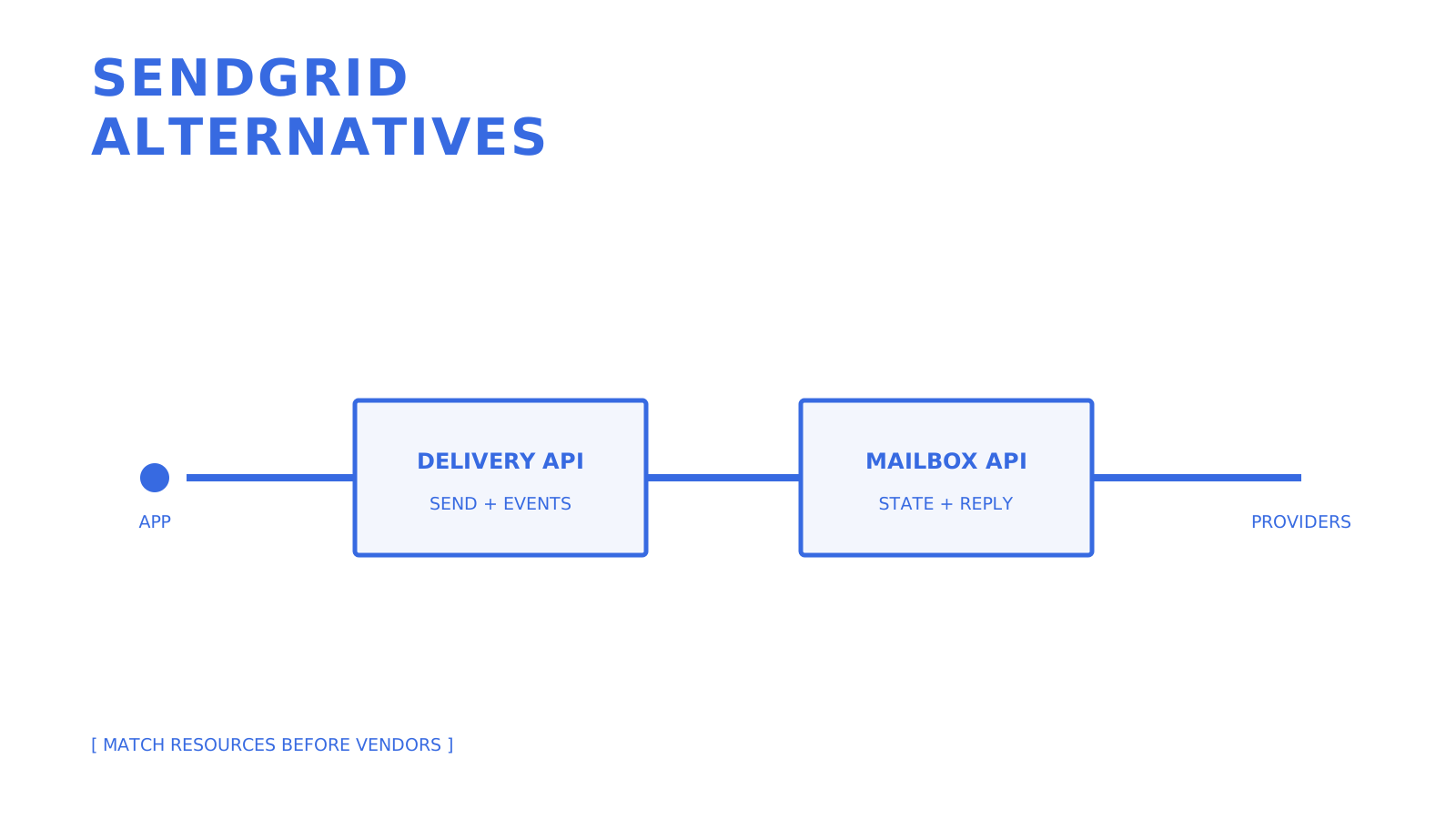
Compare the resource model first: delivery, inbound parsing, and durable mailbox state are different layers.
For agent-first email infrastructure, **Sendmux** is one SendGrid alternative to evaluate when every agent or tenant needs a persistent mailbox, structured message data, and both inbound and outbound workflows. That is a different requirement from choosing an email delivery provider. SendGrid sends email and also documents Inbound Parse for receiving mail at configured domains, but an application still owns the mailbox, thread, permission, and durable-state model around those events.
The field splits into three broad types of alternatives:
- **Self-hosted agent platforms** such as AgenticMail, for teams prepared to operate their own IMAP/SMTP infrastructure.
- **Communications inbox APIs** such as Bird, whose current API documents threads and messages across supported channels.
- **API-first hosted mailboxes** such as Sendmux and Euromail, with different resource and processing models that must be tested directly.
SocialAPI belongs on a multi-channel shortlist for social comments, direct messages, reviews, and mentions, and it documents MCP access. Its current public inbox documentation does not establish email as a channel, so it should not be treated as a SendGrid or mailbox replacement without separate evidence.
What matters is not whether a provider calls itself one of the **top email APIs**. It is whether its documented resources match the work the product performs: sending, inbound parsing, persistent mailbox state, connected accounts, or some combination of them.
## Key Takeaways
Mailbox-first infrastructure is useful when agents need durable messages, threads, scoped access, and inbound events. It is not automatically better than an email delivery API for every workload.
| Point | Details |
| --- | --- |
| Pick the right category | Separate outbound delivery, inbound parsing, connected mailbox access, and provider-hosted mailboxes before comparing products. |
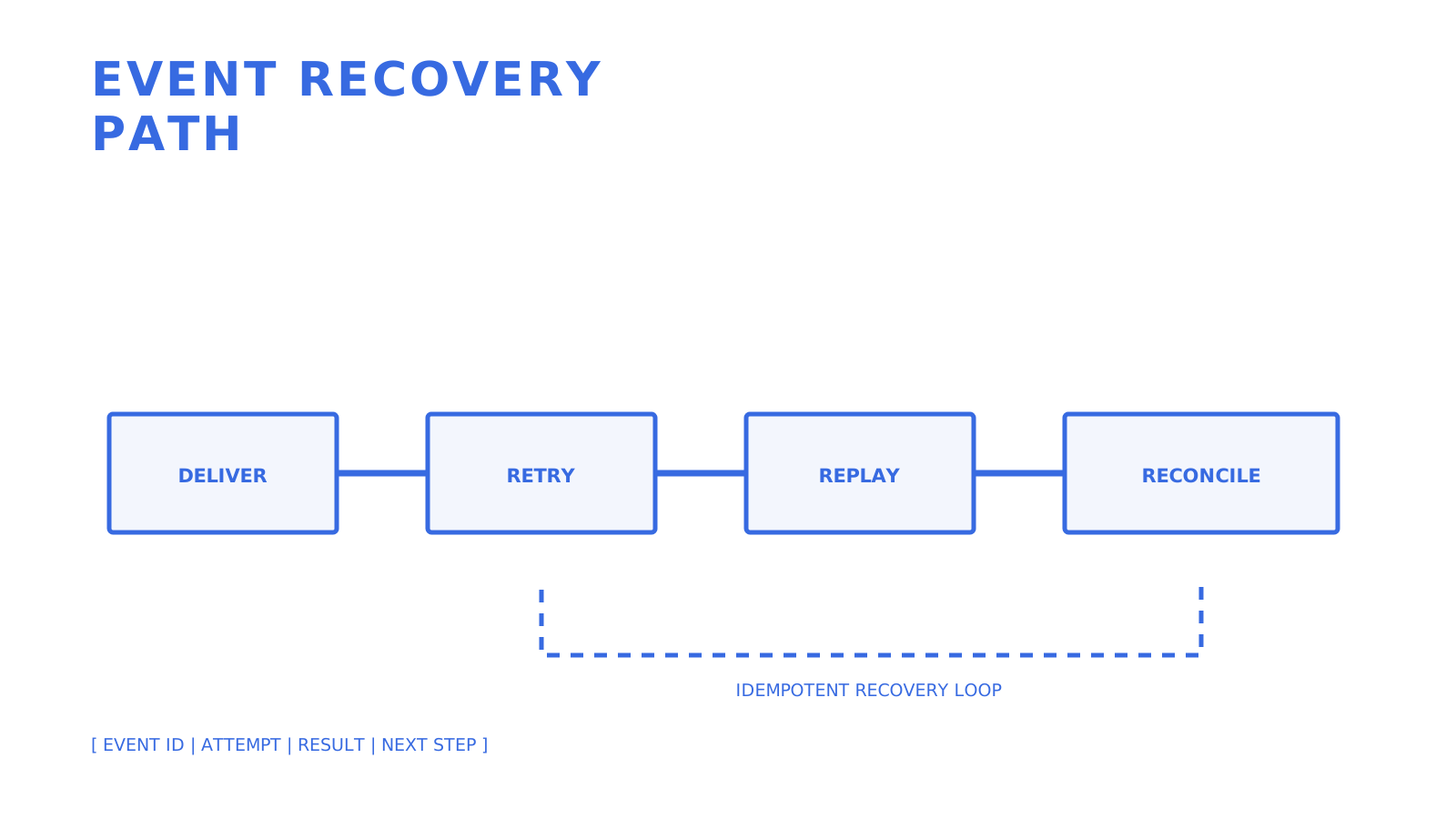
| Test the crash case | Follow the candidate's documented recovery mechanism and prove redelivery, replay, or reconciliation after interrupted processing. |
| Check routing flexibility | Confirm eligible providers, quotas, percentage distribution, delivery groups, and failure behaviour with a representative test. |
| Scope your keys | Prefer mailbox-scoped credentials and explicit permissions over one unrestricted credential shared across tenants. |
| Use Sendmux where its mailbox model fits | Persistent mailboxes, inbound state, scoped access, and outbound delivery suit some agent platforms, but they do not replace every SendGrid feature. |
| Verify provider routes | Gmail, Outlook / Microsoft 365, custom SMTP, and managed Amazon SES have distinct setup and limits. |
## Table of Contents
- [Sendgrid Alternatives for Mailbox-First Email APIs](#sendgrid-alternatives-for-mailbox-first-email-apis)
- [What Should a POC Checklist Include?](#what-should-a-poc-checklist-include)
- [How Do Deliverability Rates Compare Across Alternatives?](#how-do-deliverability-rates-compare-across-alternatives)
- [Migrating From SendGrid: Tools, Support, and Common Issues](#migrating-from-sendgrid-tools-support-and-common-issues)
- [Customer Support and SLA Options Across These Alternatives](#customer-support-and-sla-options-across-these-alternatives)
- [Security and Compliance for Mailbox-First Providers](#security-and-compliance-for-mailbox-first-providers)
- [Scalability and Performance Under Multi-Tenant Load](#scalability-and-performance-under-multi-tenant-load)
- [User Interface and Usability Differences That Matter](#user-interface-and-usability-differences-that-matter)
- [Why Mailbox-First Beats Deliverability-Only Thinking](#why-mailbox-first-beats-deliverability-only-thinking)
- [Get Started With a Mailbox-First Email API](#get-started-with-a-mailbox-first-email-api)
- [Sources](#sources)
- [FAQ](#faq)
### Primary Sources and Technical References
This comparison uses the current [Twilio SendGrid Inbound Parse documentation](https://www.twilio.com/docs/sendgrid/for-developers/parsing-email/setting-up-the-inbound-parse-webhook), [SendGrid webhook security guidance](https://www.twilio.com/docs/sendgrid/for-developers/tracking-events/getting-started-event-webhook-security-features), [AgenticMail repository](https://github.com/agenticmail/agenticmail), [Bird API documentation](https://docs.bird.com/api), [Euromail Emails API documentation](https://docs.euromail.ai/api-reference/emails), and [SocialAPI inbox documentation](https://docs.socialapi.ai/inbox). Product scope, prices, limits, and support terms can change; confirm them before migration.
## Sendgrid Alternatives for Mailbox-First Email APIs
The traditional delivery API model is designed to accept a message from an application, hand it to a delivery path, and expose status events. Agent workflows may need a longer loop: establish an address, receive a message, read structured content, preserve thread context, decide what to do, and reply. That loop requires a resource model as well as transport.
**1. Sendmux** exposes mailboxes, messages, threads, folders, attachments, identities, submissions, sending, and an SSE mailbox event stream. Mailbox access is scoped through credentials and permissions. Sending can use configured connected or managed providers, with provider eligibility, quotas, percentage routing, and delivery groups. Those controls are not a promise that every failure automatically switches providers, so a proof of concept should exercise the exact configuration and failure mode the product will use.
Sendmux bills each usage event individually. Connected outbound and inbound events cost $0.000500 each, managed Amazon SES accepted recipients cost $0.000750 each, and storage costs $0.02 per decimal GB-month. Pro costs $7 per team each month plus usage, with no separate per-mailbox line item.
**2. AgenticMail** takes a self-hosted approach. Its repository documents an SMTP and IMAP mail server, REST API, CLI, optional Gmail relay, webhooks, and agent-oriented tools. That can fit strict infrastructure ownership or data-location requirements, but the team also owns mail-server operations, domain authentication, abuse controls, uptime, monitoring, and recovery.
**3. Bird** documents conversation threads and messages, including direction, participants, timestamps, status, and authentication-related fields on supported surfaces. Those semantics are useful when evaluating structured communications, but the candidate still has to prove the channels, routing, retention, and tenant-isolation requirements of the actual workload.
**4. Euromail** documents an email API and agent-processing patterns that include lease, acknowledge, and negative-acknowledge operations. That makes interrupted processing testable. Do not project this pattern onto every provider: ask each candidate which resource is claimed, when a lease expires, how a message is retried, and what prevents duplicate side effects.
**5. SocialAPI** documents a unified social inbox and MCP tools for interactions such as direct messages and comments. Because its current public inbox surface does not document email, the source claim that it normalises email alongside DMs and comments is not supported. Evaluate it as a social-channel product unless the provider supplies current email documentation.
## What Should a POC Checklist Include?
Before committing engineering time, run a focused technical spike against the public API and the failure paths the production workload will hit.
Must-have API primitives:
- Mailbox-scoped keys with explicit send, receive, read, and update permissions.
- Thread objects, not raw message lists, with participants and reply chains intact.
- Structured JSON for message content, cleaned text and HTML, not raw MIME to parse.
- Webhook or SSE delivery for new messages, not polling as the primary path.
- An idempotency mechanism for safe retries on send.
Operational checks worth running:
- Confirm routing and failover actually trigger when you simulate a provider outage.
- Pull delivery logs and check they cover queued, sent, delivered, bounced, and deferred states.
- Verify domain verification walks you through SPF, DKIM, and DMARC, not just one of the three.
- Check whether rate limits are per-tenant or global. Global quotas mean one noisy tenant can starve everyone else.
Treat those lines as tests, not assumptions: record the candidate's exact status vocabulary, verify how quotas are really scoped, and distinguish configured eligible routing from a universal failover promise.
Developer ergonomics checks should include the OpenAPI description, generated SDK surface, CLI, and MCP tools the team will really use. Sendmux's current generated coverage matrix records 104 OpenAPI operations, generated SDK and CLI coverage for every operation, and 54 deliberately curated MCP tools. Its language packages cover TypeScript, Python, Go, PHP, Ruby, and Rust. Alongside its MCP tools, Sendmux publishes the `langchain-sendmux` toolkit and `@sendmux/ai-sdk` tools for LangChain and the Vercel AI SDK.
**Pro Tip:** *Run the recovery test before the happy-path demo. Receive a message, interrupt processing before the side effect completes, then verify the provider's documented replay or redelivery path and your own idempotency handling.*
## How Do Deliverability Rates Compare Across Alternatives?
No single inbox-placement percentage establishes how these **SendGrid substitutes** will perform for a specific domain, recipient mix, content stream, and sending provider. Transactional, conversational, marketing, and cold-outreach traffic have different consent, reputation, and volume patterns. The source claim that conversational traffic inherently delivers at higher rates than cold outreach is too broad to use as a planning guarantee.
The routing layer still matters. A fixed provider path concentrates quota and reputation exposure; several eligible providers can create options, but only when identity, domain alignment, recipient policy, and the platform's routing rules permit them. Sendmux supports configured provider quotas, percentages, and delivery groups. Treat failover as a behaviour to prove for the selected configuration, not a universal outcome.
For self-hosted AgenticMail, the operator owns more of the DKIM, SPF, reputation, uptime, and monitoring boundary. That is control, not automatic deliverability improvement. For any candidate, use seed tests and production-like canaries, then monitor provider acceptance, bounces, complaints, deferrals, and authenticated-domain alignment.
## Migrating From SendGrid: Tools, Support, and Common Issues
Migrating can involve two separate jobs. One is replacing outbound API calls, templates, credentials, event handlers, suppression logic, and reporting. The other is introducing durable inboxes for agents or tenants. If the current system uses SendGrid Inbound Parse, it already has an inbound webhook path; a mailbox-first migration changes who owns addresses, parsed content, threads, storage, permissions, and reply state.
Domain reputation does not move as a simple application setting. Review DNS and domain-authentication changes, warm-up requirements, suppression and bounce data, and coexistence before switching traffic. Existing SPF records must be merged within DNS limits rather than blindly duplicated, while DKIM selectors and DMARC policy need an explicit transition plan.
Do not budget a universal one week or promise an under-an-hour integration. The source's one-week and under-an-hour estimates were not tied to a tested workload. Time depends on templates, inbound routes, historical state, domains, provider credentials, event contracts, compliance, traffic volume, and rollback requirements. Start with a canary, keep the old path available, compare observable outcomes, and cut over only after the new path passes the critical journeys.
## Customer Support and SLA Options Across These Alternatives
Support models differ by deployment type. A self-hosted platform places first-line operations on the team running it, including failures that arrive at 2 a.m. A hosted API moves some infrastructure responsibility to the provider, but the support channel, response target, availability commitment, event replay, and data-recovery terms still depend on the selected plan and contract.
The source described Sendmux as load-tested above 10 million accepted messages a day. Current repository evidence supports a 10 million-plus daily capacity target, not a public load-test guarantee. Treat that number as a planning target until a current benchmark or contractual commitment covers the workload.
Practical SLA questions include: How long are failed webhook deliveries retried? Can an operator replay them? What event ID prevents duplicate processing? Which status history is public? Which response and restoration targets apply to this plan and region? A usage-based price does not mean every account receives the same production support from day one.
A support promise is useful only when its event recovery path is testable.
## Security and Compliance for Mailbox-First Providers
Domain authentication is a baseline control. Verify SPF, DKIM, DMARC, return-path or bounce handling, and any custom-domain records from the provider's current instructions. These controls help establish authorised sending and reporting; they do not eliminate abuse, compromised credentials, or unsafe automated actions.
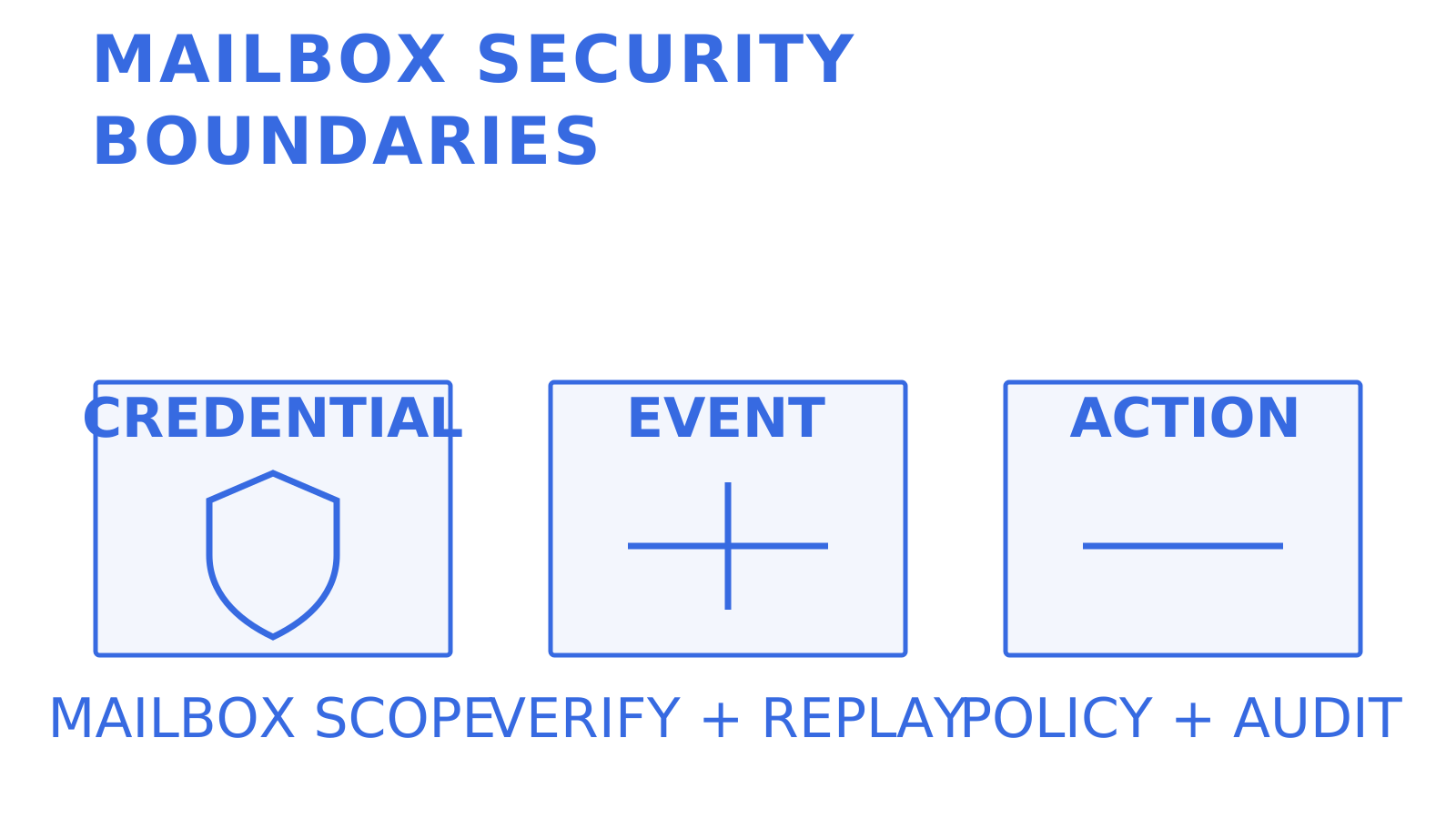
Access control matters because one tenant's mailbox must not expose another's state. Sendmux documents mailbox-scoped access and explicit permission surfaces, alongside team roles for management actions. Test permitted and forbidden credentials against message, thread, attachment, identity, and settings endpoints. Do not infer that every key is isolated merely because it was issued for a mailbox.
Webhook security is another boundary. SendGrid documents signed event webhooks and OAuth as security options. Sendmux documents signed backend webhooks, while its mailbox API exposes a separate SSE stream for live events. HMAC-SHA256 signatures, delivery retries, and SSE are related operational surfaces, but they are not one interchangeable channel.
Authentication verdicts can help an agent decide whether a sender's domain passed available checks, but those verdicts are inputs rather than proof that a message is safe. Combine them with mailbox policy, allow and block rules, content safeguards, action authorisation, and audit trails.
Keep mailbox access, event authenticity, and agent authority as separate controls.
## Scalability and Performance Under Multi-Tenant Load
Raw throughput is only one scaling dimension. A multi-tenant platform also needs fair capacity, bounded retries, observable queue age, provider-specific limits, and a way to prevent one tenant's burst from exhausting shared resources.
Sendmux applies quotas to configured providers across second, minute, hour, and day windows, and its routing layer evaluates eligible providers. That can isolate one provider's capacity boundary, but it is not the same as a guaranteed per-tenant quota. A platform serving 50 mailboxes and one serving 5,000 may need different application-level admission control even when both use the same provider API.
Ask each candidate how limits are scoped, what `Retry-After` or equivalent signal is exposed, how delayed work is retained, what expires, and how operators distinguish provider quota, lock contention, temporary failure, and terminal rejection. Test zero, one, and many messages for both permitted and forbidden tenants.
## User Interface and Usability Differences That Matter
For infrastructure, the most important interface is usually the API and documentation engineers use every day. A dashboard still matters for people investigating message state, delivery attempts, domains, usage, and access without writing a query.
AgenticMail is CLI- and self-hosting-oriented. Hosted products usually combine API access with a web dashboard, but the useful question is whether that dashboard exposes the same identifiers and states as the API. If support sees one state while the application receives another, diagnosis gets slower.
OpenAPI 3.1, generated clients, SDKs, a CLI, and MCP tools can reduce integration work when their coverage is current and tested. Generate or run the client for the exact operations in the proof of concept. A list of languages is not evidence that every edge case or release is equal, and a loose claim about LangChain or the Vercel AI SDK should not replace a verified integration surface.
## Why Mailbox-First Beats Deliverability-Only Thinking
Mailbox-first is the right frame when the product needs an address with durable state and an agent that can receive, reason, and reply. Deliverability-only comparisons miss permission scope, inbound recovery, thread state, attachments, duplicate processing, and tenant isolation.
It is still possible to overcorrect. A receipt sender, password-reset service, or marketing programme may need a strong delivery API and event stream without a persistent mailbox for each user. Conversely, an autonomous support or operations agent may need a mailbox model even if its outbound volume is low. Match architecture to behaviour instead of assuming one category wins.
For a 2026 evaluation, prioritise the resource model first, event and recovery semantics second, and eligible-provider routing third. Then test deliverability with representative domains and recipients. A missing thread or permission model can force a rebuild; a routing configuration can often be changed without replacing the whole application.
## Get Started With a Mailbox-First Email API
If the application needs persistent agent mailboxes, Sendmux is one option to test against the checklist above. It exposes mailbox-scoped API surfaces, structured messages and threads, inbound events, and outbound delivery through configured providers. Those capabilities should be verified against the exact tenant, identity, attachment, domain, quota, event, and recovery cases in the intended workload.
Start with one mailbox and one critical round trip. Receive a message, inspect the body and attachment contract, reply in context, observe the delivery state, interrupt one event path, and prove recovery. Then test 50 and 5,000 only as representative scale shapes, not as universal thresholds. Expand only after the same checks pass for multiple tenants and forbidden credentials.
## FAQ
### What Makes an Email API "Mailbox-First"?
A mailbox-first API treats the mailbox, messages, threads, identities, permissions, and inbound state as first-class resources. It may also send mail, but the defining test is whether an agent can receive, inspect, and act on durable mailbox state without assembling that model from an outbound API and an inbound parser.
### Is Sendmux a Direct Replacement for SendGrid?
Not for every SendGrid workload. Sendmux is an option when the product needs persistent agent or tenant mailboxes, scoped access, inbound state, and outbound delivery. SendGrid remains an email-delivery platform with Inbound Parse and event webhooks, so compare the exact resources, templates, marketing features, routing, and operational controls you use.
### How Do I Test Reliability Before Committing to a Provider?
Run the provider's documented recovery path rather than assuming every platform uses lease, ack, and nack semantics. Interrupt processing after receipt, verify redelivery or replay, send the same idempotency key twice, disable an event endpoint, and confirm the documented retry and reconciliation behaviour.
### Does Self-Hosting Improve Deliverability?
Not inherently. Self-hosting gives a team more control over domains, DKIM, SPF, infrastructure, and sending policy, but it also transfers reputation, abuse prevention, monitoring, patching, uptime, and incident response to that team.
### What Should I Check First in a Proof of Concept?
Start with the resource model and the critical round trip: provision or connect an address, receive a message, read its body and attachments, preserve thread context, reply, observe delivery events, and recover from one failed attempt. Then test tenant isolation, quotas, and provider-specific limits.
## Recommended
- [Front Alternatives for AI Agent Mailboxes – Best Email Tools](https://myagent.mx/blog/topic/Front%20alternatives)
- [AgentMail Alternatives for Developer Email APIs](https://myagent.mx/blog/topic/agentmail%20alternatives)
- [The Best Front Alternatives for AI Agent Mailboxes](https://myagent.mx/blog/front-alternatives)
- [AgentMail Alternatives for Developers: Inbox & API Picks](https://myagent.mx/blog/agentmail-alternatives)