---
title: "Six step POC for AI agents: Mailbox first OneSignal alternatives"
description: "Developer focused comparison of OneSignal alternatives that give AI agents real mailboxes. Run the six step POC checklist and verify Sendmux's mailbox,..."
canonical: "https://myagent.mx/blog/onesignal-alternatives"
publishedAt: "2026-08-29T21:09:19.025Z"
updatedAt: "2026-09-01T00:05:50.982Z"
category: "alternatives"
topic: "onesignal alternatives"
author: "Roshan Jonnalagadda"
authorProfile: "https://myagent.mx/blog/author/roshan-jonnalagadda"
keywords:
- "OneSignal alternatives"
- "free push notification tools"
- "OneSignal vs alternatives"
- "best push notification services"
- "push notification platforms"
- "top alternatives for OneSignal"
- "push notification software comparison"
- "best notification apps"
- "OneSignal competitors"
- "email and push notification services"
- "mobile notification solutions"
- "alternatives to OneSignal"
---
# Six step POC for AI agents: Mailbox first OneSignal alternatives
Developer focused comparison of OneSignal alternatives that give AI agents real mailboxes. Run the six step POC checklist and verify Sendmux's mailbox,...
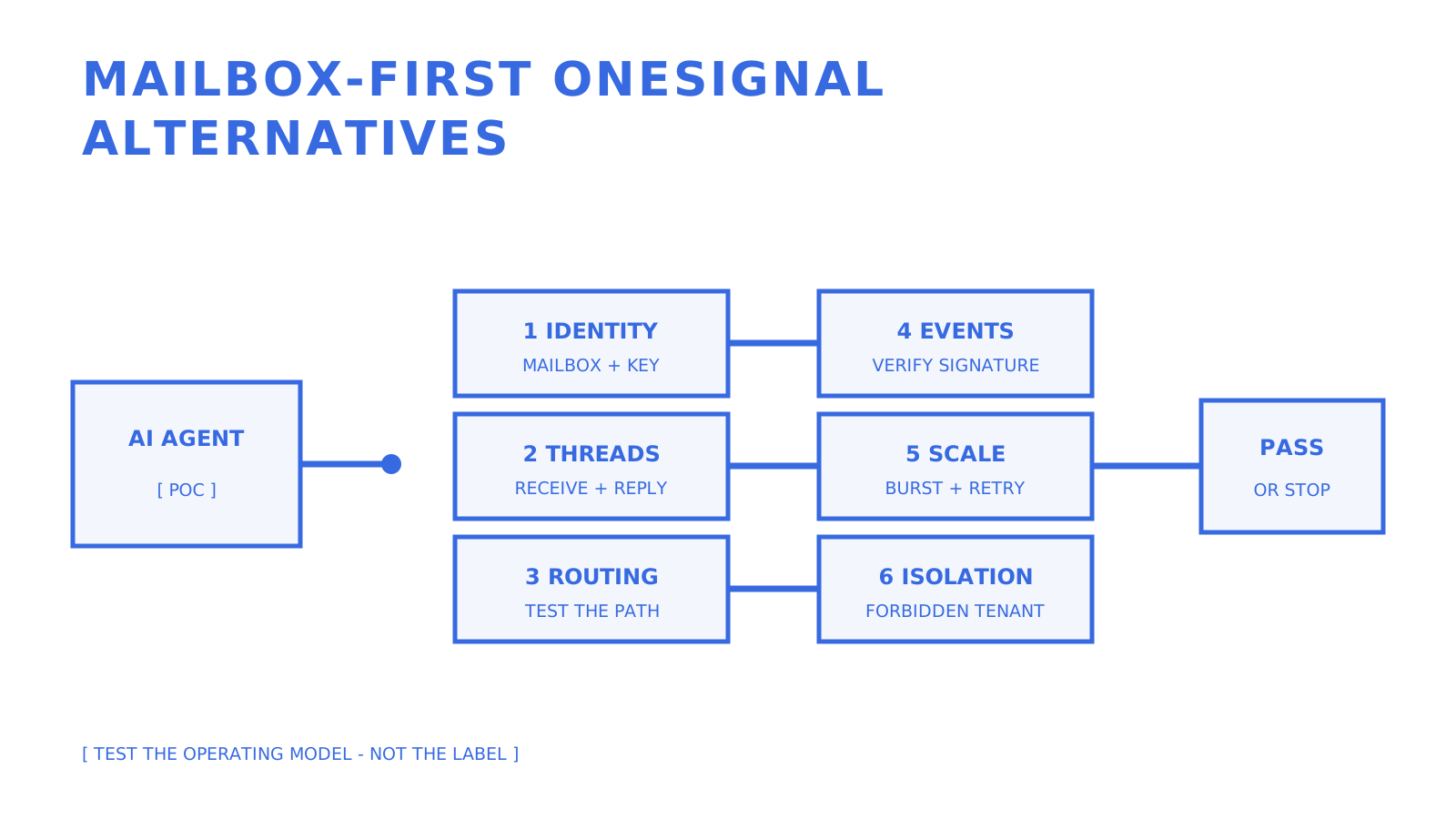
A proof of concept should test mailbox state, routing behaviour, events, and isolation as separate concerns.
If your agents need a real inbox rather than a push token, Sendmux is one mailbox-first alternative to evaluate. It gives agents mailbox API access and scoped keys instead of treating email as a one-way notification channel. It suits AI-agent builders, multi-tenant SaaS platforms, and automation teams that need programmatic sending and receiving with usage-based billing.
***
> **TL;DR:**
>
> - Sendmux offers real mailbox capabilities with scoped API keys, configured delivery controls, and unified send/receive endpoints, making it ideal for AI agents and multi-tenant SaaS.
> - It uses usage-based billing with no separate per-mailbox usage line, and current repository evidence records a capacity target of 10 million messages per day rather than a workload-specific guarantee.
> - Testing a vendor involves creating mailboxes via API, verifying threaded conversations, route-specific failure behaviour, delivery latency, and webhook security with real events.
> - Integration still requires application work, even when a vendor publishes an OpenAPI specification, SDKs, a CLI, or MCP options.
> - Focus on idempotency, the exact configured route, failure handling, and event security during a proof of concept.
***
## Table of Contents
- [What are the best OneSignal alternatives for mailbox-first email?](#what-are-the-best-onesignal-alternatives-for-mailbox-first-email)
- [Which mailbox and delivery features actually matter for agents?](#which-mailbox-and-delivery-features-actually-matter-for-agents)
- [How do you run a proof of concept for mailbox-first email?](#how-do-you-run-a-proof-of-concept-for-mailbox-first-email)
- [How well does it integrate with existing platforms and CRMs?](#how-well-does-it-integrate-with-existing-platforms-and-crms)
- [Is the interface actually usable, or just documented?](#is-the-interface-actually-usable-or-just-documented)
- [Can it handle high-volume sending without falling over?](#can-it-handle-high-volume-sending-without-falling-over)
- [What about GDPR, CCPA and data compliance?](#what-about-gdpr-ccpa-and-data-compliance)
- [Do these tools offer a free tier or trial before you commit?](#do-these-tools-offer-a-free-tier-or-trial-before-you-commit)
- [What most comparisons get wrong about this](#what-most-comparisons-get-wrong-about-this)
- [Ready to test a mailbox-first setup yourself?](#ready-to-test-a-mailbox-first-setup-yourself)
- [Sources](#sources)
- [FAQ](#faq)
## What are the best OneSignal alternatives for mailbox-first email?
The real question isn't "what replaces OneSignal" in the push-notification sense. It's which infrastructure gives an autonomous agent an actual mailbox it can send from, receive into, and reason over, without you gluing together a mail provider, an inbox hack, and a webhook relay. That's a different category, and OneSignal was never built for it.
Four realistic routes exist, and they carry very different operational costs.
- **Sendmux** gives each agent, customer or workspace a real mailbox on a shared or custom domain, with mailbox-scoped keys and unified send/receive APIs. Best for AI agents, multi-tenant SaaS and outbound automation that need per-agent inboxes without building the plumbing themselves.
- **API-first mailbox services** (category) provision mailboxes and expose REST endpoints for reading and writing messages. Inkbox, for example, documents [webhooks and full-text search](https://inkbox.ai/docs/api/mail). Best for teams that want fast provisioning without running their own mail servers.
- **Self-hosted MCP/email servers** (category) hand you full control over the mail stack and authentication. Best for organisations with strict on-premise or data-residency requirements.
- **Protocol-bridge stacks** (category) bolt SMTP/IMAP inbound parsing onto a send-only provider using webhook relays. Best for teams migrating a legacy pipeline one piece at a time.
| Dimension | Sendmux | API-first mailbox services | Self-hosted MCP/email servers | Protocol-bridge stacks |
|---|---|---|---|---|
| Mailbox-first capabilities | Real mailbox per agent, threading, cleaned text/HTML | Mailbox provisioning, structured message objects | Full mailbox control, custom parsing required | Retrofitted, no native mailbox object |
| Multi-tenancy and isolation | Tenant isolation, team roles, scoped keys | Varies by vendor, often account-level only | Manual isolation, self-managed | Isolation depends on the bridge layer |
| Delivery controls and failover | Weighted routing, per-provider quotas, configured eligible-provider routing | Provider-dependent, often single-path sending | None built in, you engineer it | None, relies on the underlying SMTP provider |
| Developer tooling and SDKs | OpenAPI 3.1, SDKs in six languages, CLI 1.5.0 with 104 generated API commands | REST API, sometimes an SDK | Whatever the open-source project ships | Whatever the parser/relay ships |
| Security and access controls | Mailbox-scoped keys, HMAC webhooks, SSE | Webhooks, API keys, scope varies | Full control, full responsibility | Weakest link is usually the relay |
| Pricing model and quotas | Usage-based, no per-mailbox fees | Often per-mailbox or tiered | Infrastructure cost, no vendor fee | Combined cost of provider plus relay tooling |
The single-line limitation worth remembering: API-first mailbox services save you build time but can reintroduce per-mailbox billing at scale; self-hosted MCP servers give you control but push all operational risk onto your team; protocol-bridge stacks work until the relay becomes the thing that pages you at 2am.
## Which mailbox and delivery features actually matter for agents?
Not every feature on a vendor's landing page changes how your agent behaves. Some are cosmetic. A handful are the difference between an agent that reasons cleanly and one that chokes on a malformed MIME part.
**Mailbox primitives first.** Agents don't want raw SMTP payloads. They want a thread object, cleaned message text, and HTML they don't have to sanitise themselves. This matters because SMTP is unstructured and returns error messages that aren't designed for machine consumption. An API that hands your LLM a parsed reply, with `in_reply_to` and `references` already resolved, removes an entire category of prompt-engineering hacks built just to compensate for messy input.
**Multi-tenancy is where things get architecturally serious.** [AgentMail's documented pod model](https://github.com/agentmail-to/agentmail-docs/blob/main/fern/pages/core-concepts/pods.mdx) groups inboxes, domains, and threads under pod-scoped access. Sendmux instead documents mailbox-scoped permissions and team roles. Test the exact tenant boundary each candidate exposes rather than assuming the two models are identical.
- Mailbox-scoped keys with explicit send, receive, read and update permissions
- Team roles (Owner, Admin, Developer, Member) for human oversight
- Per-team resource limits so one noisy tenant can't starve another
**Delivery engineering decides whether outbound scales.** Weighted delivery groups and per-provider quotas provide configured routing options, but failover depends on the selected provider type and eligibility rules. Connected Google and Microsoft sends fail closed when their authorised connection cannot be used. An `Idempotency-Key` header protects retries from creating duplicate submissions, so test the exact route and failure mode your application will use.
**Observability is non-negotiable at scale.** Delivery logs covering queued, sent, delivered, bounced, deferred, rejected and failed states, with CSV export, are what let you diagnose a deliverability problem instead of guessing.
**Practical benchmark:** inventory the exact mailbox operations your agent needs, such as sending, reading a thread, searching, drafting, and updating message state, then verify each one against the vendor's current public contract.
**Pro Tip:** *Test webhook security before you test features. Real-time delivery via SSE streams or signed webhooks with HMAC-SHA256 verification and retry/backoff tells you whether a vendor treats event delivery as production infrastructure or an afterthought.*
## How do you run a proof of concept for mailbox-first email?
Run a bounded proof of concept before committing to a vendor. The goal is to test a real send-and-receive loop against the current public contract.
1. **Create a mailbox via API**, not a dashboard click. If provisioning needs a support ticket, that's a scaling problem waiting to happen.
2. **Send a message, then reply to it from a second account**, and confirm the API returns a properly threaded exchange with cleaned text, not a raw MIME dump.
3. **Test the documented provider failure mode** and confirm whether the configured route switches, queues, or fails closed. Do not assume every provider type reroutes.
4. **Verify the webhook HMAC signature** on a real event, not just in the vendor's example code.
5. **Measure delivery latency** from send call to "delivered" status in the logs, across at least fifty messages, not five.
6. **Retry the same send with the same idempotency key** and [confirm the API creates one submission rather than two](https://resources.mailertogo.com/guide/complete-guide-to-ai-native-email-infrastructure).
Procurement questions worth asking before you sign anything: Is pricing per mailbox, per seat, or usage-based? Is there a minimum commitment? What delivery service level is published? Ask each vendor to document the exact provider-failure behaviour from step 3 and treat an unverified answer as a proof-of-concept gap.
**Pro Tip:** *Budget shape matters as much as feature checklists. Compare [Sendmux's current usage units](https://myagent.mx) with each candidate's current rate card at your expected mailbox count, accepted recipients, inbound deliveries, and storage.*
## How well does it integrate with existing platforms and CRMs?
Your agent stack doesn't operate in isolation, so integration depth matters more than raw API surface. Sendmux publishes an OpenAPI 3.1 specification, generated SDKs for TypeScript, Python, Go, PHP, Ruby and Rust, a [CLI 1.5.0](https://github.com/Sendmux/sendmux-sdk/releases/tag/ts-cli-v1.5.0) with 104 generated API commands, and hosted or self-hosted MCP options. First-party LangChain and Vercel AI SDK wrappers provide tools for sending email, listing mailbox messages and replying. Verify the exact package and operation your application needs instead of treating a tool count as coverage evidence.
That's the difference between "has an API" and "fits your stack without a translation layer." A protocol-bridge setup, by contrast, usually needs custom glue code to talk to your CRM or agent framework, because the bridge was never designed with those integrations in mind. Self-hosted MCP servers can integrate with anything, in theory, but you're writing and maintaining that connector yourself.
For teams running outbound automation through a CRM, the practical test is simple: can your agent frameworks call the mail API directly through an existing SDK, or does someone need to hand-roll a REST client first? If you're building a broader automation workflow around agent-driven outreach, tools like ChatzyBot show what a fuller conversational layer on top of that mail infrastructure can look like. A hosted OAuth MCP server, plus local and self-hosted options, also matters if your platform needs to hand agents mail access without exposing raw credentials.
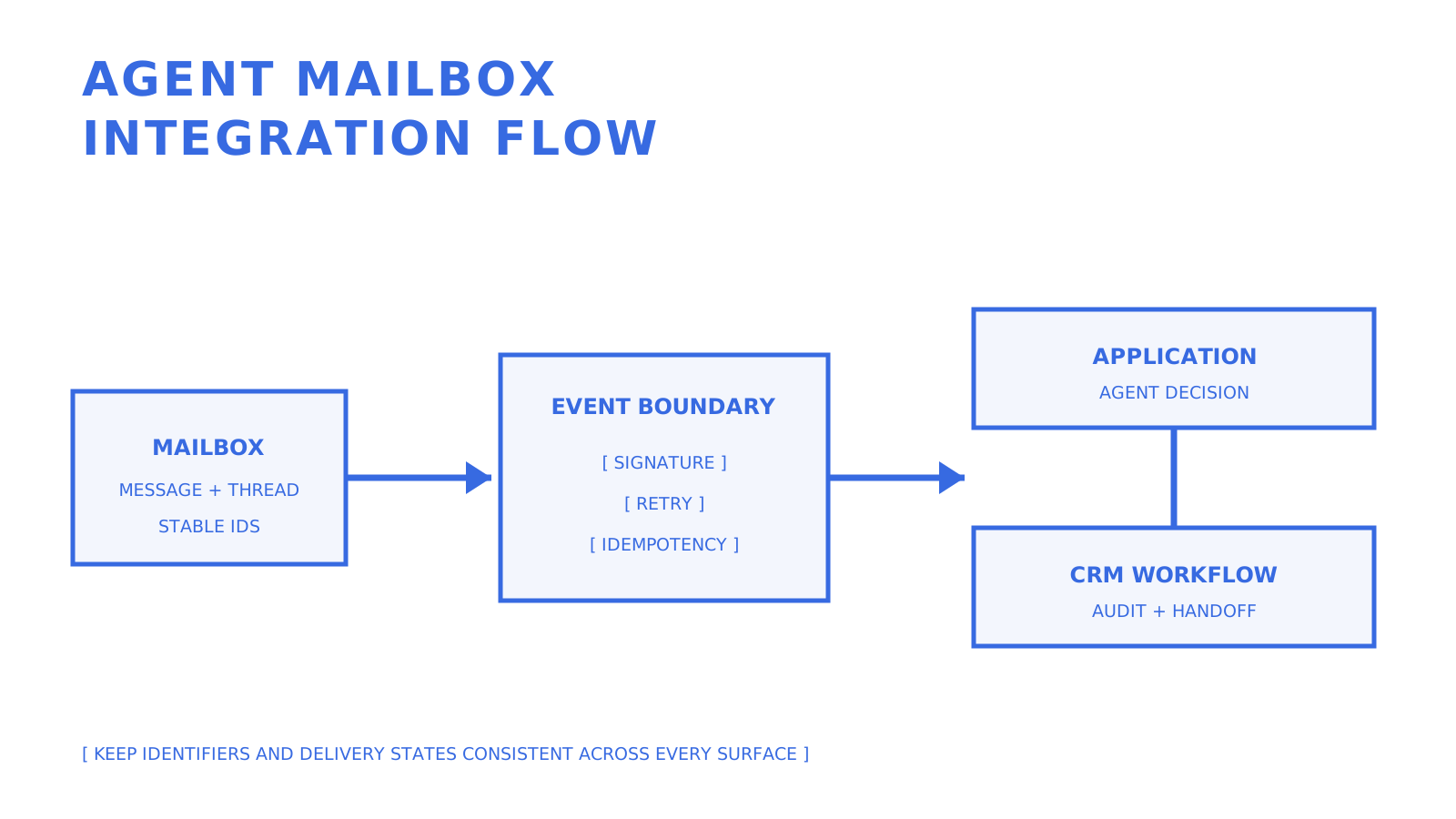
Integration depth depends on stable mailbox identifiers, signed events, and the application workflow that consumes them.
## Is the interface actually usable, or just documented?
Documentation quality and UI usability are separate questions, and vendors often nail one while ignoring the other. A dashboard that shows delivery metrics is useful for a human reviewing send health. An OpenAPI spec that's actually accurate, versus one that's three releases out of date, is what your agent's tooling depends on.
Sendmux runs both sides: a team inbox in the dashboard so humans can review what agents are sending, alongside the Mailbox API for programmatic access. That matters because most mailbox-first tools skew heavily toward one audience. API-first services tend to have thin dashboards, since their buyer is a developer who mostly lives in the API docs. Self-hosted MCP servers usually have no dashboard at all unless you build one.
The practical test during evaluation: open the dashboard and try to find a specific bounced message from a specific tenant, then find that same information through the API. If either path takes more than a couple of clicks or an obscure query parameter, that's a sign the tool was built for a demo, not daily operations.
## Can it handle high-volume sending without falling over?
Volume is where most "AI-ready" email tools quietly fail. A mailbox API that works cleanly at 500 messages a day can behave very differently at 500,000, because failure modes only show up under load: rate limits get hit, one provider throttles, retries stack up, and idempotency gaps turn into duplicate sends.
Current Sendmux repository evidence records a capacity target of 10 million messages per day, not a workload-specific guarantee. Configured delivery groups and provider quotas shape eligible routing, while connected Google and Microsoft accounts remain bound to their authorised connection. Batch sending accepts up to 100 messages per HTTP call, and SMTP submission is documented on ports 587 and 2525.
The categories that struggle most under volume are protocol-bridge stacks, because the relay layer between SMTP inbound parsing and the send-only provider becomes a bottleneck nobody planned for, and self-hosted setups where the team underestimated how much operational work goes into health checks and configured eligible-provider routing. If you're evaluating a vendor for a high-volume outbound use case, ask for their tested message-per-day ceiling directly. A vague answer here is the loudest red flag in the whole procurement process.
## What about GDPR, CCPA and data compliance?
Email infrastructure touches personal data by definition, which makes compliance posture a real evaluation criterion, not a checkbox. The question that matters isn't "do they mention GDPR on their site" but who controls the data, where it's stored, and what happens when a tenant needs their data deleted or exported.
Multi-tenant platforms carry extra weight here because a compliance failure in one tenant's data handling can expose the whole platform to risk. Tenant isolation, the kind pod-scoped keys and per-tenant resource limits are designed to enforce, isn't just an architecture nicety. It's what lets you tell an auditor that tenant A's data was never reachable by tenant B's credentials, provably, not just by policy.
Self-hosted MCP/email servers give you the most direct control over data residency, since nothing leaves your infrastructure, which is exactly why organisations with strict on-premise requirements gravitate toward them despite the operational overhead. Hosted providers, Sendmux included, need to show you where mail is stored, how long logs are retained, and how sender allowlists or denylists apply per domain or per mailbox to limit exposure. Ask any vendor directly for their data retention policy and deletion process before you commit; a vendor that can't answer clearly in one email hasn't thought hard enough about this.
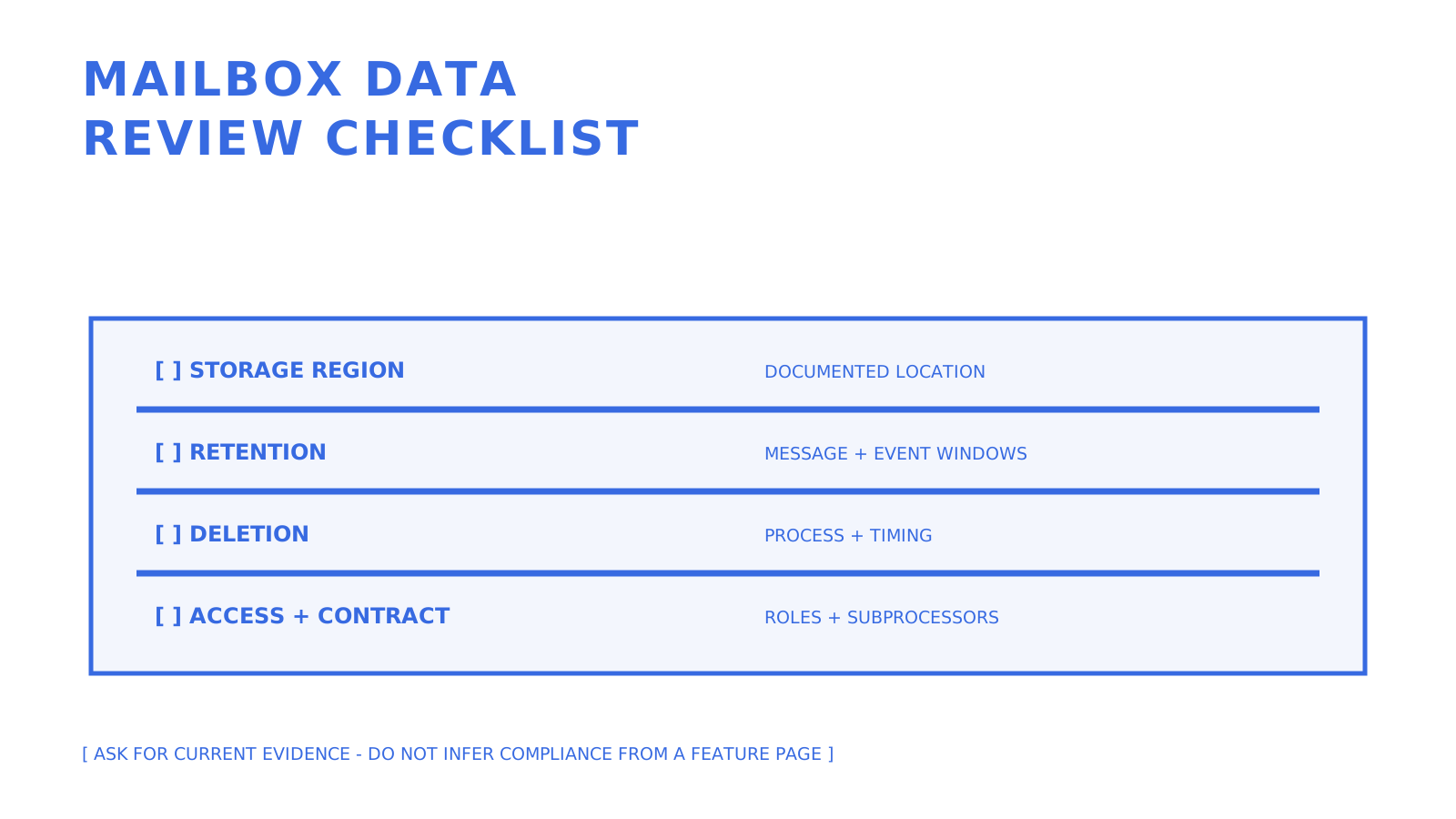
Compliance review starts with documented data location, retention, deletion, access, and contractual boundaries.
## Do these tools offer a free tier or trial before you commit?
Nobody should commit engineering time to a mailbox migration without testing it first, and the trial shape varies more across these categories than most feature comparisons let on.
API-first mailbox services often gate meaningful testing behind a paid tier once you exceed a handful of mailboxes, since their pricing model is frequently mailbox-based rather than usage-based. Self-hosted MCP/email servers are "free" in the sense that there's no vendor fee, but the real cost is your team's time standing up and maintaining the infrastructure, which is a trial cost that never shows up on an invoice. Protocol-bridge stacks inherit whatever trial terms the underlying send-only provider offers, plus whatever your own relay tooling costs to build.
Sendmux bills connected-provider accepted recipient occurrences at the equivalent of $0.50 per 1,000, managed Amazon SES accepted recipient occurrences at $0.75 per 1,000, and storage at $0.02 per decimal GB-month. There is no separate per-seat or per-mailbox usage line item. Free-team limits and owner approval still apply, so run the six-step proof of concept against the current account and billing documentation before modelling production cost.
## What most comparisons get wrong about this
Most "OneSignal alternatives" content treats email as a feature bullet on a bigger push-notification platform, and that framing is exactly backwards for anyone building agents. Push notification vendors optimise for reach and engagement metrics. Agent teams need something closer to infrastructure: a mailbox that behaves predictably under retries, exposes clean structured data, and fails in ways you can actually diagnose at 2am.
The conventional advice, "pick whichever provider has the most integrations", misses the operational detail. Compare the mailbox model, tenant boundaries, retry semantics, and provider-failure behaviour directly; integration count alone does not establish production fit.
Prioritise idempotency and route-specific failure handling early, alongside the interface, documentation, and pricing evidence. A proof of concept should show whether a retried request duplicates a send and what happens when the configured provider cannot accept it.
## Ready to test a mailbox-first setup yourself?
Use the six-step proof of concept to compare the routes against your own workload. Create a test mailbox, send a threaded reply, exercise the documented provider-failure behaviour, and verify an HMAC signature on a webhook event. Model the test against current usage units and account limits before estimating cost.
Start with the Agent Email product page to see the full Mailbox API surface, or head straight to the sales outreach use case if outbound automation is your priority. Your first API call is a mailbox creation request, then a send. If you're planning a tenant migration or need enterprise quota planning, contact the Sendmux team directly to scope it before you commit engineering time.
## Sources
- [AI-Native Email Infrastructure: Complete Developer Guide](https://resources.mailertogo.com/guide/complete-guide-to-ai-native-email-infrastructure)
- [AgentMail pods — core concepts](https://github.com/agentmail-to/agentmail-docs/blob/main/fern/pages/core-concepts/pods.mdx)
- [InkboxMail API — Mail API](https://inkbox.ai/docs/api/mail)
- [Sendmux billing documentation](https://sendmux.ai/docs/account/billing)
- [Sendmux Mailbox API documentation](https://sendmux.ai/docs/mailbox-api/introduction)
- [Novu workflow concepts](https://docs.novu.co/platform/concepts/workflows)
## FAQ
### Is Sendmux a direct replacement for OneSignal?
No. OneSignal is a push-notification platform; Sendmux is mailbox-first email infrastructure for AI agents and multi-tenant platforms, a different category entirely, which is exactly why teams building agent email search for alternatives in the first place.
### Do I need a self-hosted mail server to get full control over data?
Not necessarily. Self-hosted MCP/email servers give you maximum control at the cost of operational overhead, while Sendmux offers tenant isolation, mailbox-scoped keys and custom domain verification without you running the mail stack yourself.
### What's the real difference between API-first mailbox services and mailbox-first platforms like Sendmux?
API-first services provision mailboxes and expose REST endpoints, but their billing and routing models vary. Sendmux documents delivery groups, provider quotas, and usage-based billing with no separate per-mailbox usage line; verify the exact configured route and failure mode in your proof of concept.
### How do I verify a vendor's webhook security before committing?
Send a real test event and check the signature against HMAC-SHA256 verification in your own code, don't trust example code in the docs; Sendmux signs every webhook and retries with backoff on failure.
### Does usage-based pricing actually save money at scale?
It can, but the result depends on mailbox count, accepted outbound recipients, inbound deliveries, storage, plan fees, and each vendor's current rate card. Model the workload instead of assuming either billing shape wins.