---
title: "Build Mailboxes From $0.50 per 1,000: Six Novu Alternatives for Devs"
description: "Compare six Novu alternatives that put mailbox-first, per-agent mailboxes at the center. Evaluate pricing, MCP support, multi-tenant controls, failover,..."
canonical: "https://myagent.mx/blog/novu-alternatives"
publishedAt: "2026-08-30T23:13:26.139Z"
updatedAt: "2026-09-01T04:08:09.785Z"
category: "alternatives"
topic: "novu alternatives"
author: "Roshan Jonnalagadda"
authorProfile: "https://myagent.mx/blog/author/roshan-jonnalagadda"
keywords:
- "Novu comparison guide"
- "alternatives to Novu software"
- "Novu competitor tools"
- "best Novu substitutes"
- "Novu vs other services"
- "top Novu replacements"
- "affordable Novu alternatives"
- "Novu similar platforms"
- "find Novu alternatives"
- "compare Novu alternatives"
- "Novu alternatives"
- "popular Novu options"
- "Novu vs Courier"
---
# Build Mailboxes From $0.50 per 1,000: Six Novu Alternatives for Devs
Compare six Novu alternatives that put mailbox-first, per-agent mailboxes at the center. Evaluate pricing, MCP support, multi-tenant controls, failover,...
A useful Novu alternative comparison separates notification orchestration from persistent mailbox infrastructure.
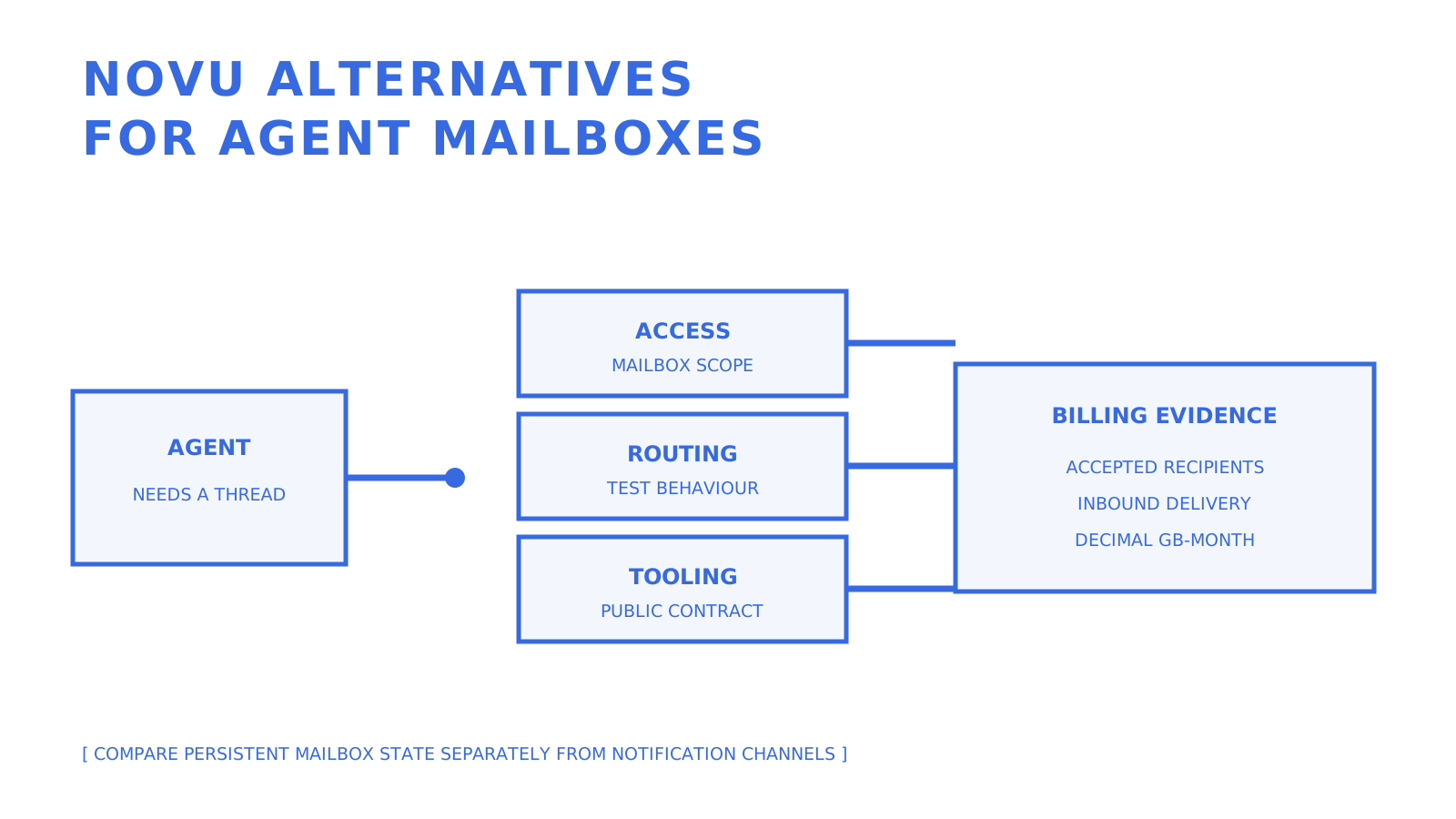
If you need per-agent mailboxes, MCP support, and multi-tenant isolation rather than general notification orchestration, Sendmux is one mailbox-first option to evaluate alongside Mailer To Go, Agent Mailbox (Neuron), Egressif, Bird, and Inkbox. Public evidence differs across the six, so verify mailbox behaviour, tenant controls, provider routing, and provisioning before choosing.
***
> **TL;DR:**
>
> - Sendmux provides mailbox infrastructure with thread support, mailbox-scoped keys, and configured provider controls; route behaviour depends on provider type and eligibility.
> - Current repository evidence records a capacity target of 10 million messages per day; connected-provider accepted recipient occurrences are billed at the equivalent of $0.50 per 1,000, with no separate per-seat usage line.
> - Verify that the platform offers programmatic mailbox provisioning, granular access controls, signed webhooks, and automatic provider failover before commitment.
> - Treat missing public evidence for throughput, MCP tooling, or tenant isolation as an evaluation gap rather than proof that a capability is absent.
> - Focus on mailbox-specific security controls, current documentation, and release history when selecting an alternative.
***
## Table of Contents
- [Novu alternatives: what actually separates them](#novu-alternatives-what-actually-separates-them)
- [Comparing the six platforms on the axes that matter](#comparing-the-six-platforms-on-the-axes-that-matter)
- [How to choose the right Novu alternative for your stack](#how-to-choose-the-right-novu-alternative-for-your-stack)
- [Pricing models: usage-based versus per-seat](#pricing-models-usage-based-versus-per-seat)
- [How feature sets compare against notification-orchestration tools](#how-feature-sets-compare-against-notification-orchestration-tools)
- [Setup and onboarding: what to expect in the first hour](#setup-and-onboarding-what-to-expect-in-the-first-hour)
- [Support and community: reading the fine print](#support-and-community-reading-the-fine-print)
- [Scalability: what the numbers actually tell you](#scalability-what-the-numbers-actually-tell-you)
- [Security and compliance features worth checking](#security-and-compliance-features-worth-checking)
- [Roadmap transparency and update cadence](#roadmap-transparency-and-update-cadence)
- [Why mailbox-first design is the detail everyone underrates](#why-mailbox-first-design-is-the-detail-everyone-underrates)
- [Try Sendmux for your agent mailbox infrastructure](#try-sendmux-for-your-agent-mailbox-infrastructure)
- [Sources](#sources)
- [FAQ](#faq)
## Novu alternatives: what actually separates them
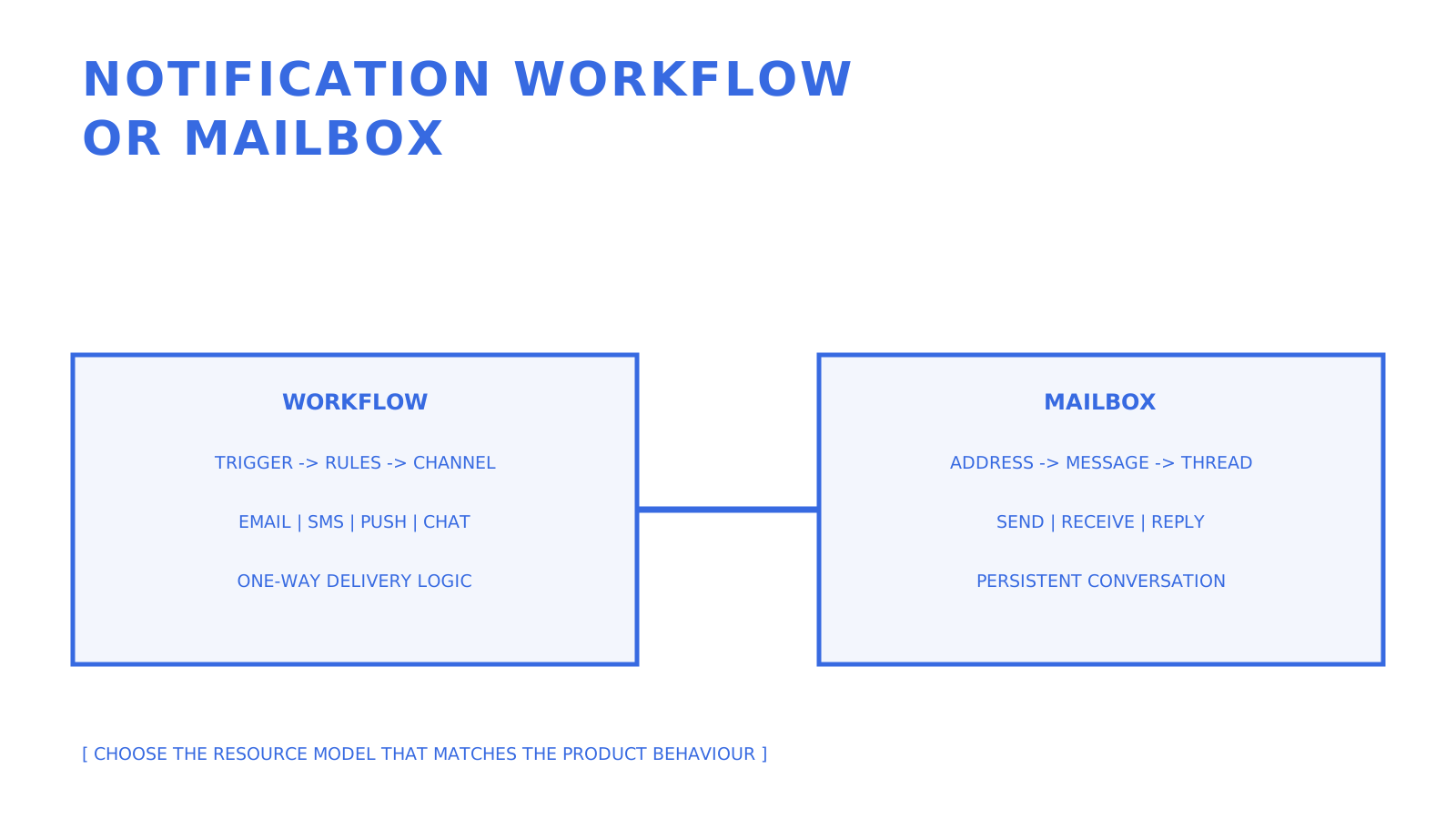
Notification orchestration platforms route alerts through channels. Mailbox-first infrastructure gives each agent, customer, or workspace an actual mailbox: a persistent address that sends, receives, and threads real email. That distinction matters the moment an agent needs to hold a conversation rather than fire a one-way alert, because a send-only API can't preserve context across replies, and agent mailboxes require both delivery and receive semantics to support any workflow longer than a single message.
This is the frame for the rest of the comparison: not "which tool sends the most notification types," but "which platform gives an autonomous agent a working mailbox it can own, reply from, and be isolated within." On that axis, the six tools below split into two camps. Sendmux, Mailer To Go, Bird, and Agent Mailbox treat the mailbox as the core primitive. Egressif and Inkbox lean on that primitive too, but each brings a narrower specialty (deliverability guardrails and search/import tooling, respectively).
### Mailbox-scoped access is the detail most teams miss first
A mailbox-scoped API key limits what any single agent can touch. Instead of one global key that can read, send, or delete across every tenant's mail, each key is bound to one mailbox with explicit permissions for send, receive, read, and update. Skip this and a single compromised or buggy agent key can read every customer's inbox on the platform. It's the first thing worth checking on any shortlist, before pricing, before UI, before anything else.
## Comparing the six platforms on the axes that matter
The table below only includes dimensions you can actually verify from each vendor's own documentation, not marketing copy.
| Platform | Mailbox-first capabilities | MCP / agent integrations | Multi-tenant controls & isolation | Sending routing & failover | Developer tools & SDKs | Pricing model |
|---|---|---|---|---|---|---|
| Sendmux | Per-agent mailboxes on shared or verified custom domains, threads, folders, mailbox-scoped keys | Hosted OAuth MCP plus local and self-hosted MCP options; separate Doc Search MCP; LangChain and Vercel AI SDK integrations | Owner/Admin/Developer/Member roles, team keys, documented team limits | Delivery groups and provider quotas; behaviour depends on route eligibility and provider type | OpenAPI 3.1, SDKs in 6 languages, CLI 1.5.0 with 104 generated API commands | Usage-based, no separate per-seat usage line |
| Mailer To Go | Zero-config inbox provisioning, agent-native inbox model | MCP server patterns built into the platform | Not detailed in public docs | Not detailed in public docs | Documented API patterns for agent frameworks | Not publicly listed
|
| Agent Mailbox (Neuron) | ThreadID tracking to preserve conversational context | MCP or HTTP API deployment | Not publicly listed | Not publicly listed | HTTP API, deploys in minutes | Not publicly listed |
| Egressif | Mailbox delivery outcomes recorded per identity | Not a primary focus | Per-identity policies for rate control | Per-identity rate gates, suppression enforcement, receiver-aware pacing | Not detailed in public docs | Not publicly listed |
| Bird | Generated or custom mailbox addresses, thread grouping, receive policies | Not a primary focus | Mailbox receive-policy controls | Not detailed in public docs | SSE event stream, webhook guidance | Not publicly listed |
| Inkbox | Mailbox provisioning, import pipelines, full-text search | Not a primary focus | Not publicly listed | Not detailed in public docs | REST API with import and search endpoints | Not publicly listed
|
A few evidence gaps are worth flagging directly. The public material reviewed here did not establish MCP tooling for Egressif or Inkbox, or detailed multi-tenant isolation contracts for Agent Mailbox and Mailer To Go. Bird's public material should be checked for the exact mailbox lifecycle, event, and provider-failure behaviour your proof of concept needs. These are verification gaps, not claims that a capability is absent.
**Pro Tip:** *Don't take a vendor's "minutes to production" claim at face value. Agent Mailbox and Mailer To Go both advertise fast provisioning, but the real test is whether a mailbox can receive its first inbound webhook inside that window, not just return a 200 on creation.*
## How to choose the right Novu alternative for your stack
Run this checklist before you commit engineering hours to any single vendor.
1. **Mailbox provisioning API.** Confirm you can create a mailbox programmatically, on your own domain if needed, without a support ticket.
2. **Mailbox-scoped keys.** Verify keys can be limited to one mailbox with granular send, receive, read, and update permissions rather than one account-wide credential.
3. **Threaded message model.** Test that replies carry `in_reply_to` and `references` headers so an agent reads a clean thread instead of reconstructing context from raw headers.
4. **Inbound delivery and signed webhooks.** Confirm webhooks arrive with a verifiable signature (Sendmux and comparable platforms use HMAC-SHA256) and retry with backoff on failure.
5. **Per-identity rate limits and suppression.** Per-identity rate gates at the delivery layer limit the blast radius of one runaway agent, so check whether the platform enforces this automatically or leaves it to you.
6. **Delivery logs with export.** Look for queued, sent, delivered, bounced, deferred, and failed states, ideally exportable to CSV for audits.
7. **Provider quotas and failover.** Ask what happens when one sending provider throttles you mid-campaign, and whether failover is automatic or manual.
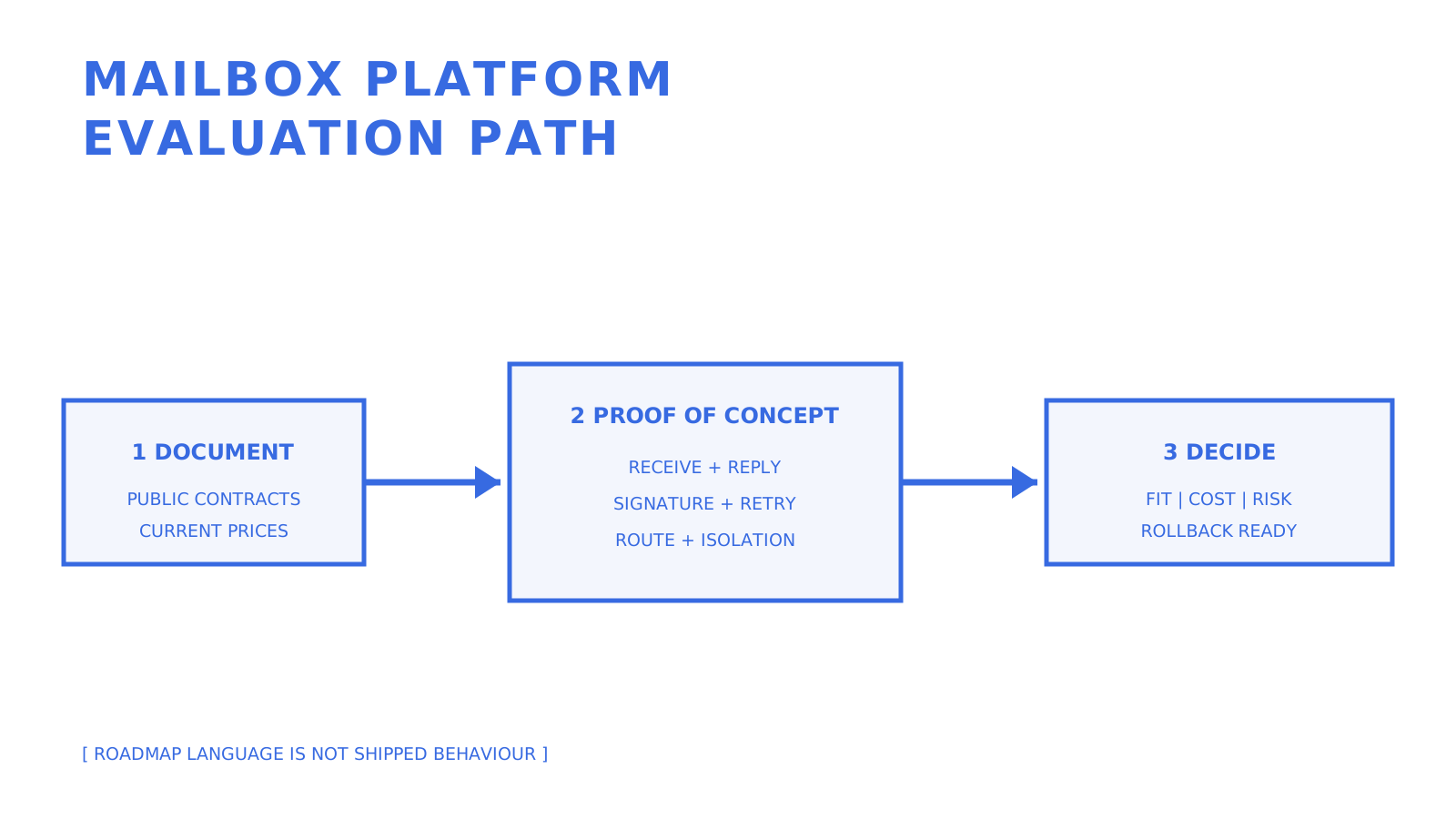
For the trial itself, budget one to four hours: provision a mailbox, trigger an inbound webhook, reply into an existing thread to confirm continuity, force a bounce to watch suppression kick in, and throttle one provider to validate failover under real conditions. If any step needs a support call to complete, that's a signal about what production support will look like later.
## Pricing models: usage-based versus per-seat
Most mailbox-first platforms bill one of two ways: per seat, or per unit of usage. Per-seat pricing charges for every human or agent mailbox you provision, regardless of how much mail actually moves. That model breaks down fast in agent-heavy systems, where you might spin up hundreds of mailboxes for a single customer's workflow, each sending only a handful of messages a day.
Usage-based billing charges for measured usage rather than each mailbox. Sendmux documents connected-provider accepted recipient occurrences, managed Amazon SES accepted recipient occurrences, inbound deliveries, and storage as separate usage units, with no separate per-mailbox usage line. Model those units against the current plan and account limits for your workload.
Other vendors on this list don't publish detailed pricing, which is worth flagging on its own. If a platform won't show you a rate card before a sales call, model your worst-case mailbox count against a plausible per-seat or per-mailbox fee before you commit engineering time to integration. A platform that looks cheap at ten test mailboxes can get expensive fast once you're running [one mailbox per customer](https://dev.to/mqasimca/one-agent-mailbox-per-tenant-in-a-multi-tenant-saas-37ne) across a few thousand tenants.
## How feature sets compare against notification-orchestration tools
Notification-orchestration platforms are built around channel abstraction: one workflow definition fans out to email, SMS, push, and in-app, with a visual workflow builder for non-technical teams to edit templates and triggers. That UI flexibility is genuinely useful for product notifications, but it assumes one-way delivery.
Mailbox-first platforms trade that channel breadth for depth on a single channel: real email with full receive semantics. There's no visual workflow builder in Sendmux, Bird, or Inkbox, because the unit of work isn't a notification template, it's a mailbox with a thread history, folders, and keywords. An agent reading a reply gets cleaned message text and HTML, not a payload describing that an email was sent.
If your product needs a password-reset or shipping-update workflow across multiple channels, Novu documents notification workflows for that orchestration model. For CRM-specific examples, see [lead follow-up and customer onboarding workflows](https://techbusinessdevelopment.com/blog/crm-workflow-automations-10-examples-for-2026-en). If your product needs an agent to hold a back-and-forth email conversation or each tenant to own a distinct sending identity, test a mailbox-first system's receive, thread, and isolation semantics directly.
Notification workflows coordinate channels; mailbox-first systems preserve addresses, inbound messages, and thread state.
## Setup and onboarding: what to expect in the first hour
Provisioning speed varies more than most vendors admit upfront. Agent Mailbox (Neuron) advertises deployment within minutes using MCP or an HTTP API, and that claim tracks with what a minimal mailbox creation flow should look like: one API call, one address back.
Sendmux documents an agent registration path that creates a mailbox and requires a human owner to approve sending. Test that approval boundary together with mailbox provisioning rather than treating a successful create response as production readiness.
Custom domain setup is where onboarding timelines diverge most. Verifying SPF, DKIM, and DMARC records, plus bounce handling, typically takes longer than mailbox provisioning itself, since DNS propagation is outside any vendor's control. Budget a separate afternoon for domain verification if you're not using a platform's shared sending domain. Bird and Inkbox both document mailbox creation clearly, but neither publishes a full domain verification walkthrough in public docs, so factor in extra discovery time if you go that route.
## Support and community: reading the fine print
Public documentation depth is the clearest proxy available for support quality before you pay anything. Mailer To Go and Egressif both publish focused solution pages describing their approach to agent mail and deliverability respectively, but neither exposes a large public developer community, forum, or changelog you can browse before signing up.
Bird's documentation on mailbox lifecycle, receive policies, and event streams is thorough and reads like a team that expects developers to self-serve through docs rather than lean on support tickets for basic integration questions. Inkbox's API reference covers provisioning, import, and search in enough detail to build against without a sales call.
Sendmux publishes an OpenAPI 3.1 specification, generated SDKs across six languages, a [CLI 1.5.0](https://github.com/Sendmux/sendmux-sdk/releases/tag/ts-cli-v1.5.0) with 104 generated API commands, and hosted or self-hosted MCP options. Its separate [Doc Search MCP](https://sendmux.ai/docs/ai-integrations/mcp) searches guides and API references. Verify the exact operation your integration needs instead of treating a tool count as coverage evidence. Community size alone does not establish support quality. Weigh documentation depth over community size.
Public documentation narrows the shortlist, but the production decision still depends on a workload-specific proof of concept.
## Scalability: what the numbers actually tell you
Throughput claims are easy to state and hard to verify without running your own load test. Current Sendmux repository evidence records a capacity target of 10 million messages per day, but that is not a workload-specific performance guarantee. Test the mailbox count, recipient mix, provider routes, and burst shape your product will use.
None of the other five platforms in this comparison publish an equivalent throughput benchmark in public documentation, which doesn't mean they can't scale, only that you can't verify it before you build. If scale is a genuine concern for your workload, ask directly for a benchmark or a reference architecture during evaluation rather than assuming parity across vendors.
Batch sending matters just as much as raw throughput for agent workloads that fire in bursts rather than a steady drip. A platform that accepts single messages fine but chokes on a batch of a hundred will surface that problem the first time an agent runs a bulk outreach job, not during a quiet demo. Test batch behaviour explicitly during your POC, not just single-message latency.
## Security and compliance features worth checking
Signed webhook verification is a baseline security check: without it, a caller that knows the endpoint can submit an unauthenticated event. Sendmux documents HMAC-SHA256 signatures and retries for outbound delivery webhooks. Verify the equivalent contract and failure handling for every other candidate directly.
Beyond webhook signing, look for mailbox-scoped access control as a security feature, not just a convenience one. A key limited to a single mailbox with explicit permissions contains the damage from a leaked credential to one tenant's mail, rather than exposing every customer on the platform. Sender allowlists and denylists, applied per domain or per mailbox, add a second layer that stops an agent from emailing addresses it has no business contacting.
If your platform has regulatory obligations around email content or storage, request current certification, data-processing, retention, and deletion evidence from every shortlisted vendor. Do not infer compliance from a feature page or from an absence in this article's reviewed material.
## Roadmap transparency and update cadence
A public changelog is stronger evidence than an undated roadmap because it distinguishes shipped behaviour from future intent. For planned features such as cross-mailbox search APIs, filter-scoped keys, migration/import tools, or connected-inbox support for Gmail, Microsoft 365, Proton Mail and IMAP, require current public contracts before treating them as available. Sendmux's documented mailbox search is scoped to the selected mailbox. It does not establish cross-mailbox search or inbox-sync support for those providers.
Inkbox documents import pipelines and full-text mailbox search, which is worth testing if migration tooling is an immediate need. For every other current or future capability, use the vendor's latest public contract or obtain written evidence during evaluation rather than inferring a roadmap from missing material.
If roadmap transparency matters to your decision, that's a fair question to put directly to a vendor's sales or developer relations team rather than guessing from a changelog that may not exist publicly yet.
## Why mailbox-first design is the detail everyone underrates
Channel breadth and mailbox architecture answer different questions. For an agent-mailbox workload, test whether an agent can hold a real thread, stay isolated to its own mailbox, and have limits applied at the intended identity boundary.
Per-identity rate gates and suppression controls can limit the scope of one agent's behaviour, but their exact effect depends on the provider and reputation boundary. Developer tools such as an OpenAPI specification, SDKs, and a scriptable CLI make the integration contract easier to inspect and test.
## Try Sendmux for your agent mailbox infrastructure
The six candidates expose different mailbox, isolation, delivery, and tooling contracts. Sendmux combines mailboxes, mailbox-scoped credentials, and configured provider controls in one API, but route behaviour still depends on provider type and eligibility. Test that exact route rather than assuming universal failover.
Every agent or workspace can use a mailbox on @myagent.mx or a verified custom domain, with mailbox API access, SSE mailbox events, signed HMAC-SHA256 webhooks, and team roles. Run a proof of concept that provisions a mailbox, tests threaded replies, verifies a webhook signature, and exercises the exact configured provider route. Connected-provider accepted recipient occurrences cost the equivalent of $0.50 per 1,000, with no separate per-seat usage line item.
## Sources
- [Novu workflow concepts](https://docs.novu.co/platform/concepts/workflows)
- [Inkbox Mail API](https://inkbox.ai/docs/api/mail)
- [Egressif agent email infrastructure](https://egressif.io/solutions/ai-agents)
- [Sendmux billing documentation](https://sendmux.ai/docs/account/billing)
- [Sendmux Mailbox API documentation](https://sendmux.ai/docs/mailbox-api/introduction)
## FAQ
### What Makes a Platform "Mailbox-First" Rather Than Notification-Based?
A mailbox-first platform gives each agent or tenant a real, persistent email address that sends and receives full threaded conversations, rather than firing one-way alerts through a channel abstraction.
### Does Sendmux Support MCP for Agent Frameworks?
Yes. Sendmux documents hosted OAuth MCP plus local and self-hosted MCP options. Doc Search MCP searches guides and API references. It is separate from the product MCP connection. First-party LangChain and Vercel AI SDK wrappers provide tools for sending email, listing mailbox messages and replying. Verify the current tool surface against the workflow your agent framework needs.
### How Do Mailbox-Scoped API Keys Improve Security?
A mailbox-scoped key limits access to one mailbox with explicit send, receive, read, and update permissions, so a leaked or compromised key can't expose every tenant's mail on the platform.
### Which Alternative Handles Provider Failover Automatically?
Sendmux supports configured delivery groups and provider quotas, but route behaviour depends on provider type and eligibility. Connected Google and Microsoft accounts fail closed when their authorised connection cannot be used, so test the exact failure mode rather than assuming universal failover.
### Is Usage-Based Pricing Cheaper Than Per-Seat for Agent Mailboxes?
It can be, but the result depends on mailbox count, accepted outbound recipients, inbound deliveries, storage, plan fees, and each competitor's current rate card. Model the workload instead of assuming either billing shape wins.