---
title: "Avoid rebuilds: Maildir vs mbox for AI agents, use mailbox APIs"
description: "Decide whether an ephemeral inbox or a persistent mailbox API suits your AI agent. Learn API flows, scoped tokens, and scaling tradeoffs."
canonical: "https://myagent.mx/blog/maildir-vs-mbox"
publishedAt: "2026-09-29T14:22:38.201Z"
updatedAt: "2026-10-01T15:52:48.000Z"
category: "agents"
topic: "maildir vs mbox"
author: "Roshan Jonnalagadda"
authorProfile: "https://myagent.mx/blog/author/roshan-jonnalagadda"
keywords:
- "maildir format advantages"
- "maildir vs mbox differences"
- "which is better maildir or mbox"
- "mbox file format"
- "maildir vs mbox"
- "mail storage comparison"
- "how to convert mbox to maildir"
---
# Avoid rebuilds: Maildir vs mbox for AI agents, use mailbox APIs
Decide whether an ephemeral inbox or a persistent mailbox API suits your AI agent. Learn API flows, scoped tokens, and scaling tradeoffs.
For an autonomous agent, "maildir vs mbox" really comes down to a different question: should your agent get a temporary inbox for a one-off task, or a persistent, API-accessible mailbox it can use across many conversations? For most agents that need to receive replies, hold context or represent a tenant, a hosted mailbox with scoped credentials on a shared domain is the more capable and more maintainable path.
***
> **TL;DR:**
>
> - Persistent mailboxes with API support for threading, search, and event delivery are essential for agents that need memory, search, or tenant isolation.
> - Scalability relies on automated self-registration, tenant separation, and request limits, enabling thousands of mailboxes without manual provisioning.
> - Mailbox providers must have API endpoints for message filtering, batch operations, attachment handling, and real-time event delivery to ensure efficiency.
> - Using scoped credentials and staged approval processes helps prevent deliverability issues and limits damage from compromised agents.
> - Simple disposable inboxes outperform persistent ones only for single, one-off verification tasks lacking history or multi-tenant needs.
***
## How the two approaches differ for autonomous agents
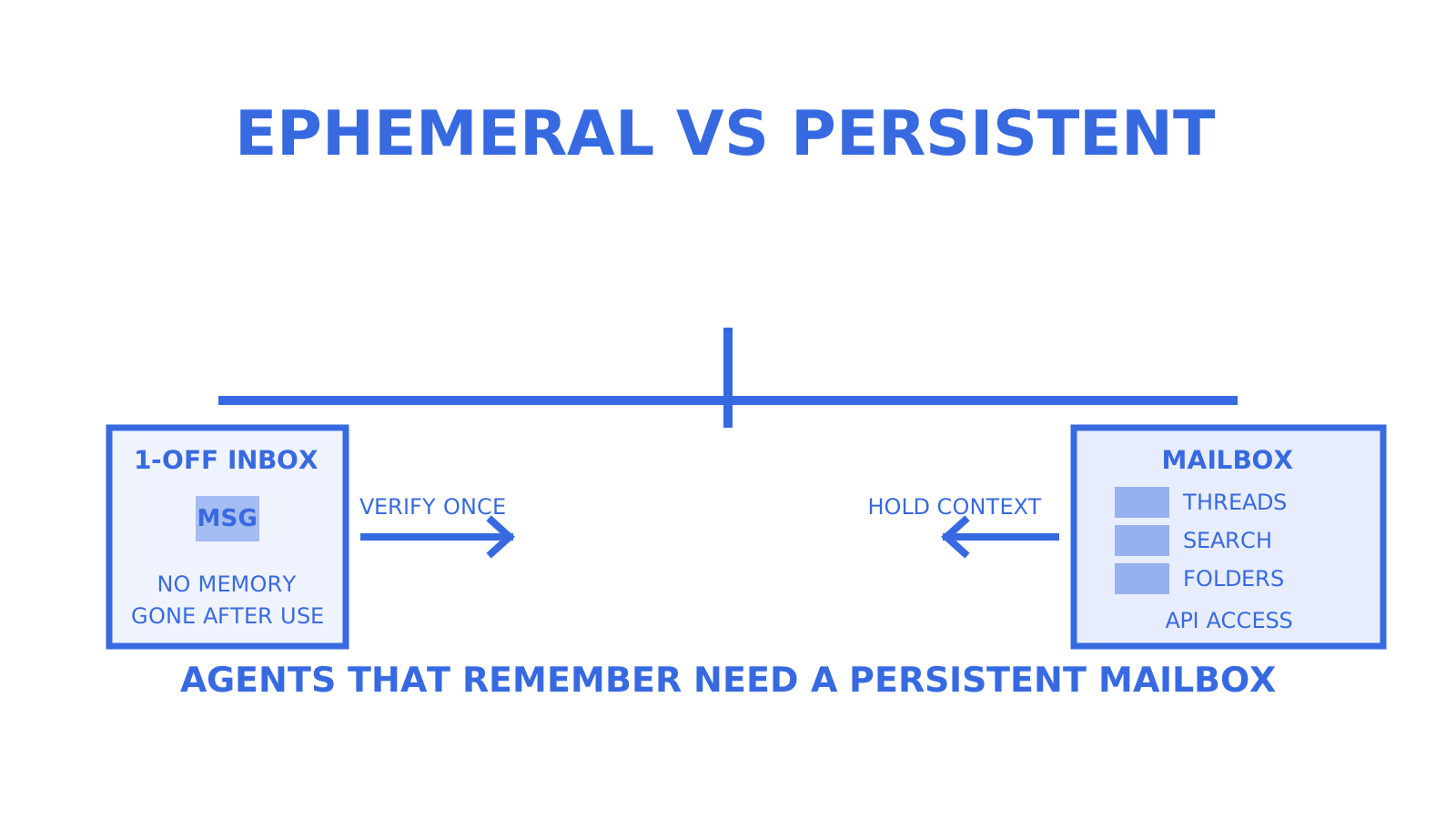
An ephemeral inbox works well when an agent needs to prove ownership of an address, receive a single confirmation code or complete a short verification loop and then disappear. It is quick to spin up and asks nothing of your architecture. The trouble starts when the same agent needs to remember a conversation, search past messages or represent one customer among thousands. A one-off inbox has no memory of its own history, so every new task starts from zero context.
A persistent, API-first mailbox solves that by keeping messages, threads and folders as durable state rather than a stream you catch once and discard. Threading, search and tenant isolation live in the platform, so the agent queries what it needs instead of reconstructing it from scratch.
- **Ephemeral inboxes** suit short verification tasks where nothing needs to be remembered afterwards.
- **Persistent mailboxes** suit agents that hold multi-turn conversations, need search across history, or represent a distinct tenant, customer or case.
- **Storage and quotas** become real considerations once mailboxes are long-lived, since attachments and message history accumulate.
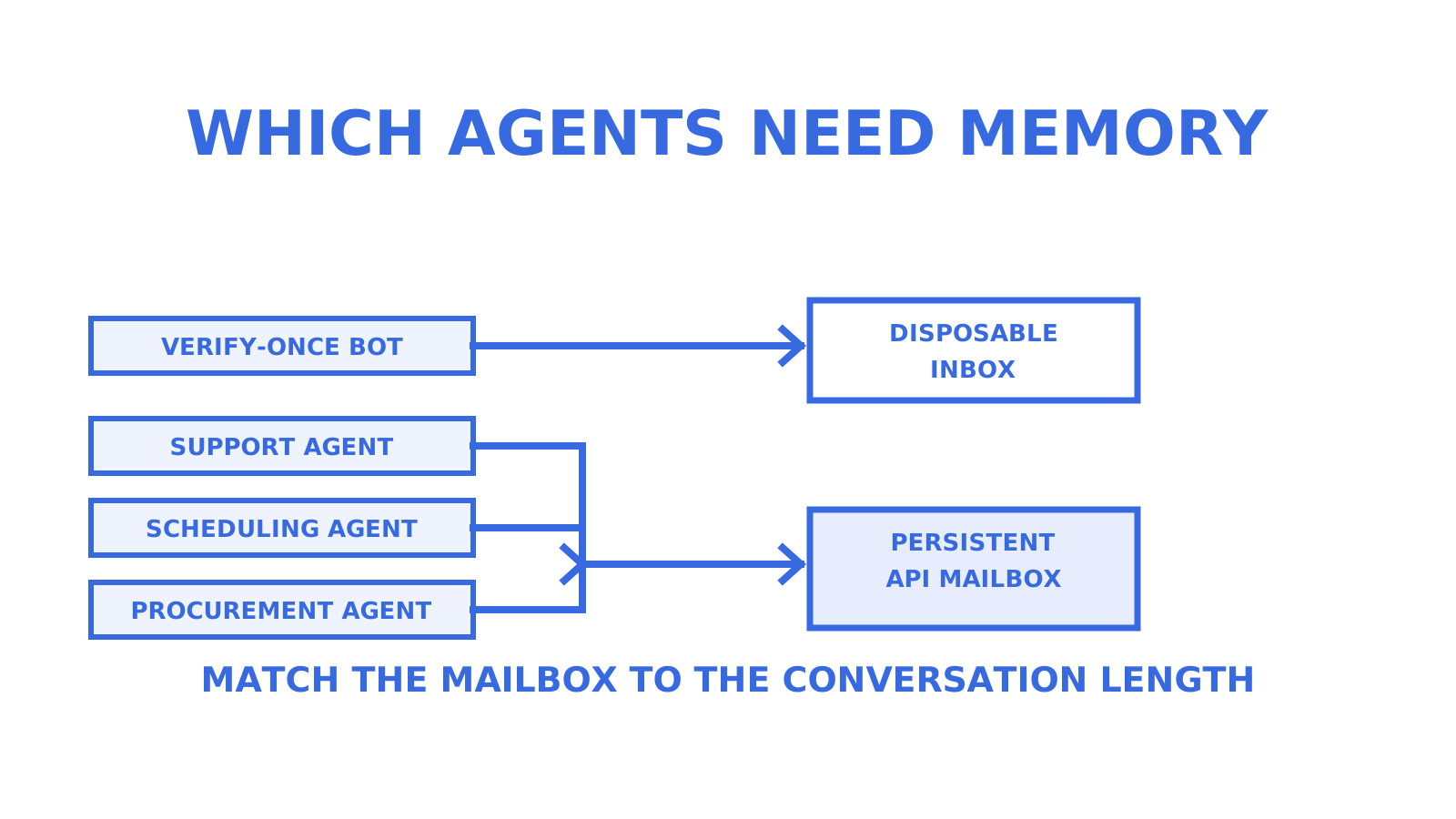
- **Support, scheduling and procurement agents** typically need persistence; simple outbound-only notification bots often don't.
The right choice depends on whether the agent's job requires memory. Build for the actual conversation length, not the simplest thing to wire up today.
## Mailbox API capabilities agents must have
Before picking a provider, check that its Mailbox API actually gives your agent what it needs to act on mail, not just receive it.
1. **Threading support**, using fields such as `in_reply_to` and `references`, so a reply lands in the right conversation instead of starting a new one.
2. **Search and snippet endpoints** that filter by folder, sender, subject, date range or keyword, and return previews without pulling full message bodies every time.
3. **Attachment handling** that accepts uploads by reference or base64, enforces sane size limits, and serves inbound files through short-lived download links rather than forcing binaries into a prompt.
4. **Sync tokens and batch operations** so an agent can ask "what changed" instead of re-listing an entire mailbox, and update or delete many messages in one call.
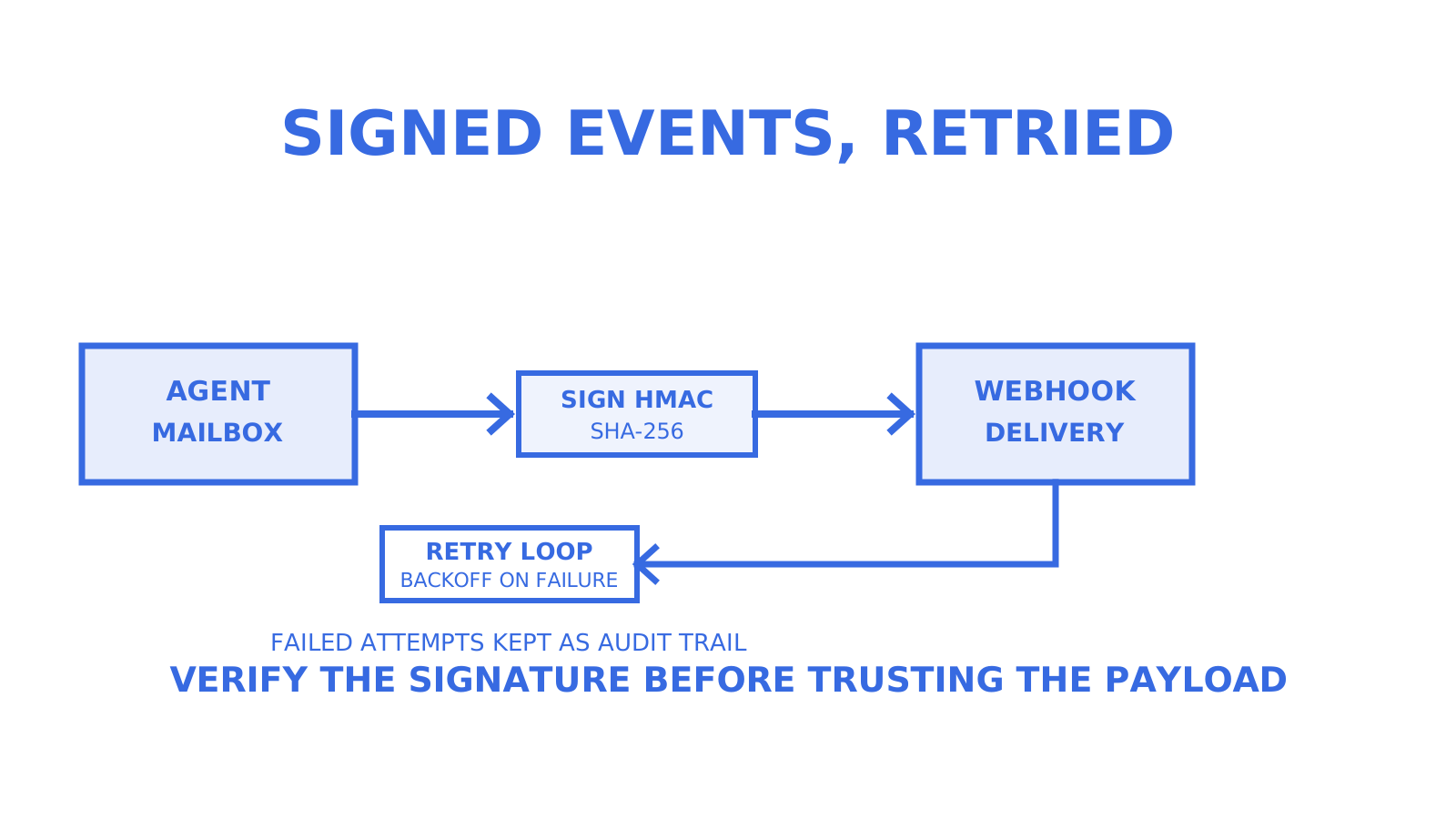
5. **Real-time event delivery**, either through a Server-Sent Events stream or signed webhooks with retry and backoff, so inbound mail reaches the agent without constant polling.
Sendmux's Mailbox API, for example, supports message threading, search filters, attachment uploads and short-lived download links, along with sync tokens, batch operations and SSE or webhook event delivery. That combination matters because agents that only get a raw dump of every message tend to burn context and tokens re-parsing history they've already seen.
**Pro Tip:** *Ask a prospective mailbox provider for its OpenAPI spec before you write a single line of integration code. If threading, search and batch endpoints aren't in the spec, treat them as unavailable for your integration.*
## Security and scoped credentials for agent mailboxes
Giving an agent an email identity means giving it credentials, and the shape of those credentials decides how much damage a compromised agent can do. A well-designed platform separates keys by purpose rather than issuing one all-powerful token.
- **Infrastructure-level keys** manage sending accounts, domains, webhooks and billing, and should never touch individual mailbox operations.
- **Mailbox-scoped keys** are tied to one mailbox with explicit permissions for send, receive, read and update, doubling as SMTP and IMAP credentials where needed.
- **Agent tokens** carry only the scopes granted at registration, such as read and receive, with send withheld until a human signs off.
- **Allow and block rules** at domain or mailbox level, plus the ability to suspend a mailbox across every channel in one action, give operators a kill switch when something goes wrong.
As of 2026, autonomous agent mailboxes can support self-registration, where an agent obtains an email address and a durable scoped credential with no human present, with the credential granting read and receive access once the mailbox is active and before any human owner approves sending. That staged model means an agent can start processing inbound mail once its mailbox is live, while the ability to send under a human's name waits for a deliberate approval step. Rotate keys periodically, verify webhook signatures with HMAC-SHA256, and grant the narrowest scope that lets the agent do its actual job.
## Implementation checklist: how an agent self-registers and becomes mailbox-enabled
Getting an agent from zero to a working, sendable mailbox follows a predictable sequence once the platform supports self-registration.
1. **Discover the platform** through its agent-facing document (an `auth.md` style manifest works well) so the agent knows where to register and what the flow expects.
2. **Clear the provider's registration challenge where one applies**: some platforms use a proof-of-work check to prevent bulk automated abuse of free mailbox allocations.
3. **Receive an anonymous agent identity**, a constrained mailbox address and a durable read credential, all issued without a human in the loop.
4. **Confirm the mailbox is live** through the mailbox status endpoint with the durable read credential, which already carries read and receive scopes.
5. **Process inbound mail immediately** using the Mailbox API and either an SSE stream or signed webhooks, while sending stays locked.
6. **Invite a human owner**, who approves the mailbox, after which the agent can exchange its durable read credential for a short-lived sending token when it needs to send under that person's name.
Testing this locally is straightforward: point a simple SSE client at the events endpoint to watch inbound mail arrive in real time, and verify webhook signatures against the shared secret before trusting a payload. Sandbox against a low-limit free mailbox first, so a bug in your retry logic doesn't burn through sending quota before you've confirmed the flow works end to end.
**Pro Tip:** *Log every webhook attempt, including failed ones, for at least a few days. Retry and backoff behaviour is easier to debug with a history than by reproducing the failure live.*
## Pricing and scaling: what to budget and monitor when you run agent mail at scale
Agent mailbox costs are usually driven by a small number of metrics, and understanding them early avoids surprises once you're running dozens or hundreds of mailboxes.
- **Outbound accepted-recipient occurrences** are billed per recipient, so a message with a To, Cc and Bcc address counts as three occurrences, not one.
- **Inbound deliveries** are billed per mailbox that receives a copy, meaning one message sent to two mailboxes counts as two deliveries.
- **Storage** accrues per gigabyte per month, which matters once attachments and long message histories build up across many mailboxes.
- **Free tiers** are genuinely useful for prototyping a single agent, but daily sending caps and a fixed mailbox count mean production traffic quickly needs a paid tier.
- **Bring-your-own sending providers** keep reputation on infrastructure you control, while managed sending trades that control for convenience at a slightly higher per-recipient rate.
For products where an agent handles one entity per mailbox, an applicant, a case, a customer, mailbox count grows far faster than message volume per mailbox. Usage-based billing without a per-mailbox fee tends to suit that shape better than a flat per-inbox price, since you're not paying a fee for every quiet mailbox that only receives the occasional message.
## Definition and basic explanation of Maildir format
In the context of agent mailboxes, "Maildir style" storage refers to the idea of keeping each message and its metadata as a distinct, addressable unit inside a mailbox, rather than treating the mailbox as an undifferentiated stream of bytes. For an AI agent, this shows up as an API that lets you fetch, filter or delete individual messages by ID, attach keywords or labels to them, and organise them into folders without disturbing anything else in the mailbox.
That granularity is what makes features like batch update, batch delete and precise search filters possible. An agent can ask for messages in a specific folder, from a specific sender, within a date range, with an attachment, and get back exactly those rows rather than a wall of undifferentiated mail it has to parse itself. Sync tokens build on the same idea, letting an agent ask "what changed since my last check" instead of re-reading the whole mailbox.
For a platform team choosing infrastructure, check whether the API surface gives you message-level addressing, folder structure and metadata such as keywords and quotas. Treat the provider's underlying storage layout as a separate consideration. A provider that exposes those cleanly through documented endpoints, rather than forcing you to parse raw message dumps, saves considerable integration time regardless of how it stores bytes on disk.
## Comparison of Maildir and mbox in terms of performance (speed, resource usage)
Framed for agent infrastructure, the performance question is really about how quickly an agent can find and act on the specific message it needs, not how fast it can read an entire mailbox front to back. A design built around message-level addressing and indexed search lets an agent issue a targeted query, filtering by sender, subject, date range or keyword, and get a small, precise result set back.
That matters enormously for agents built on language models, where every token in the prompt costs money and attention. An API with a count endpoint that answers "how many messages match this filter" without returning any message bodies, and a snippets endpoint that returns short previews instead of full text, keeps payloads small by design. Compare that to an approach where an agent has to pull a large chunk of mailbox content and filter it client-side: the resource cost shifts from the mailbox platform to the agent's own compute and context window, which is usually the more expensive place for it to sit.
Attachment handling follows the same logic. Uploading files as a reference or short-lived download link, rather than embedding raw bytes into a request, keeps individual API calls fast and avoids inflating prompts with binary data an agent doesn't need to reason about directly. The practical performance question for an agent mailbox provider isn't disk I/O, it's how narrow and specific the queries it exposes are.
## Comparison of Maildir and mbox in terms of reliability and robustness
Reliability for an agent mailbox is less about the storage mechanism and more about what happens when something in the delivery chain fails. Inbound mail can be delivered, bounced, delayed, marked as spam or rejected, and an agent needs to know which outcome occurred rather than guessing from a missing message.
A dependable setup distinguishes between real-time event delivery and audit trail. Delivering events through Server-Sent Events or signed webhooks gives an agent immediate notice of new mail, while retaining attempts, status and latency for each webhook delivery gives you something to debug against when a delivery goes missing. Webhooks signed with HMAC-SHA256 let a backend verify that a payload genuinely came from the mailbox platform rather than a spoofed request, which matters once an agent is taking action based on inbound content.
Robustness also shows up in how gracefully a system handles partial failure. A batch operation that updates or deletes many messages in one call needs clear per-item success and failure reporting, not an all-or-nothing response that leaves an agent unsure which messages actually changed. And because agents read and act on mail programmatically, retry logic on the agent's own side matters as much as reliability on the platform's side. A [developer guide on retry logic for malformed AI responses](https://blog.datatool.dev/blog/retry-logic-for-malformed-ai-responses-2026-dev-guide) is worth reading alongside your mailbox integration, since an agent that mishandles a malformed webhook payload can behave just as unpredictably as one facing a genuine delivery failure.
## Comparison of Maildir and mbox in terms of scalability
For agent mail, prioritise how many mailboxes a platform can provision and manage as your product grows over how many messages a single mailbox can hold. A context-boundary product, where every applicant, case or customer gets a distinct mailbox, can see mailbox counts run into the thousands even while traffic per mailbox stays modest.
That shape breaks pricing models built around a flat fee per inbox, since you'd be paying for isolation you rarely use. It also stresses any system that relies on manual provisioning, since a human can't reasonably create thousands of mailboxes one at a time. Self-registration, where an agent provisions its own mailbox through the registration API rather than waiting on a person, is what makes that kind of scale workable at all.
Tenant isolation matters just as much as raw mailbox count. Teams need hard separation across mailboxes, domains, sending accounts, billing and API keys, so one tenant's mail, quota or credentials can never leak into another's. Rate limits on the API itself, measured in requests per minute rather than per mailbox, also shape scalability: a platform that treats a 100-message batch as a single request lets you move volume without burning through your limit one message at a time. The practical scalability test for any provider is simple: can it hand a new tenant a working mailbox without a human touching a dashboard, and can it do that a thousand times over without your bill or your rate limit becoming the bottleneck.
## Typical use cases or environments best suited for Maildir vs mbox
Different agent types genuinely need different mailbox shapes, and matching the two is an integration decision worth making early.
Support and customer service agents benefit heavily from persistent, threaded mailboxes, since a single customer issue often spans several messages over days, and losing thread context means re-explaining the problem every time. Scheduling and personal-assistant agents similarly need search and folder structure, since they're constantly looking back at prior confirmations and availability windows.
Procurement, research and monitoring agents that mostly watch for specific inbound patterns, an invoice, a status update, a price alert, lean heavily on search filters and event delivery rather than deep threading, since each message is often self-contained. Multi-tenant SaaS platforms and AI SDR or outbound tools sit at the far end of the scale question: they need one mailbox per customer or per campaign, provisioned automatically, with tenant isolation enforced by the platform rather than by convention in application code.
Simple, one-off verification bots, the kind that confirm an email address and never speak again, are the one place where a lightweight, disposable inbox genuinely outperforms a full mailbox platform: there's no context to preserve, so the overhead of threading, folders and quotas buys nothing. Everywhere else, once an agent needs to remember a conversation or represent a distinct tenant, a persistent API-first mailbox is doing real work that an ephemeral inbox simply can't.
## When a mailbox-first API is the right design choice
Plan for a simple agent to start needing memory. For example, a support bot that seems stateless in week one can be threading conversations by week three. Persistent mailboxes with scoped credentials handle that shift without a rebuild.
Gating send behind human approval keeps one misbehaving agent from becoming a deliverability problem for an entire domain. And a consistent Mailbox API with proper SDKs and an OpenAPI spec saves the kind of integration time that otherwise disappears into parsing raw MIME and reverse-engineering undocumented behaviour.
## Try a ready mailbox: sign up and integrate with myagent.mx
If you want an agent working against a real mailbox today rather than next sprint, [Myagent](https://myagent.mx) hands out a working @myagent.mx address with no card and no human signup step. The free tier gives one team two mailboxes with starter sending limits, and Pro removes those resource caps for $7 per team per month plus usage once you're past prototyping.
The developer surfaces are built for this exact flow: OpenAPI specs, SDKs across TypeScript, Python, Go, PHP, Ruby and Rust, a CLI, and both SSE and webhook options for real-time events, [documented in the source material available at myagent.mx](https://myagent.mx). Scoped tokens mean your agent can read and receive mail once its mailbox is active, while sending stays locked until a human owner approves it, so you keep control of what goes out under your name.
Head to Myagent to provision a mailbox and start wiring up your agent's inbound flow.
## Links to docs and guides for implementation
For the agent self-registration flow, see the [engineering post on giving an agent its own mailbox](https://myagent.mx/blog/ai-agent-mailbox). For role-based access and team-level operational patterns, see [team inbox management for agents and platforms](https://myagent.mx/blog/team-inbox-management).
## FAQ
### Is maildir or mbox better for an AI agent's inbox?
Neither underlying file format is the right frame for agent infrastructure. What matters is whether the mailbox provider exposes threading, search, scoped credentials and event delivery through an API, and a persistent, API-first mailbox generally serves multi-turn or multi-tenant agents better than a disposable inbox.
### Can an AI agent get an email address without a human signing up?
Yes. Sendmux lets an agent register an @myagent.mx mailbox without a human signup form: registration returns a durable credential, the mailbox can read and receive mail once it is active, and sending stays unavailable until a human owner accepts an invite and approves it.
### Why is sending usually blocked until a human approves the mailbox?
Sending under a real address carries deliverability and reputation risk, so Sendmux grants an agent read and receive access first and requires a human owner to approve sending before the agent can exchange its durable credential for a short-lived sending token. This keeps a person accountable for what actually leaves under their name.
### What does myagent.mx cost for a developer testing an agent mailbox?
The Sendmux free tier covers one team with two mailboxes, one connected sending account and starter sending caps at no cost, and Pro is $7 per team per month plus usage once you need more mailboxes or higher limits, as listed on Myagent. There are no per-seat or per-mailbox fees on either plan.
### How does an agent receive mail in real time?
Sendmux offers two delivery paths: a Server-Sent Events stream for clients that can't host a public endpoint, or webhooks signed with HMAC-SHA256 and retried with backoff, either of which can push inbound mail to the agent as it arrives.