---
title: "AgentMail Alternatives for Developers: Inbox & API Picks"
description: "Discover the best AgentMail alternatives for developers, from Sendmux's robust inbox solutions to cost-effective options like Amazon SES."
canonical: "https://myagent.mx/blog/agentmail-alternatives"
publishedAt: "2026-08-18T00:00:00.000Z"
updatedAt: "2026-08-18T00:00:00.000Z"
category: "alternatives"
topic: "agentmail alternatives"
author: "Roshan Jonnalagadda"
authorProfile: "https://myagent.mx/blog/author/roshan-jonnalagadda"
keywords:
- "top alternatives to agentmail"
- "best email marketing tools"
- "email automation software"
- "cheaper agentmail options"
- "email service alternatives"
- "agentmail alternatives"
- "agentmail vs resend"
---
# AgentMail Alternatives for Developers: Inbox & API Picks
Discover the best AgentMail alternatives for developers, from Sendmux's robust inbox solutions to cost-effective options like Amazon SES.
Start with the inbox model, then compare delivery, tenancy, and operating cost.
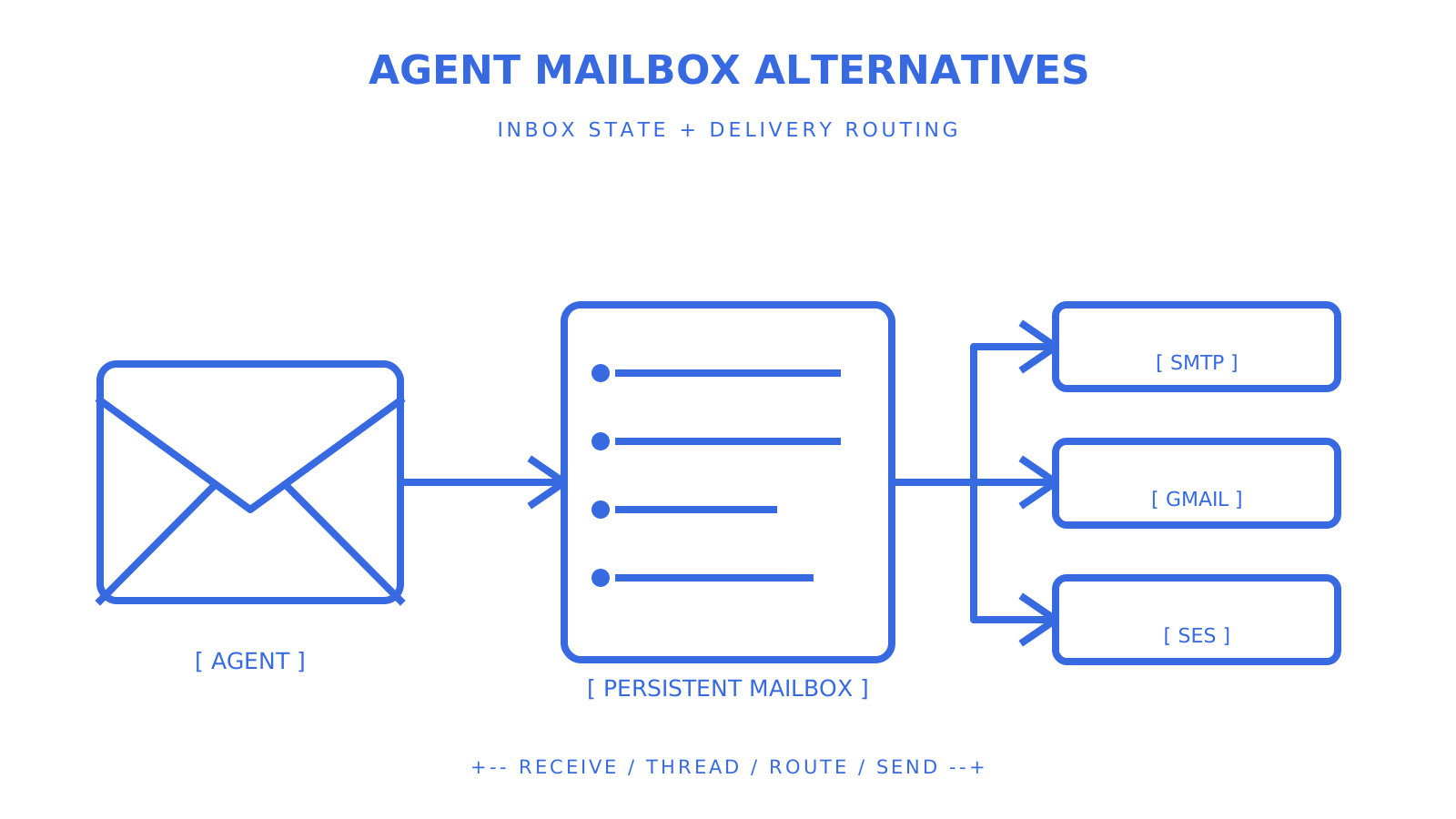
For AI agents that need persistent inboxes with integrated sending and receiving, **Sendmux** is the strongest developer-first AgentMail alternative when bring-your-own provider routing matters. Its Mailbox API covers messages, threads, folders, identities, cleaned content, and attachments. Configured Gmail, Outlook, SMTP, and managed Amazon SES providers handle outbound delivery with quotas, weighting, and failover.
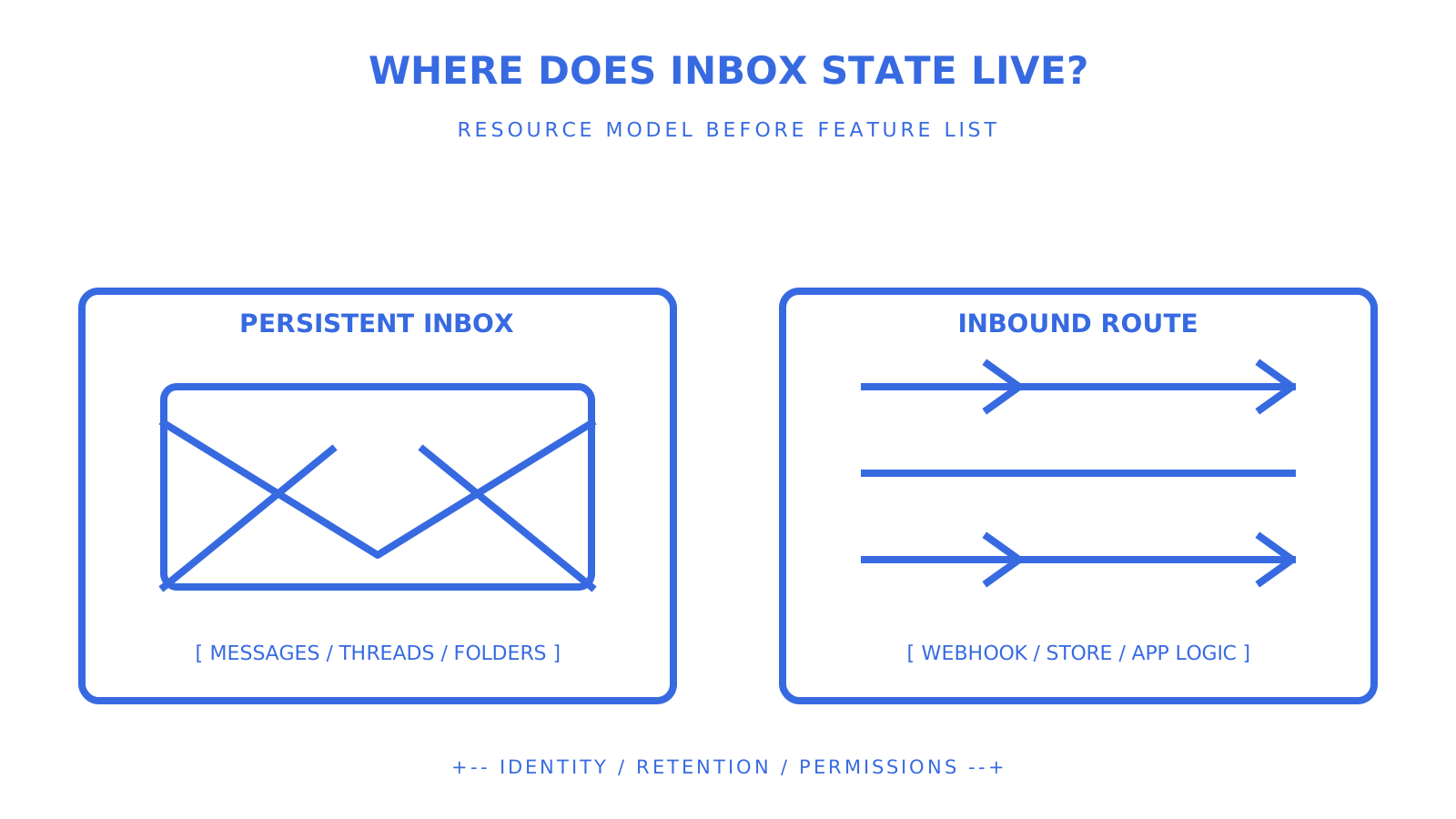
AgentMail is also a genuine mailbox platform. Its current documentation describes inboxes, messages, threads, labels, attachments, drafts, webhooks, WebSockets, and inbox-scoped access. Resend now stores received email and exposes it through a Receiving API as well as webhooks. The practical distinction is the resource model: persistent per-agent inboxes and queryable conversation state, or domain-level receiving plus application-owned routing and state.
An older [Resend and AgentMail comparison](https://www.coursesidekick.com/computer-science/34048458) is useful context for how quickly this category changes, but current vendor documentation is the authority for today's feature set.
Use this workload-based shortlist:
- **Best for agent mailboxes plus bring-your-own routing:** Sendmux, for persistent mailboxes and weighted configured providers in one system.
- **Best for an AgentMail-style managed inbox:** AgentMail itself, with inboxes, threads, labels, drafts, and multi-tenant pods.
- **Best for dedicated cold-outreach infrastructure:** Infraforge, when dedicated IPs, mailbox provisioning, and sender isolation match the programme.
- **Best for AWS-operated, usage-priced sending:** Amazon SES, when the team can own storage, threading, DNS, monitoring, and receiving workflows.
- **Best for domain-level inbound webhooks:** Resend, when stored received email plus API retrieval fits better than a per-agent mailbox resource.
This guide covers **top alternatives to agentmail**, **best email marketing tools**, **email automation software**, **cheaper agentmail options**, **email service alternatives**, **agentmail alternatives**, and **agentmail vs resend**. The products span several categories, so the comparison starts with architecture instead of forcing them into one ranking.
Marketing suites use another billing and workflow model again; the [EmailVendorSelection platform guide](https://www.emailvendorselection.com/best-email-marketing-platforms/) remains a broader discovery list rather than evidence for an agent-mailbox API.
## Key Takeaways
Choose the inbox model first. Pricing, SDKs, delivery controls, and migration work only make sense after deciding who owns messages, threads, identities, and long-lived conversation state.
| Point | Details |
| --- | --- |
| Inbox state decides the shortlist | A mailbox resource and domain-level receiving solve different application problems. |
| Dedicated IPs are conditional | They can isolate reputation, but they add warm-up and operating work and are not required for every workload. |
| Billing units shape cost | Compare inbox, message, storage, domain, provider, support, and overage charges at your expected usage. |
| Migration risk sits in DNS and state | Stage MX and sending changes, preserve message identifiers, and verify webhook payloads before cutover. |
| Sendmux fits multi-provider agent systems | Mailbox APIs, scoped permissions, and weighted configured providers combine receiving state with delivery control. |
## Table of Contents
- [What Are the Best AgentMail Alternatives for Developers?](#what-are-the-best-agentmail-alternatives-for-developers)
- [Short Profiles: What Each Alternative Actually Does](#short-profiles-what-each-alternative-actually-does)
- [How We Evaluated These AgentMail Alternatives](#how-we-evaluated-these-agentmail-alternatives)
- [How Do You Choose the Right Alternative for Your Agent?](#how-do-you-choose-the-right-alternative-for-your-agent)
- [How Do You Migrate Off AgentMail Without Downtime?](#how-do-you-migrate-off-agentmail-without-downtime)
- [Why Sendmux Treats Agent Mailboxes as Infrastructure](#why-sendmux-treats-agent-mailboxes-as-infrastructure)
- [AgentMail Alternatives for Developers: Inbox and Delivery Picks](#agentmail-alternatives-for-developers-inbox-and-delivery-picks)
- [Ready to Give Every Agent a Real Inbox?](#ready-to-give-every-agent-a-real-inbox)
- [Sources](#sources)
- [FAQ](#faq)
## What Are the Best AgentMail Alternatives for Developers?
The right pick depends on whether the agent needs an addressable mailbox, domain-level receiving, a shared sending service, or dedicated outreach infrastructure. These are different resources. Compare inbox state, delivery controls, API depth, tenancy, and billing shape before comparing headline prices.
A mailbox keeps identity and conversation state together; domain receiving leaves more state to the application.
| Provider | Best fit | Receiving model | Delivery model | Evidence to verify |
| --- | --- | --- | --- | --- |
| Sendmux | Agent and multi-tenant products using several outbound providers | Persistent mailbox resources with messages, threads, folders, identities, and attachments | Gmail, Outlook, SMTP, or managed Amazon SES with quotas, weighting, and failover | Owning repositories, OpenAPI snapshots, generated SDKs, and targeted tests |
| AgentMail | Teams wanting managed inboxes designed for agents | Persistent inboxes with threads, labels, drafts, attachments, webhooks, and WebSockets | AgentMail-managed sending, custom domains, and plan-dependent delivery features | Official inbox documentation and pricing |
| Infraforge | Cold-outreach programmes needing dedicated infrastructure | Provisioned outreach mailboxes | Dedicated IP and domain infrastructure | Official product and pricing pages |
| Amazon SES | AWS teams prepared to build the mailbox layer | Receipt rules and actions rather than a user mailbox | Usage-priced API and SMTP sending | AWS documentation and regional pricing |
| Resend | Applications routing received mail by domain | Stored received email, webhook events, and API retrieval | API and SMTP sending | Resend Receiving documentation |
| Mailgun | Applications building around routes and parsed inbound posts | Routes can forward, store temporarily, or post parsed mail | API and SMTP sending | Mailgun receiving and sending documentation |
| Postmark | Application email with inbound parsing | Inbound addresses post parsed content and attachments to an application | Transactional and broadcast Message Streams | Postmark inbound and Message Streams documentation |
| MailerSend | Templated transactional delivery | Product-specific inbound options should be verified for the selected plan | Email API and SMTP delivery | MailerSend developer documentation |
| Mailtrap | Teams needing both email testing and production sending | Email Sandbox for testing, with separate production Email API products | Production API and SMTP sending | Mailtrap Email Sandbox and Email API documentation |
The source article framed this as mailbox-first platforms versus webhook-only providers. That split is now too crude. AgentMail documents full inbox state. Resend stores inbound messages even when a webhook endpoint is down and lets applications retrieve them through the Receiving API. Postmark and Mailgun also have inbound processing surfaces. The engineering question is where identity, threading, retention, permissions, and routing live.
Dedicated infrastructure is another separate axis. A dedicated IP can isolate an IP reputation boundary, but it also needs a sensible warm-up and monitoring plan. Shared pools do not automatically fail when one tenant misbehaves, and dedicated IPs do not automatically create good deliverability. Judge this against the sender's volume, history, destinations, and operating capacity.
## Short Profiles: What Each Alternative Actually Does
**Sendmux** suits developers who need a queryable mailbox and controlled outbound routing in the same system. Its current Mailbox API surface includes messages, threads, folders, identities, attachment operations, and cleaned message content. Mailbox credentials use explicit `email.send`, `email.receive`, `mailbox.read`, and `mailbox.settings.update` permissions. Outbound providers can be SMTP, Gmail API, Outlook API, or managed Amazon SES. The generated OpenAPI 3.1 surface matrix records 101 operations: 53 management, 41 mailbox, and 7 sending operations.
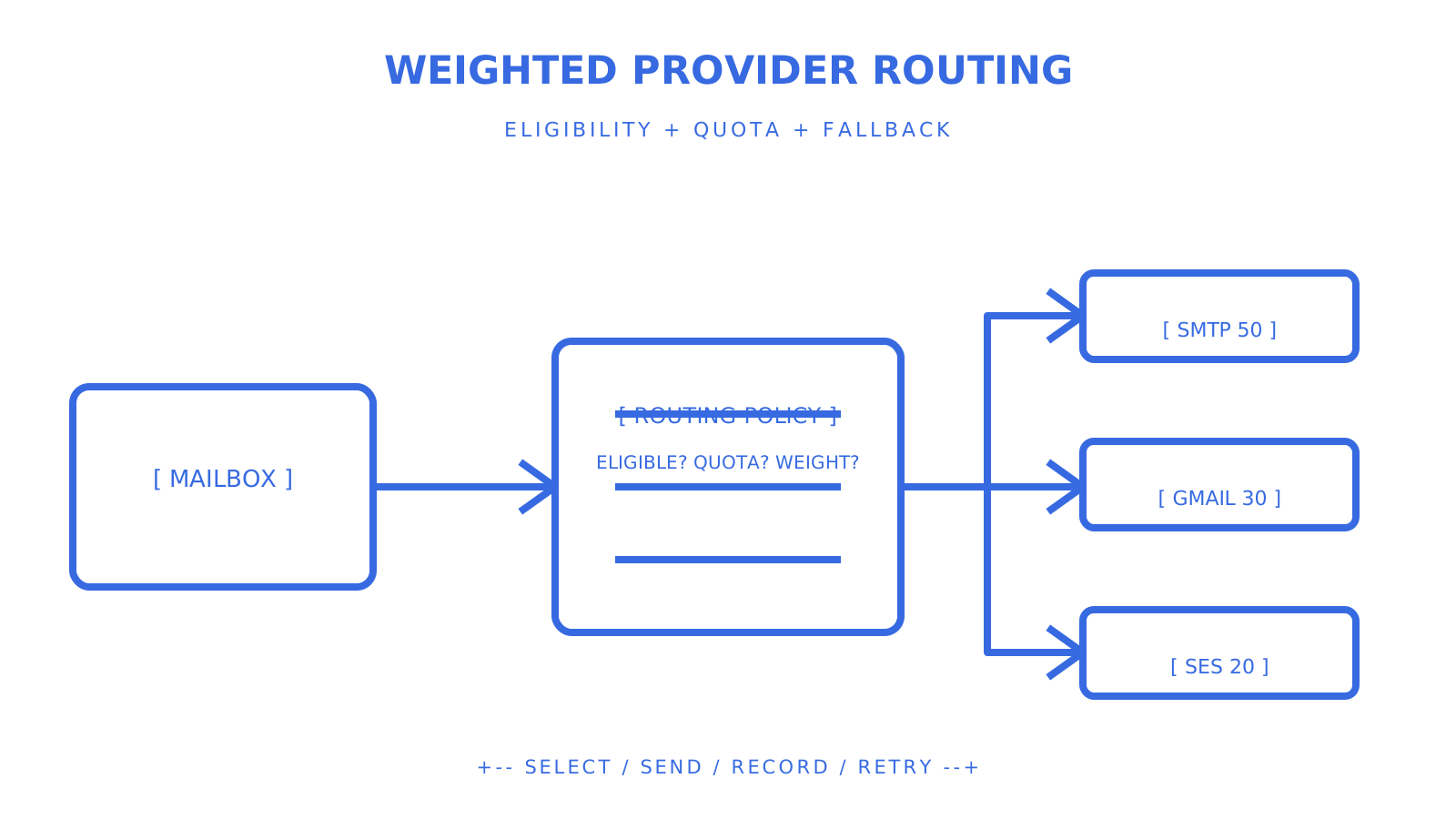
One mailbox can keep conversation state while eligible providers share outbound work by configured weight.
The first-party SDK repository covers TypeScript, Python, Go, PHP, Ruby, and Rust. It also contains LangChain and Vercel AI SDK integrations. Pro costs $7 per team each month plus usage. Each provider-accepted recipient through an owned or connected provider costs `$0.000500`; managed Amazon SES costs `$0.000750` per accepted recipient. Storage costs $0.02 per decimal GB-month, with no separate seat or mailbox fee.
**AgentMail** is the closest like-for-like mailbox alternative in this list. Its official inbox guide covers sending, receiving, reply and forward operations, drafts, attachments, labels, threads, webhooks, WebSockets, custom domains, REST, Python and TypeScript SDKs, SMTP, and an MCP server. Its published self-serve tiers currently list 3, 10, and 150 inboxes before enterprise pricing. Check the live page because plan limits can change.
**OpenMail** presents itself as agent email infrastructure. Verify its current mailbox model, residency, pricing, and support commitments directly before treating it as an EU-residency substitute. The source article's specific residency and integration-size comparison did not include enough primary evidence to retain as fact.
**Infraforge** is aimed at cold-outreach infrastructure. Its official materials emphasise dedicated IPs, domains, and mailboxes. That can suit a programme where sender isolation is central, but it is not the same resource model as a general agent mailbox API. Confirm warm-up, monitoring, mailbox access, pricing, and support for the intended volume.
**AI Inbx**, **Mailforge**, **Sequenzy**, **A1 Inbx**, **Smartlead**, **Mailpool**, **AGmail**, **agentmail.email**, **Knock**, **InboxKit**, **AeroSend**, **Maildoso**, **Zapmail**, **Robotomail**, and **Bavimail** remain discovery candidates from the source. Public documentation varies, and this review did not find enough current primary evidence to rank each one on mailbox state, delivery controls, or support. Keep them on a research list rather than treating a one-line profile as verified product guidance.
**Mailgun** provides mature API and SMTP sending, plus receiving routes that can forward, temporarily store, or post parsed messages to an application. It can support an application-owned inbox layer, but the application remains responsible for its own mailbox identity, durable state, permissions, and threading model. Treat [Trustpilot reviews](https://www.trustpilot.com/review/mailgun.com) as user reports to investigate, not proof of technical behaviour.
**Postmark** supports transactional and broadcast Message Streams and also documents inbound parsing. Incoming messages can be posted as JSON with headers, content, and attachments. That is useful for application workflows, though it is not the same as giving every agent a persistent mailbox resource. Current product behaviour belongs in Postmark's official documentation, not a review summary.
**Amazon SES** provides usage-priced sending and receiving building blocks in AWS. It is inaccurate to say it has no receiving capability, but it does not present a conventional persistent user mailbox. Teams generally combine receipt rules and actions with their own storage, thread model, permissions, and application logic. Use the current regional [Amazon SES pricing](https://aws.amazon.com/ses/pricing/) when modelling cost.
**MailerSend** documents an Email API for transactional messages and templates. Verify inbound requirements separately rather than assuming a sending API supplies queryable mailbox state. Its developer documentation is the correct source for request shape, limits, and plan-dependent features.
**Resend** supports inbound email as well as sending. It processes received messages, sends `email.received` webhook events, stores email when a webhook endpoint is unavailable, and exposes content and attachments through receiving APIs. It does not document the same per-agent inbox, folder, credential, and thread resource model as AgentMail or Sendmux. That makes **agentmail vs resend** an architecture comparison, not a simple send-versus-receive comparison.
**Mailtrap** has two relevant product families: Email Sandbox for testing and Email API/SMTP for production sending. The source sentence calling it a sandbox and “not production infrastructure” is out of date. Teams should compare the specific Mailtrap product they intend to use and avoid treating sandbox behaviour as evidence for production delivery.
**SendGrid** and **Twilio** cover established messaging and delivery surfaces. They belong on the broader **email service alternatives** list, but an agent builder still needs to verify inbound state, threading, tenancy, and credential boundaries for the exact product. Product names alone do not prove mailbox fit.
**Pro Tip:** *Before evaluating any alternative, decide whether the agent must query message history later, use a stable mailbox identity, or only react to a received event. That answer removes several mismatched products before a pricing call.*
## How We Evaluated These AgentMail Alternatives
Selection used seven criteria: inbox model, API depth, delivery controls, integrations and SDKs, billing shape, scalability and limits, and data-residency or compliance evidence.
For each product, the checks were:
1. Read current official API and product documentation where it was publicly available.
2. Note whether mailbox or receiving resources can be created programmatically.
3. Check whether inbound delivery uses stored resources, webhooks, real-time events, or application-owned persistence.
4. Separate vendor documentation from user-review signals such as [Trustpilot](https://www.trustpilot.com/review/mailgun.com).
5. Compare published pricing units without assuming an unlisted fee is zero.
- What was not tested: private service-level enforcement, controlled inbox-placement rates, undisclosed limits, and support response times.
- Sources of truth: owning Sendmux repositories and current primary vendor documentation. Review platforms were not used to establish product facts.
Run a proof of concept with representative messages, domains, attachments, replies, and failure cases before committing. The source suggested a 500-message batch. That can be a planning example, but it is not a universal sample size or deliverability benchmark.
## How Do You Choose the Right Alternative for Your Agent?
Start with your own requirements. A feature spreadsheet is less useful when the products expose different core resources.
Check these first:
- Does each agent need its own persistent mailbox, or is domain-level receiving enough?
- What send and receive volume do you expect in the first 90 days, and what happens if it grows by 10x?
- Does the workload need dedicated IPs, or would that add cost and warm-up work without enough volume?
- Do you need multi-tenant isolation with per-customer credentials and role-based access control (RBAC)?
- What retention, export, deletion, and audit behaviour must exist for stored messages?
During vendor evaluation, ask directly:
1. Can mailboxes or receiving routes be created and removed through the documented API?
2. What happens when an outbound provider is unavailable or over quota during a send?
3. Which permissions can be scoped to one mailbox, tenant, domain, or operation?
4. What limits apply by second, minute, hour, day, mailbox, domain, and account?
5. Which logs and metrics can be exported, and in what format?
Three red flags deserve careful review: no persistent state when the agent must query history, no suitable reputation-isolation option for a high-risk outreach workload, and a required manual dashboard step in an otherwise automated provisioning path. Each is conditional on the workload, not an automatic failure for every email application.
## How Do You Migrate Off AgentMail Without Downtime?
Migration risk concentrates in DNS, message continuity, credentials, and application identifiers. Plan a reversible cutover.
1. Inventory inboxes, domains, credentials, messages, threads, labels, attachments, and retention requirements.
2. Export supported message and thread data, then document anything the current platform cannot export.
3. Prepare SPF, DKIM, DMARC, and MX changes without removing working records early.
4. Provision target mailboxes or receiving routes and map old identifiers to new ones.
5. Test sending, replies, attachments, webhook signatures, retries, and thread reconstruction on a small cohort.
6. Move one domain or cohort at a time, monitor provider responses and application errors, and keep a rollback path.
7. Retire the old service only after the agreed continuity and retention checks pass.
Before cutover, compare webhook schemas, message and thread identifiers, attachment encoding, quotas, retention, retry behaviour, and SDK coverage. Internet email threading commonly uses `Message-ID`, `In-Reply-To`, and `References` fields defined by [RFC 5322](https://www.rfc-editor.org/rfc/rfc5322); provider-specific thread IDs still require an explicit mapping.
The source article offered a few hours, a few days, and several weeks as migration ranges. Those are illustrative, not verified commitments. A small proof of concept can be quick, while DNS coordination, data migration, provider approval, dedicated-IP warm-up, and reputation rebuilding can extend the schedule. Estimate from an inventory and rehearse the rollback.
## Why Sendmux Treats Agent Mailboxes as Infrastructure
Sendmux combines persistent mailbox resources with a separate outbound provider layer. An agent can read messages, threads, folders, identities, cleaned bodies, and attachments while delivery uses configured Gmail, Outlook, SMTP, or managed Amazon SES providers.
- The current OpenAPI inventory contains 101 operations: 53 management, 41 mailbox, and 7 sending.
- Mailbox keys expose `email.send`, `email.receive`, `mailbox.read`, and `mailbox.settings.update` permissions.
- Provider types are `smtp`, `gmail_api`, `outlook_api`, and `amazon_ses`.
- Provider selection filters ineligible accounts and exhausted quotas before weighted selection, with a fallback path when rounding leaves no earlier match.
- SDK source exists for TypeScript, Python, Go, PHP, Ruby, and Rust, plus LangChain and Vercel AI SDK packages.
These are the primitives that separate mailbox-centred infrastructure from a sending API plus an application-owned inbound pipeline. They do not remove the need to test deliverability, define retention, or review current commercial terms.
## AgentMail Alternatives for Developers: Inbox and Delivery Picks
Most comparison pages ask whether a product sends, receives, and has a low starting price. That hides the hard engineering choice. An agent may need state: an address it owns, threads it can query, attachments it can retrieve, and permissions that do not expose another tenant's mail.
AgentMail documents that mailbox model. Sendmux documents mailbox resources too, then adds configured multi-provider outbound routing. Resend stores received email and provides webhook-driven receiving, but the application owns more of the address routing and conversation model. Amazon SES, Mailgun, and Postmark provide useful primitives for teams prepared to assemble that layer.
Decide the inbox model before opening the pricing spreadsheet. Then compare delivery controls, SDK ergonomics, retention, support, and total cost at the expected volume. A cheap sending API becomes expensive when the team must build identity, threading, storage, permissions, and operations that the workload actually requires.
## Ready to Give Every Agent a Real Inbox?
If agents need to send, receive, and return to earlier conversations, test a mailbox-centred design with representative traffic. Sendmux gives each agent or tenant a mailbox on `@myagent.mx` or a verified custom domain and can route outbound delivery through configured providers. Review the [Sendmux developer documentation](https://docs.sendmux.ai/) and verify the current API and commercial terms before adoption.
Start with a small proof of concept. Create test mailboxes, send and receive representative messages, inspect cleaned bodies and attachments, verify thread behaviour, and force one safe provider-failure case. For a multi-tenant product, test that one tenant's credential cannot read or change another tenant's mailbox.
Related MyAgent guides:
- [Front Alternatives for AI Agent Mailboxes – Best Email Tools](https://myagent.mx/blog/topic/Front%20alternatives)
- [The Best Front Alternatives for AI Agent Mailboxes](https://myagent.mx/blog/front-alternatives)
- [AI Agent Email for Developers: Build Real Agent Inboxes](https://myagent.mx/blog/topic/ai%20agent%20email)
## Sources
- [AgentMail inbox capabilities](https://docs.agentmail.to/knowledge-base/inbox-capabilities)
- [AgentMail pricing](https://www.agentmail.to/pricing)
- [Resend Receiving documentation](https://resend.com/docs/dashboard/receiving/introduction)
- [Amazon SES pricing](https://aws.amazon.com/ses/pricing/)
- [Mailgun receiving routes](https://documentation.mailgun.com/docs/mailgun/user-manual/receive-forward-store/receive-http)
- [Postmark inbound parsing](https://postmarkapp.com/developer/user-guide/inbound/parse-an-email)
- [Postmark Message Streams](https://postmarkapp.com/message-streams)
- [MailerSend Email API](https://developers.mailersend.com/api/v1/email)
- [Mailtrap production Email API](https://mailtrap.io/email-api/)
- [RFC 5322 Internet Message Format](https://www.rfc-editor.org/rfc/rfc5322)
- [Best email marketing platforms (EmailVendorSelection)](https://www.emailvendorselection.com/best-email-marketing-platforms/)
- [Comparing Resend and AgentMail: Which Email API Fits Your Needs? (Course Sidekick)](https://www.coursesidekick.com/computer-science/34048458)
- [Trustpilot](https://www.trustpilot.com/review/mailgun.com)
## FAQ
### What Are the Best Alternatives to AgentMail?
Sendmux is the strongest fit when agents need persistent mailboxes plus routing across configured outbound providers. Infraforge serves dedicated outreach infrastructure, Amazon SES supplies AWS sending and receiving primitives, and Resend stores inbound email for webhook-and-API workflows.
### How Is AgentMail Different From Resend?
AgentMail exposes per-agent inboxes with messages, threads, labels, drafts, attachments, and access methods. Resend stores received email, emits webhook events, and provides receiving APIs, while the application owns more of the address routing and conversation state.
### What's the Best Email Automation Tool for AI Agents?
For an agent that must send, receive, and revisit conversation state, choose a mailbox API before adding workflow automation. Sendmux and AgentMail expose mailbox resources; campaign and lifecycle tools solve a different layer of the system.
### Which AI Email Assistant Tool Is Best for Developers?
Choose by resource model: Sendmux for mailbox state plus configured provider routing, AgentMail for a managed agent-inbox platform, or Resend for stored domain-level receiving with webhook-and-API processing. Validate the fit with representative traffic.
### How Long Does Migrating Off AgentMail Take?
There is no reliable universal duration. Estimate from mailbox count, export support, DNS changes, identifier mapping, provider approval, dedicated-IP warm-up, and rollback testing, then migrate one cohort at a time.